BNB Pasteur Hardfork 2026 Brings New Security to BSC Mainnet


BNB Pasteur Hardfork 2026: Price Surged on BSC Mainnet Security Update
The BNB Pasteur Hardfork 2026 officially activates on the BSC mainnet at 02:30 AM UTC on August 25, 2026. This release closes out a major summer development cycle for the ecosystem.

Source: Official Announcement
Rather than cutting block times again, this $BNB update concentrates on network protection, validator integrity, and execution efficiency.
Major $BNB chain news confirms that the activation builds upon previous speed milestones to help nodes handle heavy throughput safely.
What the BNB Pasteur Hardfork 2026 Changes for Bridges and Every Node
The BNB chain Pasteur Hardfork rolls out through meta-proposal BEP-673, bundling three distinct protocol enhancements. The changes that directly improve daily operations:
BEP-682 blocks duplicate validator signatures during cross-chain bridge verification, closing a gap that could otherwise let an attacker fake extra voting weight.
BEP-695 makes sure retired validator keys actually lose their authority, and that governance votes respect blacklisted addresses.
BEP-675 lets block builders submit blocks that are already fully executed, giving them more room to pack in transactions before the network's tight time limit runs out.
On testnet, that last change pushed throughput from around 1,237 TPS to 2,324 TPS, with average block gas use climbing from roughly 46 million to 84 million, out of a 100 million limit. Block time stayed at 450 milliseconds the entire time, and fees did not rise.
What Node Operators Must Do Before This BNB Update August 2026 Hits
Update client software to version 1.7.7 ahead of the fork.
Remove any deprecated configuration flags tied to older builds.
Confirm bridge and validator services are running the updated logic before the 02:30 UTC switch.
Regular users and app developers do not need to do anything in this BNB Pasteur Hardfork 2026. No wallets move, no contracts need redeployment, and daily activity on BSC should look the same from the outside.
BNB Price Today Surges as Network Upgrade Momentum Lifts Market Cap
Anticipation surrounding the BNB Pasteur Hardfork 2026 upgrade gave token valuations a noticeable lift over the last 24 hours. Key market numbers for $BNB price today as per CoinMarketCap:
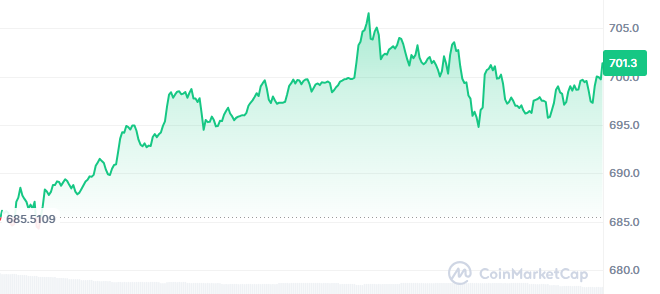
Spot Price: $701.35, reflecting a 2.45% daily gain.
24-Hour Range: Trading fluctuated between $677.10 and $702.40.
Market Capitalization: Near $93 billion,
$BNB All-Time High Reference: Remains at $1,369.99
Market analysts trace the recent climb to the positive sentiment surrounding technical delivery and overall momentum in crypto news today.
Institutional interest has picked up alongside the price move. Grayscale rebalanced its Smart Contract Fund this year and gave $BNB the largest single weighting in the basket, ahead of both Ether and Solana. That sits apart from a separate, still-pending spot $BNB ETF filing working through regulatory review.
How Binance Chain Upgrade Compares BSC Performance to Leading Rivals
While rival networks pursue sweeping structural redesigns, the BNB Pasteur Hardfork 2026 takes a practical approach by hardening existing infrastructure and squeezing more throughput.
Versus Ethereum (Fusaka & Glamsterdam): Ethereum focuses on scaling Layer 2 rollups through expanded blob data capacity (PeerDAS) and L1 parallel execution. BSC instead optimizes direct Layer 1 execution, offering retail traders sub-second finality and sub-cent fees natively without requiring L2 bridges.
Versus Solana (Agave 4.2 & Alpenglow): Solana upgrade is overhauling consensus to slash slot times down to 200 ms and reach 150 ms finality. BSC avoids disruptive consensus rewrites, choosing instead to close bridge attack vectors and let builders submit pre-executed blocks to double effective capacity under BEP-675.
BNB Chain Roadmap 2026: From Fermi Speed to Pasteur Security Fixes
Pasteur is the latest link in a chain of 2026 upgrades rather than a standalone event. Fermi upgrade cut block times to 450 milliseconds in January.
Osaka and Mendel locked that pace in by April, bringing benchmark throughput near 5,200 TPS and pushing in-memory finality down to about 650 milliseconds.
That followed a full year of hardforks in 2025 — Pascal, Lorentz, and Maxwell among them, which had already dropped block times from 3 seconds to well under a second and pulled gas fees down sharply.
Alongside the network upgrades, tooling has moved fast too. $BNB Agent Studio launched in July as a one-prompt way to deploy autonomous AI agents on BSC, and its second version in mid-August added on-chain agent payments, TypeScript support, and scoped self-custodial wallets called Altana. Chain data shows BNB hosting a large share of all registered AI agents tracked across blockchains today.
Looking further out, the second half of 2026 targets another full doubling of mainnet throughput, alongside better resource isolation so one busy app cannot slow down every other one. Beyond that, $BNB Chain is designing a next-generation Layer 1 aimed at agentic trading, with a testnet expected by the end of 2026 and mainnet early the following year.
Disclaimer: This article is for informational purposes only and does not constitute financial or investment advice. Crypto markets carry significant risk. Always do your own research before making any investment decisions.
Also read:









