Espresso Testnet Hits 0.24 Second Finality: When Will Mainnet Go Live?


Espresso Testnet Reaches 0.24 Second Finality: Is Mainnet Ready Next?
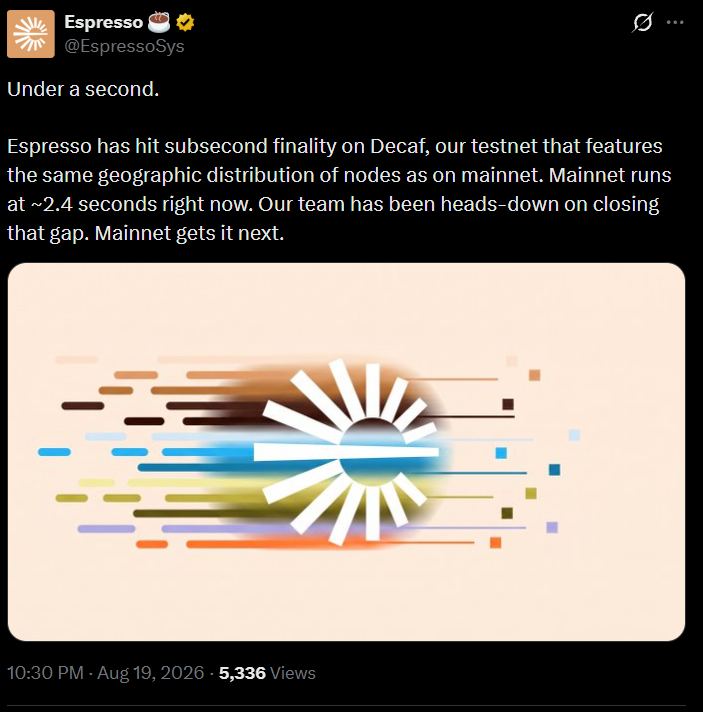
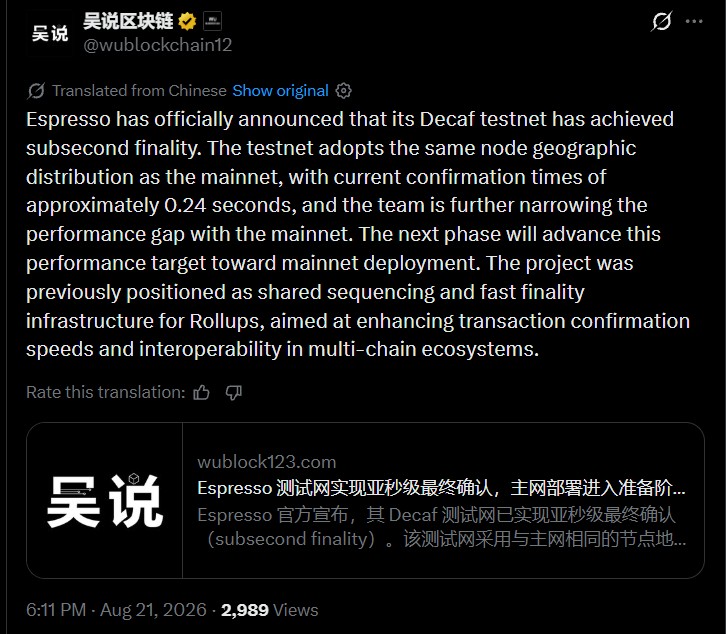
Espresso Systems has announced a milestone for its sequencing infrastructure: the Decaf testnet has reached subsecond finality, with confirmation times landing around 0.24 seconds.
What makes the result notable is that Decaf mirrors the same geographic spread of validator nodes used on the live Espresso mainnet, rather than relying on a tightly clustered test setup.
The project has built its reputation around shared sequencing and fast-finality infrastructure for rollups and multi-chain applications, and this update marks a step toward bringing that vision closer to production.
Decaf Testnet Achieves 0.24-Second Finality
The core announcement centers on a single figure: Decaf now confirms transactions in roughly 0.24 seconds, comfortably under the one-second mark. According to the information shared, the testnet runs with around 100 nodes.
It's worth being precise — this is a testnet result, not a live production figure. The team has been clear that its main network still operates at a slower pace, so the Decaf numbers should be read as a proof point for what the underlying technology can do, not as the current experience for everyday users.
Decaf Uses Mainnet-Like Geographic Node Distribution
What separates this benchmark from a typical lab result is node placement. Many Espresso testnet cluster their validators in a single data center or region, which makes low latency easy to achieve but says little about real-world conditions.
Decaf instead spreads its nodes geographically in a pattern similar to the live network. Physical distance between nodes matters because consensus protocols need messages to travel back and forth before a transaction can be considered final — the further apart nodes sit, the longer that round trip takes.
By replicating that spread, this testnet offers a benchmark far more representative of what users could eventually expect once the same performance reaches production.
Mainnet Still Runs at Around 2.4 Seconds
For context, the live network currently finalizes transactions in about 2.4 seconds — roughly ten times slower than what Decaf just demonstrated.
Metric | Testnet | Mainnet |
Finality | ~0.24 seconds | ~2.4 seconds |
Network | Testnet | Live network |
Node distribution | Mainnet-like geographic spread | Live network |
Current status | Subsecond achieved | Improvement underway |
Deployment | Subsecond finality |
Working to Close the Performance Gap
The team says it is concentrating on shrinking the gap between test and production environments. The stated goal is straightforward: carry the subsecond performance validated on Decaf over to the live network.
No specific date has been released for when the main network will reach subsecond finality, and no timeline should be assumed beyond what has been officially confirmed.
Why Subsecond Finality Matters for Rollups and Multi-Chain Apps
Finality refers to the point at which a transaction can be treated as permanently settled, with no realistic chance of reversal. The faster that point arrives, the smoother an application feels — payments clear quicker, trades settle faster, and interfaces update in near real time instead of sitting in a pending state.
This kind of speed is especially relevant for rollups, custom sovereign chains, and applications operating across several blockchain networks at once, where waiting several seconds for confirmation on each hop can add up and hurt usability. Lower-latency sequencing infrastructure of this kind is aimed squarely at closing that gap.
Key Milestones and Roadmap
-
Earlier phase: Shared sequencing and fast-finality infrastructure is built out for rollups.
-
Decaf testnet phase: A testnet launches using a geographic node distribution modeled on mainnet.
-
August 21, 2026: The team announces as it has achieved roughly 0.24-second finality.
-
Current phase: Work continues to narrow the gap between Espresso token testnet and mainnet performance.
-
Next phase: The goal is extending subsecond finality to the live network.
Conclusion: Moving Closer to Subsecond Mainnet Finality
Reaching roughly 0.24-second finality on the Decaf is a meaningful signal, particularly because it was achieved under a geographic node distribution designed to resemble live conditions rather than an idealized lab setup. The main network, for now, still finalizes transactions in about 2.4 seconds.
The real test ahead isn't proving the technology can hit subsecond speeds — that's already been shown — it's translating the testnets result into a stable, production-grade experience for everyday users. Subsecond finality on the live network has not been confirmed as active, and any launch timing should be treated as unconfirmed until officially stated.
Disclaimer: This article is for informational purposes only and does not constitute financial, investment, or trading advice. Cryptocurrency markets are volatile and involve risk. Always conduct your own research before making any investment decisions.
Also read:







