Ethereum News: Traders May Soon Pay Gas Fees With USDC Instead of ETH

Ethereum News: Hegotá Upgrade, $32.4M ETH Buy and Justin Sun Unstaking
Ethereum had a busy news cycle on September 8, 2026, with developments spanning protocol planning and large wallet activity. On the technical side, the Ethereum Foundation released a detailed roadmap and tier list for the upcoming Hegotá network upgrade.
On the market side, two large holders made notable moves: a trading firm expanded a hedge against a sizable short position, and a well-known crypto figure continued unstaking ETH from a liquid staking protocol.
This article breaks down each story and what it may mean for people following Ethereum closely.
At a Glance
-
The Ethereum Protocol Cluster graded 62 proposed EIPs for the 2027 Hegotá upgrade, with EIP-7805 (FOCIL) and EIP-8141 (Frame Transactions) landing in the top S tier.
-
EIP-8141 would let wallets pay gas fees in stablecoins such as USDC or USDT instead of ETH.
-
The Foundation set a target of a quantum-resistant Ethereum base layer by December 2029.
-
Abraxas Capital added 13,000 tokens (about $32.4 million) in spot purchases to hedge a $353 million short position on Hyperliquid.
-
Justin Sun unstaked another 5,000 tokens from Lido, bringing his total redemptions since August 26 to 10,000 tokens.
On September 8, 2026, Ethereum (ETH) price is at $2481.74, falling 1.2% over 24 hours. It has recorded about $10.66 billion in trading volume, while its market capitalization stood near $302.78 billion.
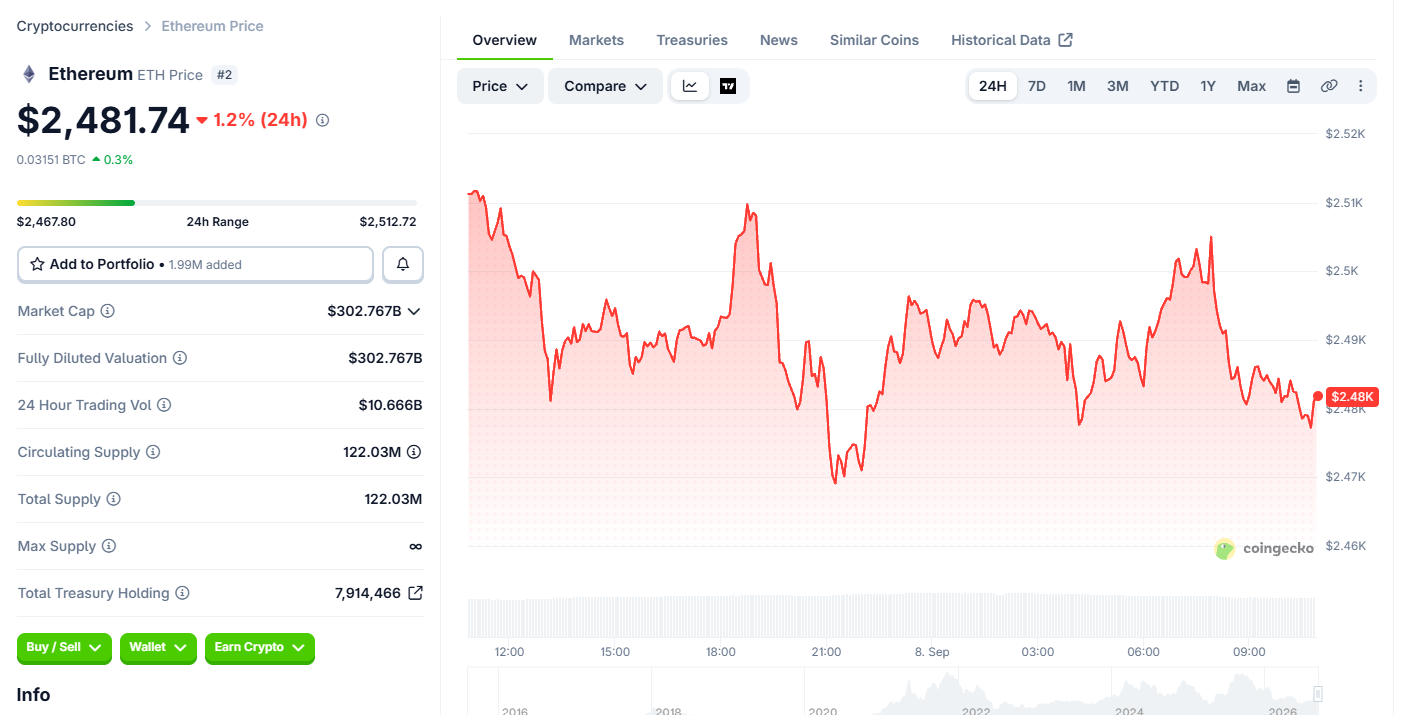
Source: CoinGecko Data
Ethereum Hegotá Upgrade Gets Major 2027 Roadmap
The Ethereum Foundation's Protocol Cluster published its assessment of the Hegotá upgrade, reviewing 62 proposed Ethereum Improvement Proposals (EIPs) and grading each one for likely inclusion.
The review pulled together input from roughly 60 researchers, engineers, and domain experts spread across nine teams within the Protocol Cluster, who submitted 397 individual tier grades before debating the more contested proposals as a group. It is planned to follow the Glamsterdam upgrade and is currently targeted for 2027.
EIP-8141 Could Let Users Pay Ethereum Gas Fees With USDC and USDT
One of the most talked-about proposals is EIP-8141, also known as Frame Transactions, which received an S-tier "must ship" grade. This account abstraction proposal would allow a wallet holding only stablecoins such as USDC or USDT to pay network gas fees without first acquiring ETH.
For everyday users, this removes a common point of friction: needing to buy a small amount just to complete a transaction. If implemented as planned, it could make onboarding smoother for newcomers and simplify stablecoin-based activity.

Source: EthereumFoundation X Post
Ethereum Foundation Prioritizes Quantum Resistance by 2029
Alongside the EIP tier list, the Protocol Cluster released a companion post outlining research priorities through the rest of the decade. The headline commitment is making Ethereum's base layer, covering execution, consensus, and data availability, resistant to quantum computing attacks by December 2029.
Other research areas named include fast finality, privacy, state management, and zero-knowledge EVM (zkEVM) tooling. EIP-7805, known as FOCIL and designed to resist censorship, was named the other S-tier proposal and is expected to be a headline feature of Hegotá.
Ethereum Hegotá EIP Tier List: Which Proposals Made the Cut?
Of the 62 EIPs under review, only two reached S tier, 15 were graded A tier as "expected to ship," and 28 were rejected outright, leaving the rest in lower or undecided categories.
Ethereum Hegotá EIP Breakdown
| Category | Details |
| EIPs Reviewed | 62 |
| S-Tier | EIP-7805 and EIP-8141 |
| A-Tier | 15 EIPs |
| Rejected | 28 EIPs |
| Contributors | ~60 researchers, engineers and experts |
| Teams Involved | 9 Protocol Cluster teams |
| Tier Grades Submitted | 397 |
| Target | Quantum-resistant Ethereum L1 by Dec. 2029 |
The Foundation has framed the tier list as one input among several for scoping Hegotá, not a final decision. A Reddit AMA on r/ethereum is scheduled for September 16 at 2 pm UTC, where the community can ask further questions.
Abraxas Capital Buys 13,000 ETH to Hedge $353M Hyperliquid Short
On the market side, on-chain analytics account Lookonchain flagged that trading firm Abraxas Capital purchased an additional 13,000 tokens in the spot market, worth approximately $32.39 million. The purchase was described as a hedge against Abraxas's existing short position on the Hyperliquid derivatives platform.
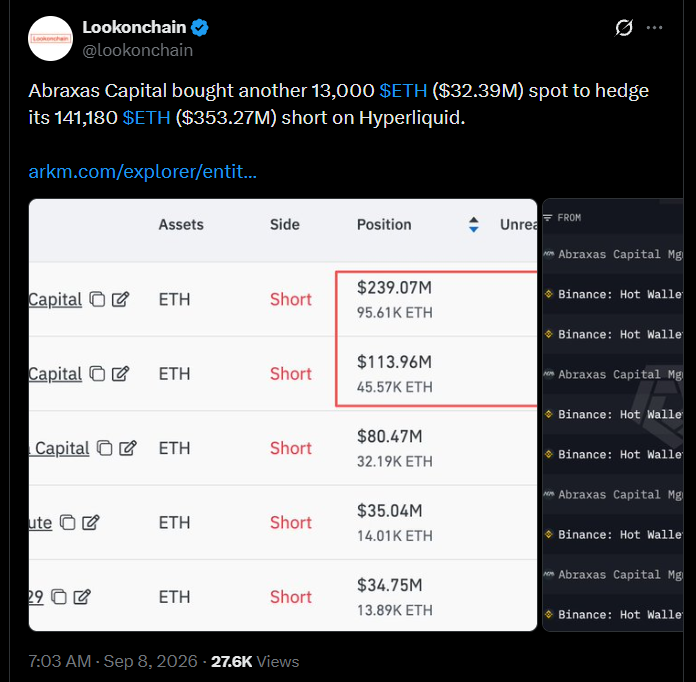
Source: Lookonchain
Why Abraxas Is Increasing Its Spot ETH Holdings
Abraxas currently holds a short position of 141,180 ETH on Hyperliquid, with a notional value of about $353.27 million. Firms sometimes buy spot assets alongside a short derivatives position to offset risk if the price moves against the short.
According to the same monitoring account, Abraxas has repeated this pattern before, gradually increasing its spot ETH holdings as part of managing its short exposure rather than reversing its overall market view.
Justin Sun Unstakes Another 5,000 ETH From Lido
Separately, on-chain tracker @ai_9684xtpa reported that Justin Sun unstaked another 5,000 ETH from the Lido liquid staking protocol. This brings his cumulative redemptions since August 26 to 10,000 ETH.
$12.3M ETH Was Previously Transferred to Poloniex
Following an earlier batch of redemptions, roughly $12.3 million worth of ETH was sent to the Poloniex exchange in two separate transfers, at a reported price near $2,481 per ETH.
The associated address still holds around 238,000 stETH, valued at approximately $594 million, making it the second-largest asset in that wallet. Traders often watch large transfers to exchanges as a possible, though not guaranteed, precursor to selling.
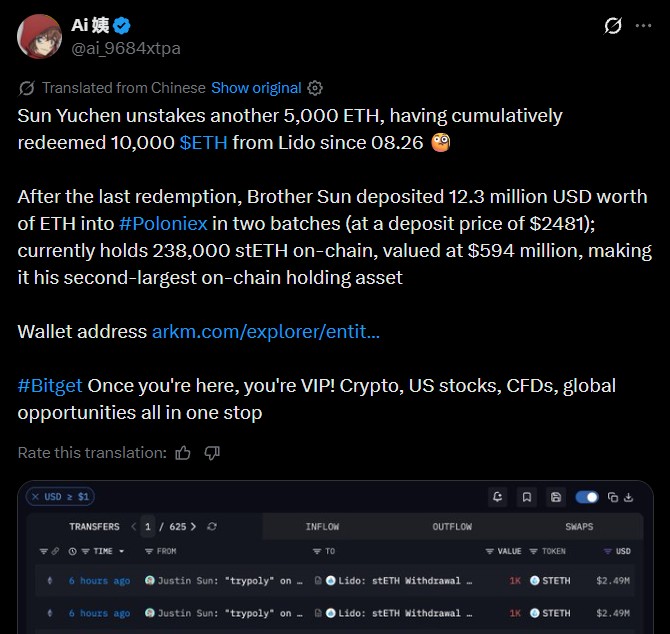
Source: AI X post
Ethereum Whale Activity and Hegotá Roadmap: What Comes Next?
| Date | Ethereum Developments |
| Aug. 26, 2026 | Justin Sun begins cumulative 10,000 coins Lido redemptions |
| Sep. 7, 2026 | Ethereum Foundation publishes Hegotá EIP tier list and protocol priorities |
| Sep. 8, 2026 | Abraxas buys another 13,000 coins to hedge its short |
| Sep. 8, 2026 | Justin Sun unstakes another 5,000 coins |
| Sep. 16, 2026 | EF scheduled to host Hegotá Reddit AMA |
| 2027 | Hegotá upgrade planned, including EIP-8141 |
| Dec. 2029 | EF targets quantum-resistant L1 |
These stories sit in two different categories. The Hegotá roadmap reflects Ethereum's longer-term technical direction, while the Abraxas and Sun activity reflects short-term positioning by large holders.
Neither whale movement should be read as a direct signal that ETH's price will rise or fall; hedging a short and unstaking tokens are both routine treasury and risk-management actions that can happen for many reasons unrelated to a price call.
What These Ethereum Developments Mean for ETH Investors
For everyday users, the Hegotá roadmap points toward a smoother experience, particularly if EIP-8141 ships and stablecoin gas payments become available, alongside a longer-term push for quantum-resistant security.
For traders, the Abraxas hedge is a reminder that large short positions on platforms like Hyperliquid are often paired with offsetting spot purchases rather than representing a simple directional bet.
Justin Sun's unstaking and prior transfers to Poloniex are worth monitoring, since large holder movements to exchanges can precede selling, but on their own they do not confirm any particular market outcome. As always, this information is for context and should not be treated as financial advice.
Conclusion
Ethereum's Hegotá upgrade is shaping up as a significant step for usability and long-term security, with EIP-8141's stablecoin gas payments and the 2029 quantum-resistance target standing out as the biggest commitments.
Meanwhile, large holder activity from Abraxas Capital and Justin Sun shows how derivatives hedging and staking withdrawals continue alongside protocol development. Readers should watch the September 16 Hegotá AMA for further clarity on the 2027 roadmap, and continue tracking on-chain data for any further large ETH movements.
Disclaimer: This article is for informational purposes only and does not constitute financial, investment, or trading advice. Cryptocurrency markets are volatile and carry significant risk. Always do your own research and consult a licensed financial advisor before making investment decisions.
Also read:









