India Crypto Users Can Withdraw Freely, So Why Can't They?


Asset Withdrawals are Legal Under India Crypto Rules: Binance
Something big just surfaced in the India crypto space. Binance's South Asia spokesperson confirmed on May 21, 2026, that no Indian law, regulation, directive, or guideline restricts crypto withdrawals from centralized exchanges to personal wallets.

The statement went to The Economic Times and landed like a quiet bomb inside the Indian crypto community.
Binance Breaks Silence on India Crypto Withdrawal Freedom
Binance India operates under FIU-IND registration. It reports withdrawal data to authorities and still allows users to move their assets freely to self-custody wallets. The exchange serves between 5 crore and 10 crore Indian users and says it runs full compliance alongside full withdrawal access, both at the same time.
On the other hand, domestic exchanges like CoinDCX and WazirX tell users a different story. Many users hit delays, repeated KYC demands, or flat-out blocks when trying to withdraw cryptocurrecies to an external wallet. Some platforms like Unocoin allow freer transfers, but they are the exception.
The legal reality and the ground-level reality are completely different things. No hard rule bans withdrawals, but platform policies built around regulatory fear create the same practical effect as a ban.
Why Indian Exchanges Give for Blocking Digital Asset Withdrawals
The reasons domestic platforms give centre on the Prevention of Money Laundering Act. They argue that allowing free outflows creates money laundering risk and puts them in a difficult spot with banking partners who already treat crypto-related activity as high-risk.
Banks pressure exchanges to limit cryptocurrency flows. Exchanges fear regulatory scrutiny in a grey legal environment. So they over-comply, restricting things the law never restricted, to protect their banking relationships and avoid being the next platform in a headline.
India Crypto Regulation in 2026: Still an Unfinished Story
India crypto rules 2026 exist in fragments. Cryptocurrency is legal but its gains face a 30% flat tax plus 1% TDS on every transfer. The country has no dedicated digital asset law. The proposed regulatory discussion paper has been delayed and shelved.
No single regulator owns the full picture, the RBI has historically opposed cryptocurrency while FIU-IND handles AML registration for virtual digital asset service providers. DeFi, NFTs, staking, and cross-border flows all sit without clear guidance.
On May 20, 2026, the Standing Committee on Finance met with Binance, WazirX, and ZebPay to discuss virtual digital asset policy, covering illicit use and capital outflows. That meeting signals movement, but no concrete India crypto regulation has followed yet.
How This Regulatory Gap Is Hurting India Crypto Adoption and Domestic Revenue
After the 30% tax and 1% TDS kicked in during 2022, billions in trading volume shifted to offshore platforms. India digital asset adoption slowed among active traders who moved to global exchanges with lower friction and clearer withdrawal policies.
Users stuck on domestic platforms report repeated KYC demands, blocked transfers, and forced reliance on P2P trading, which carries its own risks including account freezes and scam exposure. The frustration is pushing more Indians toward hardware wallets and self-custody as the only reliable exit.
The domestic exchanges choosing restriction over clarity are making a business and risk decision, not following a legal one.
RBI and the Rupee Crisis Add Another Layer to This Debate
The timing of this withdrawal debate sits against a worsening rupee story. The rupee has fallen near record lows of 96 to 97 per USD in 2026, battered by $17 billion to $19 billion in FII outflows and oil prices crossing $120 per barrel.
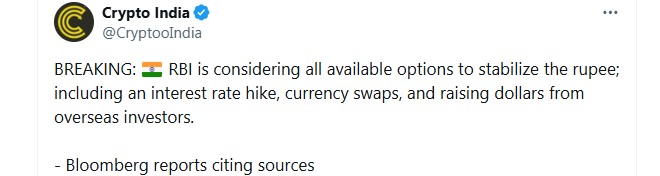
Source: X Official (@CryptooIndia)
The RBI is now reviewing options including interest rate hikes, currency swaps, and overseas dollar mobilization to stabilize the currency. A $5 billion swap auction is already scheduled for May 26, 2026.
Free cryptocurrency withdrawals combined with stablecoins like USDT create a path that bypasses the Liberalised Remittance Scheme caps on traditional transfers, and that capital flight angle is exactly why banks stay cautious and why the RBI watches this space closely.
Note: This article is for information purposes only. All the information and facts are based on market present data. The article itself does not claim anything.









