Japan Blockchain Bond Settlement Plan Gets 2027 Timeline


Tokyo Sets a Clock on Real-Time Clearing for Bonds and Stocks
Regulators have finally attached a real timeline to an idea long discussed in crypto news but never scheduled.
According to a report from Nikkei Asia published on August 25, 2026, the government, the central bank, and major institutions are preparing a Japan blockchain bond settlement framework aimed at instant, round-the-clock clearing for government debt and equities.
As of August 26, 2026, this is the first such initiative with a formal implementation schedule, following years of smaller pilots.
What Did Officials Announce About Japan Blockchain Bond Settlement?
The Financial Services Agency, the Ministry of Finance, the Bank of Japan blockchain working group, and participating institutions will launch a dedicated study group this summer, according to Reuters, citing the same Nikkei report.
The mandate: design a distributed-ledger network capable of handling JGB blockchain settlement and equity clearing without today's multi-day delays.
A development plan is expected to be finalized around early 2027, reportedly covering:
The technical architecture of the ledger
Division of duties among the government, central bank, and institutions
A roadmap for phased rollout
If approvals go through, operations could start within a few years, with a live network targeted for the early 2030s.
Why Does Real-Time Bond Settlement Matter Right Now?
Under the existing structure, a Tokyo Stock Exchange trade clears in two business days, while a JGB trade finalizes in one. That gap locks up capital that could otherwise be redeployed instantly under a Japan blockchain bond settlement model.
Year | Milestone |
2018 | JGB clearing cycle shortened to one day (T+1) |
2019 | Equity clearing cycle shortened to two days (T+2) |
Summer 2026 | Study group formed for blockchain stock settlement Japan plan |
Early 2027 (target) | Development roadmap to be finalized |
Early 2030s (target) | Possible network launch, pending approval |
Records from the Bank for International Settlements show Tokyo has steadily compressed processing windows across multiple decades of market reform, though never through a fully automated, always-on network before now.
Officials say the new rails could eventually extend beyond domestic trades to cross-border remittances as well.
Direct Answer: What Is Japan 24/7 Settlement Under This Plan?
This describes a
In short, the Japan blockchain bond settlement plan aims to make trade finality continuous rather than batch-based.
Earlier Pilots Point to This Moment
This isn't Tokyo's first move toward on-chain finance. Four large banking groups have run a separate collateral trial for government debt on a permissioned network since April 2026, an early signal that lenders were positioning for the coming Japan blockchain bond settlement shift and FSA blockchain settlement standards.
The research account WuBlockchain flagged the Nikkei story shortly after it broke. 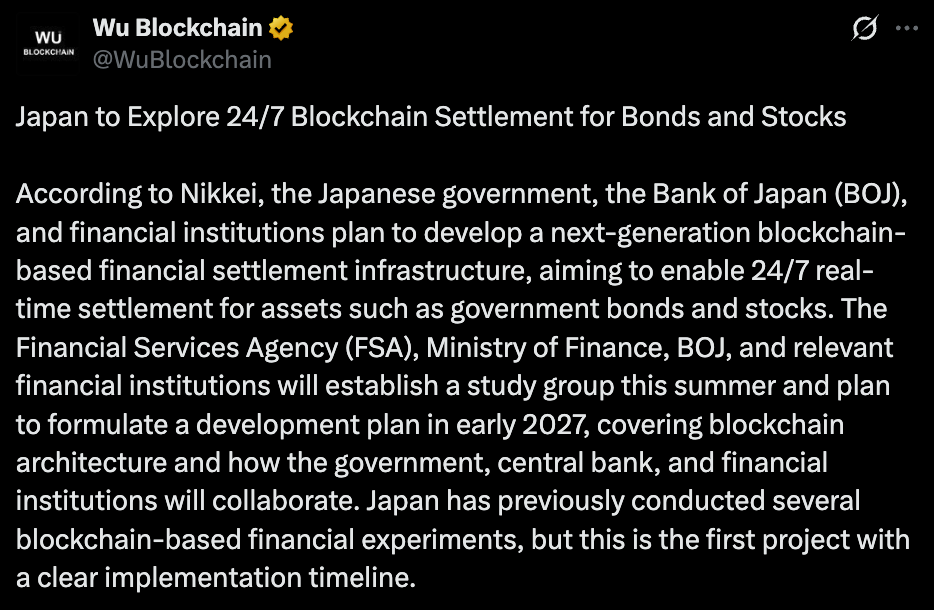
Calling it a structural shift for the debt market and a notable piece of Japan crypto news for the week.
A separate account tracking Tokyo's tokenization efforts had also surfaced the earlier bank collateral pilot months before the latest study group news, pointing to sustained institutional appetite for Japan digital securities settlement infrastructure.

Source : Nikkei Asia Official X Post
Where This Fits Into Broader Digital Asset Plans
The initiative connects to wider work already underway, including tokenized deposits, digital currency trials, and yen-denominated stablecoin pilots with domestic banks.
Officials indicated the initiative could be folded into a multiyear strategic-sector investment plan starting fiscal 2027.
One idea reportedly under discussion: converting a slice of reserve accounts lenders hold at the central bank into tokens on the new network, bringing official money onto the same rails as tokenized securities.
This Japan bond market blockchain integration would be among the more structurally significant pieces.
Expert Opinion
Analysts note this approach favors coordination over speed. Given the scale of outstanding government debt, any failure in clearing finality could carry systemic weight, which likely explains the multi-year runway before a formal roadmap lands.
If executed, Tokyo could become one of the first major economies with genuinely continuous processing for sovereign debt, a step ahead of the US, which only reached T+1 for equities in 2024.
Analysts suggest the timeline could still shift given legal and interoperability work ahead. The broader story is worth watching well beyond crypto news today, as it signals how far institutional adoption has come.
Disclaimer: This article is for informational purposes only and does not constitute financial or investment advice. The plans described remain in early planning stages and are subject to regulatory approval, delay, or change. Readers should conduct independent research before making decisions related to Japanese bonds, equities, or distributed-ledger infrastructure projects.









