JPYC Stablecoin News: Lawson Trials Payment at Tokyo Store

JPYC Stablecoin News: Lawson Tests JPYC at a Tokyo Cash Register
This JPYC stablecoin news centers on a payment trial held on August 6, 2026, at the Lawson Takanawa Gateway City store in Tokyo.
The store tested Japan's first stablecoin payment built directly into a standard convenience store cash register. Lawson ran the trial with telecom partner KDDI and wallet provider HashPort, using the yen-pegged token.
The test was limited to company staff, partners, and media. It was not open to the general public.
How the Tokyo Store Tested JPYC at the Till
The cashier scanned products as usual. The customer then opened the HashPort Wallet, a non-custodial app, and showed a barcode linked to their JPYC balance. The cashier scanned that barcode with the same scanner used for regular purchases.
Payment data moved through PAYTREE, a multi-code gateway run by Canal Payment Service.
HashPort Wallet for Biz, a merchant-side tool, handled the transaction on Lawson's end. This meant the store did not need to open or manage a blockchain wallet directly.
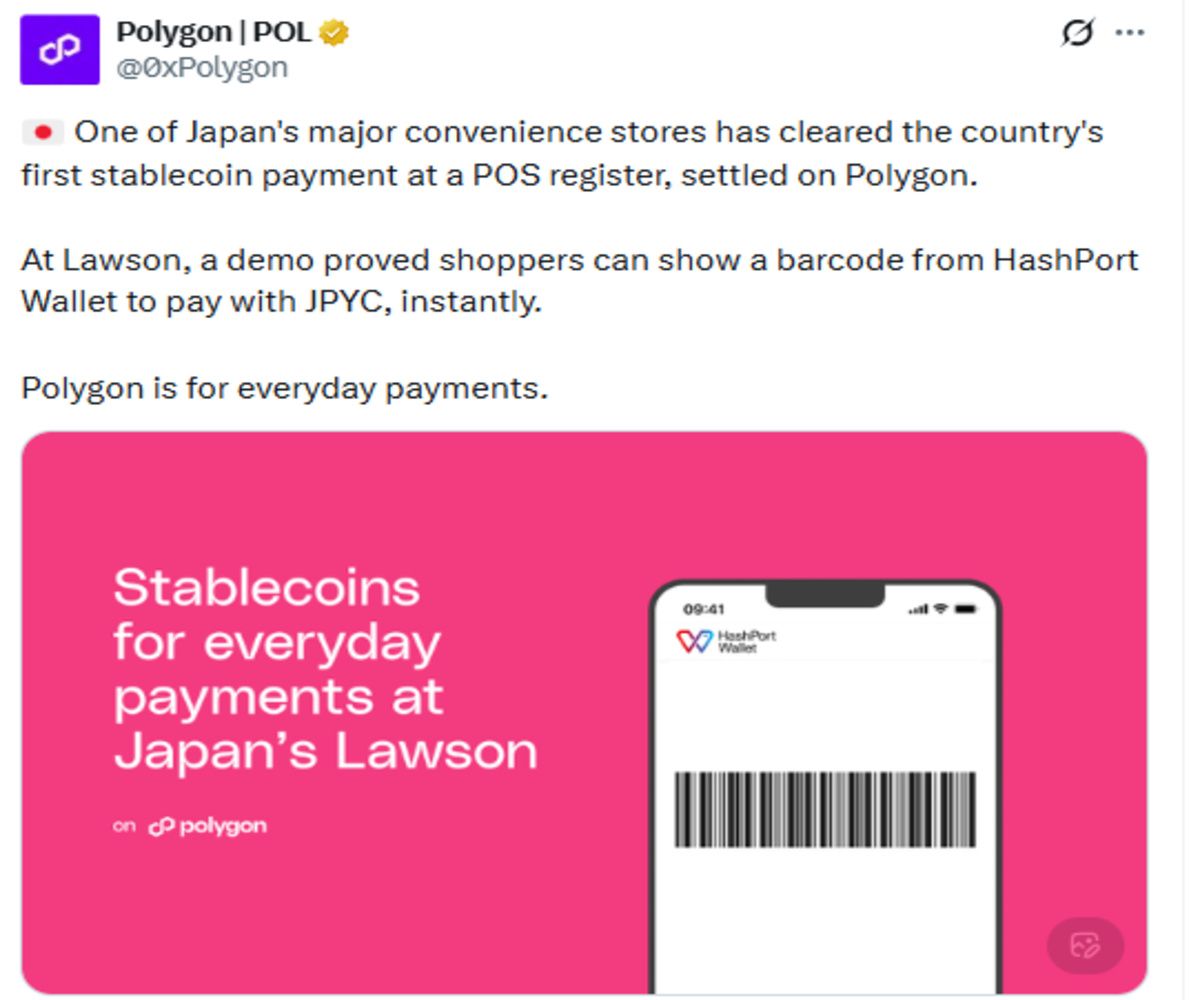
Source: Official Polygon X Post
The transfer settled on Polygon, a blockchain network.
Why This JPYC Stablecoin News Matters for Japanese Retail
HashPort CEO Seihaku Yoshida described two achievements from the test: the payment fit into Lawson's existing POS setup with little to no hardware change, and the transaction ran without gas fees for the shopper.
From the customer and cashier view, the process resembled existing Japanese barcode payment apps, with one extra confirmation tap.
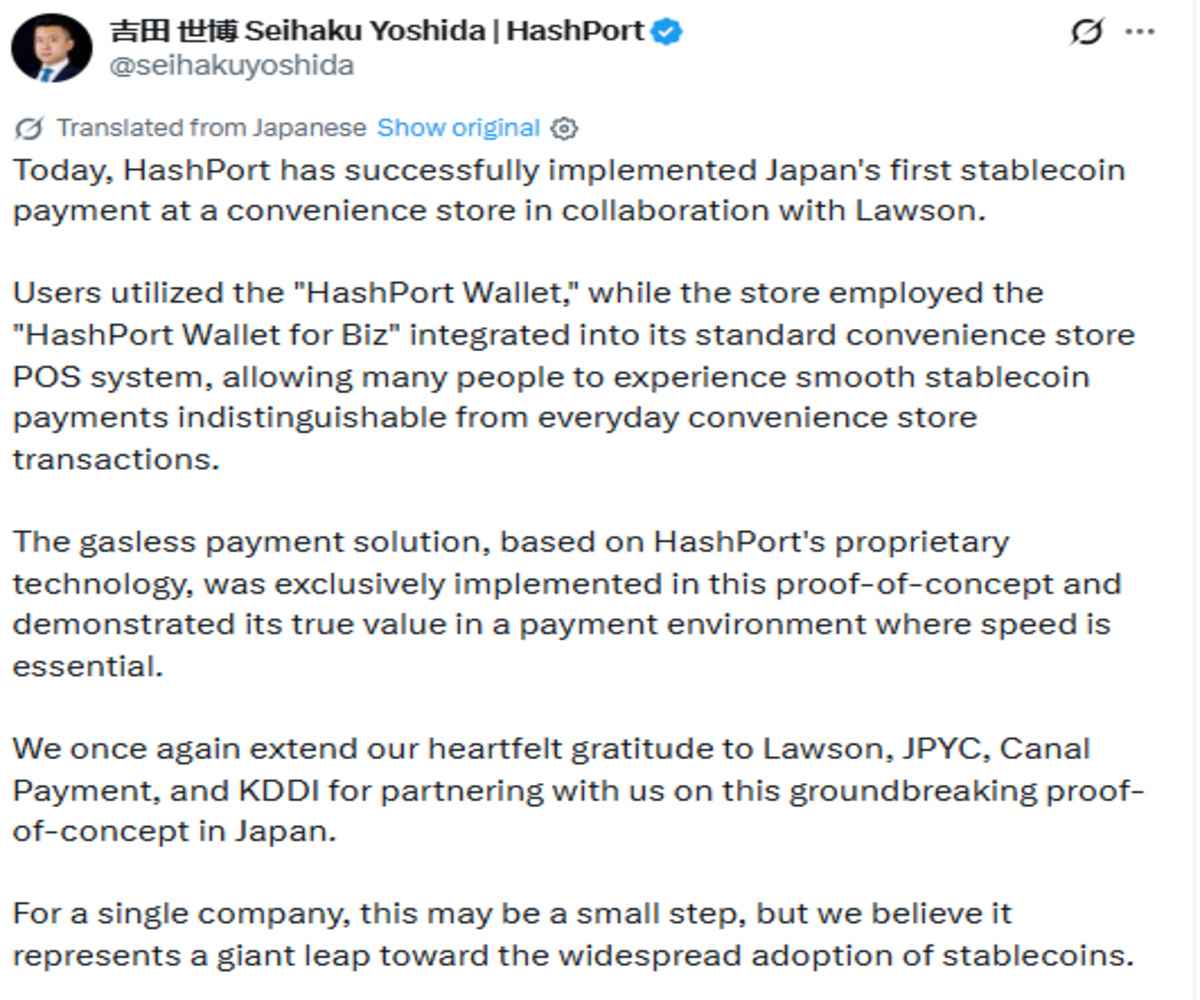
Source: Official X Post
JPYC is a yen-backed token issued by JPYC Inc. It launched on October 27, 2025, as Japan's first stablecoin registered under the country's Payment Services Act.
According to reporting on own disclosures, its on-chain circulation passed 2 billion yen, around 12.36 million dollars, in late July 2026.
JPYC Raises $38 Million Ahead of the Lawson Trial
JPYC Inc. closed an extended Series B funding round this week at 6 billion yen, close to $38 million. Logistics firm AZ-COM Maruwa Holdings joined as the newest backer.
The company has said the funds will support its financial infrastructure and speed up adoption of the yen-pegged token across Japan. The raise lands just as moves from pilot programs into retail tests like the one at Lawson.
Source: X Post
JPYC and Tether: Two Different Models
JPYC and Tether (USDT) are both stablecoins, but they serve different markets and scales.
Feature | JPYC | Tether (USDT) |
Peg | Japanese yen (1:1) | US dollar (1:1) |
Issuer | JPYC Inc. | Tether |
Launch | October 27, 2025 | 2014 |
Regulatory status | Registered under Japan's Payment Services Act | Operates under varying jurisdictional rules; publishes reserve reports |
Circulating supply (reported) | About 2 billion yen (~$12.36 million) | |
Total Supply | 8.8B | 189.09B |
Primary use case | Domestic retail and POS payments in Japan | Global trading, DeFi liquidity, and cross-border settlement |
Networks | Ethereum, Polygon, Avalanche, Kaia | 10+ networks including Ethereum, Tron, Solana |
Source: Coin Market Cap
JPYC remains a small, domestically focused stablecoin compared with Tether's global scale. The Lawson trial focuses on proving retail usability rather than expanding circulation size.
What Comes After the Tokyo Trial
Lawson has a second proof-of-concept planned for August 17, 2026, at its Gate City Osaki Atrium store. That test will use MetaMask and include JPYC alongside USDC and USDT.
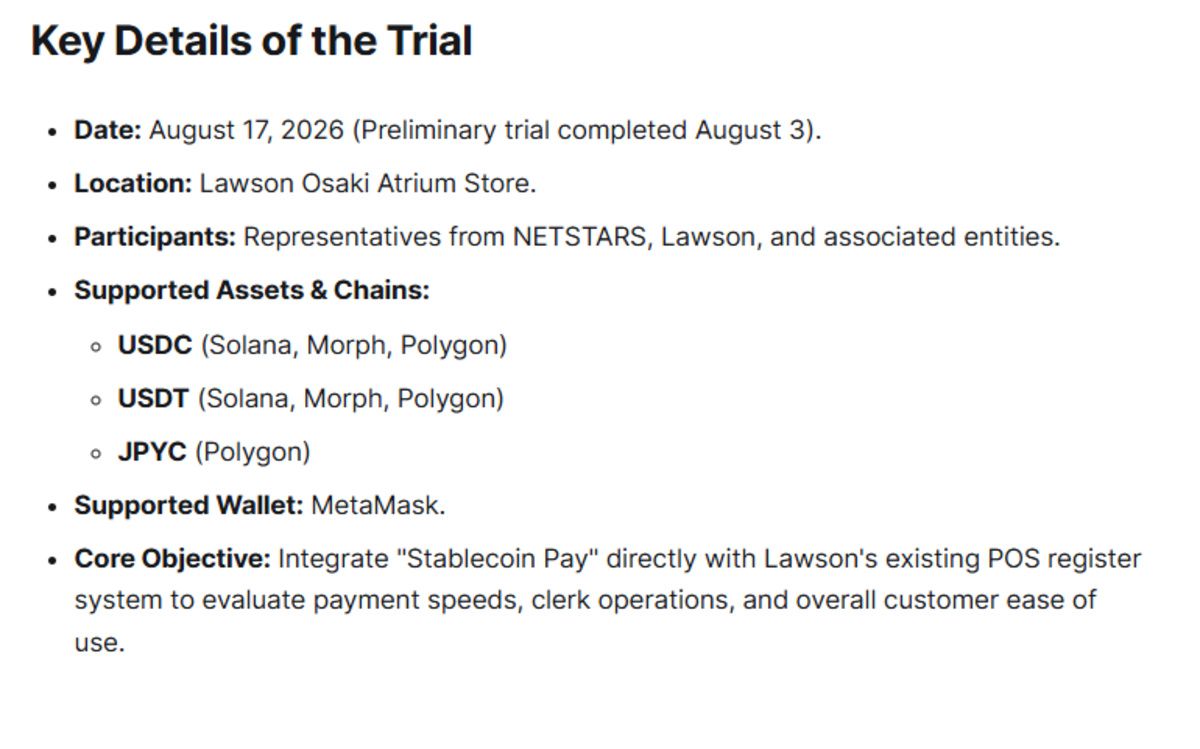
Source: Fintech Observer official
Lawson has said it may run further internal tests through August to check refund handling, franchise usability, and transaction speed before making any decision on wider use.
Expert Opinion
The Lawson trial shows that stablecoin payments can work inside a high-volume, low-value retail setting without changing the front-end experience for shoppers or staff.
Whether this scales past a single store depends on how Lawson evaluates operational factors like refunds and peak-hour throughput, along with continued regulatory clarity for yen-backed tokens in Japan.
Conclusion
Lawson's August 6 test marks an early but concrete step toward token acceptance in Japanese retail. The next trial on August 17 will show whether the model holds up across multiple tokens and a second location.
Disclaimer: This article is for informational purposes only and does not constitute financial advice. Cryptocurrency and stablecoin markets carry risk. Readers should conduct their own research before making any financial decisions.










