Kalshi News: Trading Volume Falls 7.3% as FX and Rate Futures Planned

Kalshi News Today: August Volume Falls, FX and Rates Perpetuals Expand
Kalshi News Today covers two major developments: a pullback in trading volume after a World Cup-fueled summer and a push into foreign exchange and interest-rate perpetual futures. Together, they show a platform still expanding even as short-term activity cools and regulatory scrutiny grows.
At a Glance
-
Kalshi's August trading volume dropped 7.3% to $37.17 billion, down from $40.1 billion in July.
-
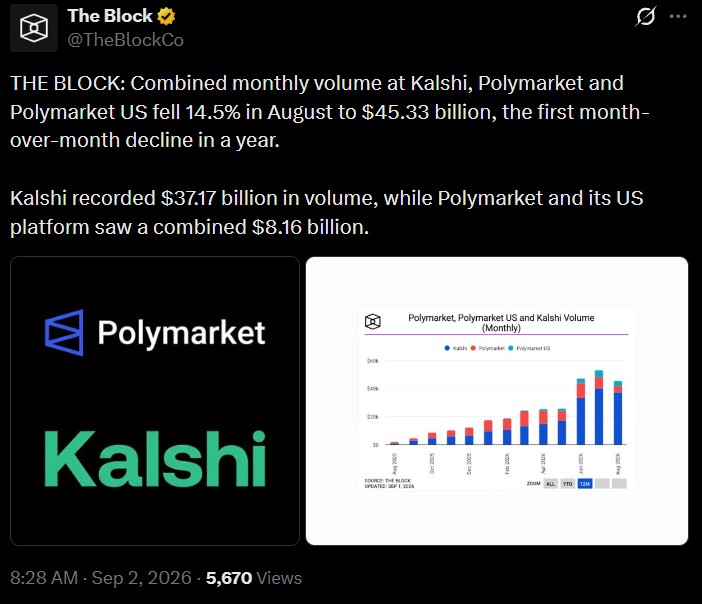
Combined volume across Kalshi, Polymarket, and Polymarket US fell 14.5% to $45.33 billion, the first monthly decline in a year.
-
It has applied to regulators for FX and interest-rate perpetual futures contracts.
-
The filing extends a product line that began with a Bitcoin perpetual approved in late May 2026.
-
It plans to keep leverage limits below the levels commonly offered by offshore platforms.
August Trading Volume Drops After World Cup Surge
Kalshi recorded $37.17 billion in trading volume in August, a 7.3% decline from July's $40.1 billion. The drop follows a summer surge tied to the FIFA World Cup, which ran from June 11 to July 19 and pushed prediction-market activity well above typical levels.
The August decline therefore appears to reflect a cooling period after an unusually active summer. While monthly activity fell, the platform continued to record substantially higher volume than earlier in the year.
Source: The Block
Combined Prediction Market Volume Falls 14.5% in August
Combined monthly volume across Kalshi, Polymarket, and Polymarket US fell 14.5% to $45.33 billion, marking the first month-over-month decline since August 2025.
Polymarket and its U.S. platform experienced a sharper pullback. Their combined volume dropped 36.7% to $8.16 billion from $12.89 billion in July. Even so, the overall prediction market sector remained considerably larger than it was in May.
| Market | July 2026 | August 2026 | Change |
| Kalshi | $40.10B | $37.17B | -7.3% |
| Polymarket + US | $12.89B | $8.16B | -36.7% |
| Combined | $52.99B | $45.33B | -14.5% |
Why Did Trading Activity Fall in August?
The decline largely followed the end of the FIFA World Cup on July 19. The tournament generated a major wave of sports-related interest across prediction markets during June and July, creating unusually high trading activity.
With that catalyst gone, August volume moved lower. However, the combined $45.33 billion recorded by the three platforms remained well above May's $25.66 billion, suggesting that the broader prediction market industry has retained much of the growth achieved during the summer.
Kalshi Files for FX and Interest Rate Perpetual Futures
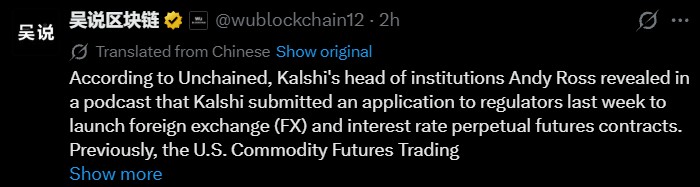
The other major development involves Kalshi's expansion into financial derivatives. Andy Ross, the company's head of institutional business, said on a podcast that the platform submitted applications for foreign exchange and interest-rate perpetual futures.
The submission was made Monday, although it had not appeared on the U.S. Commodity Futures Trading Commission's public docket as of the following afternoon. Previous Kalshi perpetual filings have taken several days to appear publicly.
If approved, the products would extend the platform's reach beyond prediction contracts and into major financial markets covering currencies and interest rates.
Source: Wu Blockchain
Perpetual Futures Expansion Moves Beyond Crypto
Perpetual futures are contracts without a fixed expiration date that are designed to track an underlying asset's price through periodic funding payments.
The expansion into perpetuals began in late May 2026, when the CFTC approved its Bitcoin perpetual contract, described as the first domestically regulated perpetual contract of its kind in the United States. Ether and XRP filings followed soon afterward.
The company then expanded toward traditional commodities and equity markets, filing for contracts linked to gold, silver, platinum, copper, and the US500 index.
| Date | Development |
| Late May 2026 | CFTC approves Kalshi's Bitcoin perpetual |
| Early June 2026 | Ether and XRP filings follow |
| July 2026 | Gold, silver and platinum filings submitted |
| Aug. 18, 2026 | US500 and copper filings submitted |
| Sept. 1, 2026 | FX and interest-rate applications confirmed |
How Kalshi Plans to Limit Leverage
Ross said the platform's regulated structure means it will not offer the very high leverage levels available on some offshore venues. Instead, leverage limits will vary depending on the volatility of the underlying asset.
The approach is intended to reduce the risk of retail traders facing large liquidations. Both retail and institutional participants could access the order book, while institutions can also participate through futures commission merchants.
Ross also pointed to a calibration study involving approximately 2.2 million data points. He argued that market prices remained closely aligned with real-world outcomes even when individual markets had relatively limited trading activity.
Regulatory Pressure Continues Despite Expansion
The expansion comes as Kalshi faces increasing scrutiny from U.S. state regulators. More than a dozen states have taken enforcement action or filed lawsuits involving Kalshi and Polymarket, particularly over sports-related contracts.
Connecticut recently sued Kalshi Prediction Market in an effort to block the platform from offering sports contracts, escalating a legal dispute that has continued for months.
At the same time, it continues to expand its sports presence. The platform recently signed a deal with the U.S. Tennis Association to become the exclusive prediction-market partner of the U.S. Open, whose main draw began on August 30.
What's Next for Kalshi After the FX and Rates Filing?
The next key development will be the appearance of the FX and interest-rate submissions on the CFTC's public docket. The regulatory route will also matter. Kalshi's previous filings have used different processes, including voluntary requests for review and self-certification.
Approval or listing of the new contracts is therefore not guaranteed. Traders will need to watch for the official filing details and any subsequent regulatory action.
Overall, the August data shows that prediction-market activity cooled after the World Cup, but remained well above spring levels. At the same time, Kalshi is continuing to broaden its product lineup into currencies, rates, commodities, and equity benchmarks.
Conclusion
The latest Kalshi News Today update points to a market that is cooling from its World Cup-driven peak without losing its broader momentum. August trading volume declined, but activity remained significantly above May levels.
Meanwhile, the proposed FX and interest-rate perpetuals would take Kalshi deeper into traditional financial markets if regulators allow them to launch. The platform is also emphasizing leverage limits and its regulated structure as it expands.
For now, the FX and interest-rate contracts remain pending applications rather than approved products. Traders should watch the CFTC docket, future regulatory decisions, trading volumes, and the ongoing state-level legal battles for the next major developments.
Disclaimer: This article is for informational purposes only and does not constitute financial, investment, or trading advice. Prediction markets and perpetual futures carry significant risk, including possible loss of principal. Always do your own research and consult a licensed financial advisor before making investment decisions.






