Philippines Crypto News: BSP Proposes Freeze on New Payment Firms

Philippines Crypto News: How the BSP Freeze Could Reshape Crypto
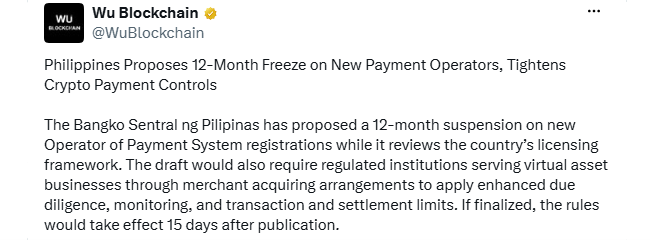
Philippines crypto news today centers on a major regulatory move from the country's central bank. The Bangko Sentral ng Pilipinas has proposed a 12-month suspension on new Operator of Payment System registrations, pausing fresh applications while it reviews how payment operators get classified and licensed nationwide.
Source: Wu Blockchain
The draft circular does more than pause registrations. It also brings tighter oversight for institutions that serve virtual asset businesses, adding a new layer to the country's already dual-track crypto regulation system.
Philippines Crypto BSP OPS Freeze: What the Draft Circular Covers
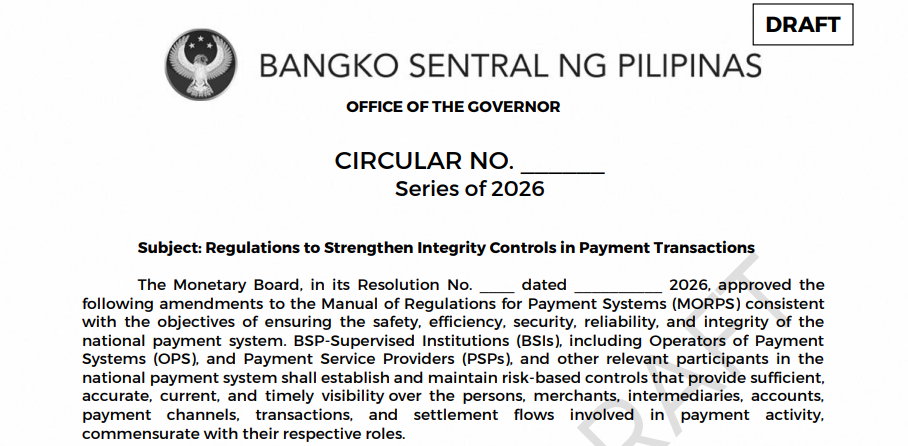
The BSP's proposal centers on giving regulators room to rebuild the OPS taxonomy and licensing rules from the ground up.
Source: Official Draft
New OPS registration applications would stop for a full 12 months.
The pause allows a complete review of licensing categories and risk management standards.
A proposed centralized QR merchant database aims to improve tracing of merchants and their ultimate beneficiaries.
Layered payment setups involving multiple intermediaries face new restrictions.
If finalized, the rules take effect 15 days after publication, and the BSP is currently collecting public feedback.
This Philippines crypto news update does not claim a ban on cryptocurrencies. It targets how payment infrastructure gets built and supervised going forward.
VASP Payment Controls Tighten Under New Philippines Crypto Rules 2026
Virtual asset service providers would be treated as a higher-risk category alongside gambling platforms, certain gaming operators, and money service businesses under the draft rules.
BSP-supervised institutions offering merchant acquiring services can only work with VASPs through direct merchant arrangements.
Enhanced due diligence and ongoing monitoring become mandatory for these relationships.
The draft proposes transaction and settlement limits apply specifically to high-risk categories.
Accountability requirements grow stricter whenever intermediaries sit between a merchant and a financial institution.
These Philippines crypto rules 2026 build on measures already introduced earlier this year, including stricter pre-listing checks for tokens, required delisting triggers for risky assets, and a ban on privacy-focused coins like Monero and Zcash on licensed platforms.
Philippines Crypto Adoption 2026: Why Regulators Are Moving Now
The timing of this Philippines Crypto news update also lines up with strong grassroots crypto activity across the country. The Philippines ranks near ninth globally on crypto adoption indexes, with growth driven mainly by everyday use rather than pure trading.
Awareness of virtual assets among adults rose to about 20 percent in 2025, up from just 6 percent in 2021 as perDatawallet.
Stablecoins, remittances, and QR-based payments make up a growing share of real-world crypto use.
A long-standing moratorium on new VASP licenses under BSP Circular 1108 remains in place, extended indefinitely in 2025 over consumer protection concerns.
The Securities and Exchange Commission separately oversees crypto-asset service providers focused on trading and investment activity.
That combination, rising public use paired with a still-limited pool of licensed VASPs, appears to be pushing regulators toward tighter payment integrity controls rather than loosening the framework.
What Comes Next for Philippines Crypto Regulation 2026
The draft circular now enters a public feedback period before any final version takes shape. A few developments are worth tracking closely:
Possible amendments to the broader VASP framework under Circular 1108.
Continued coordination between the BSP and SEC on overlapping crypto oversight.
Progress on Project Agila, the country's wholesale central bank digital currency initiative.
Expanded regulated rails for stablecoins, remittances, and merchant payments, even as high-risk activity faces new limits.
This Philippines crypto freeze reflects a broader pattern building across the region: regulators are not shutting the door on digital assets, but they are narrowing the path for how payment operators and virtual asset businesses connect to the traditional financial system. For anyone building or transacting through Philippine payment rails, the next 12 months will likely decide what that narrower path actually looks like.
Disclaimer: This is not financial advice. Regulatory proposals can change before finalization. Always verify current rules through official BSP channels before making decisions.
Also read:









