Pi Network News: RoboPay Partnership Brings Robot Service Payments


Pi Network News: Pi Joins RoboPay as Payment Partner for Robot Service
This Pi Network news update centers on a new partnership announced by Fabric Foundation.
The Network, through its official PiCoreTeam account, has joined RoboPay as a payment partner, meaning the digital asset can now be used to pay for robo services across the Fabric network.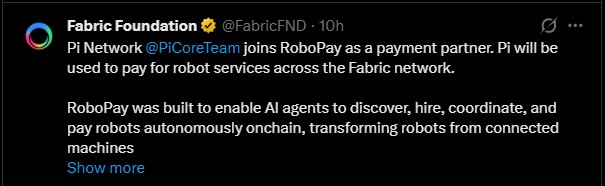
What Happened: Why Pi Joins RoboPay?
RoboPay was built to let AI agents discover, hire, coordinate, and pay robots autonomously onchain, turning robots from connected machines into autonomous economic actors that provide real-world services.
With it added as a payment partner, that same infrastructure now extends beyond AI agents to everyday the digital asset users.
How Pi's User Fit Into RoboPay
Tens of millions of users will get access to robot services directly through currency they already hold.
According to the announcement, this changes how people interact with robotics: instead of buying a robot outright, users can simply purchase the outcome they need.
What Robot Services Could Look Like
Once available, anticipated robot services tied to this Pi Network news update may include:
-
Requesting a delivery robot to bring groceries
-
Dispatching a security robot to patrol a property
-
Scheduling an inspection autonomous machine for industrial facilities
-
Interacting with humanoid assistants in retail and hospitality settings
The announcement frames autonomous labor as something that could become as accessible as any digital service.
Why This Partnership Matters
By connecting humans, AI agents, and robots through the same payment infrastructure, the payment network and Pi say they've built the foundation for an open machine economy.
In this setup, physical intelligence becomes an on-demand service, meaning users won't need to own robots. Instead, they can request robotic solutions whenever needed and pay instantly using the digital asset through RoboPay.
This expanding utility also aligns with recent Pi Network smart contract developments, supporting broader real-world blockchain applications. Discoverable, programmable, and instantly payable, autonomous labor can participate in everyday commerce alongside real people.
This isn't Pi's first move into robotics either. the Network had already invested in OpenMind, the company behind the FABRIC protocol that RoboPay's machine-to-machine network runs on, back in 2025.
That earlier investment lines up directly with this new partnership, suggesting the the payment network integration builds on a relationship the network had already established rather than a brand-new connection.
What Comes Next
Fabric Foundation describes this as part of a broader shift, one where humans, AI, and robots can all transact, collaborate, and create value together using shared payment rails.
The partnership introduces another potential real-world utility, subject to the rollout of RoboPay service, tying the network directly to physical solutions rather than just digital transactions.
Conclusion
This latest Pi Network news shows expanding beyond typical crypto use cases into the emerging machine economy through its RoboPay partnership.
With tens of millions of holders potentially gaining access to autonomous machine based services, the real test now shifts to rollout: which services actually go live and how soon everyday the network users can put this new utility to use.
Disclaimer
This article is for educational and informational purposes only and should not be considered financial or investment advice. Always conduct your own research before making investment decisions.










