SEC Regulation Crypto Assets Proposal: What Changes for Crypto


SEC Crypto Safe Harbor: When Could a Token Stop Being a Security?
The SEC Regulation Crypto Assets proposal could create a new fundraising framework for certain crypto investment contracts in the United States. Announced August 18, the proposal introduces two new registration exemptions and a conditional safe harbor, aiming to give crypto issuers clearer legal pathways to raise money in the United States.
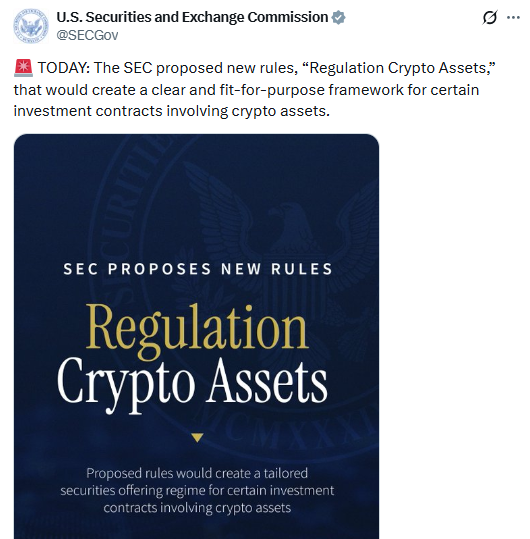
What "Regulation Crypto Assets" Actually Proposes
Per the SEC's own announcement, the rule builds directly on the Commission's earlier March 2026 interpretive guidance on how federal securities laws apply to crypto assets and related transactions. Together, the two efforts are meant to form a "comprehensive, tailored securities offering regime" for the sector, while keeping core investor protections intact.
Key elements of the proposal:
Two new exemptions from Securities Act of 1933 registration requirements, specifically tailored to crypto investment contracts
A conditional safe harbor that would exclude a crypto asset from being treated as an "investment contract" — and therefore a security — once specific conditions are met
State-law preemption for offerings made under the new exemptions, plus certain secondary-market transactions, meaning issuers wouldn't also need to separately register under individual state securities laws
A 60-day public comment period, beginning once the proposal is formally published in the Federal Register
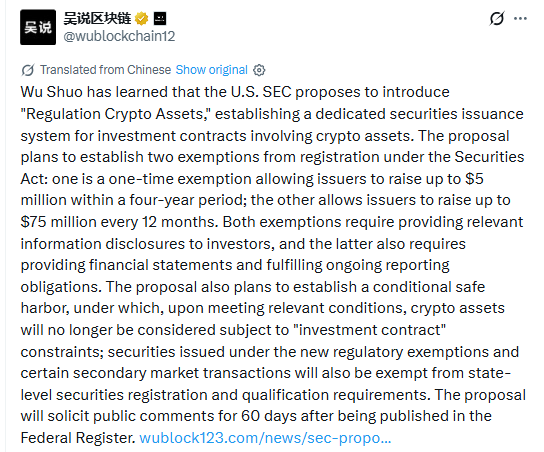 Source: X (formerly Twitter)
SEC Chairman Paul S. Atkins said the goal is to give "digital asset entrepreneurs and market participants clear pathways to raise capital under the federal securities laws," and described the safe harbor as applying once an issuer has completed, or permanently ceased, the managerial efforts it promised investors under the original offering.
The Two New Exemptions, Compared
The proposal's core mechanism is a choice between two exemption tracks, each with different raise limits and different disclosure obligations:
Feature | Exemption 1 | Exemption 2 |
Maximum raise | $5 million | $75 million |
Time period | Once, within any 4-year period | Once per 12-month period |
Investor disclosures required | Yes — principles-based narrative disclosures | Yes — same narrative disclosures |
Financial statements required | No | Yes |
Ongoing reporting required | No | Yes |
The structure mirrors, in spirit, existing exemptions like Regulation Crowdfunding and Regulation A that already exist for traditional securities — smaller raises face lighter disclosure burdens, while larger raises come with financial statement and ongoing reporting requirements closer to a full registered offering.
The Safe Harbor: When a Crypto Asset Stops Being a "Security"
Separate from the two fundraising exemptions, the proposal's conditional safe harbor addresses a different, longer-running question: at what point does a token stop being classified as a security under the "investment contract" test?
Per the SEC's statement, once specified conditions are satisfied, a crypto asset would no longer be deemed subject to an investment contract under either the Securities Act of 1933 or the Securities Exchange Act of 1934. Practically, this targets the common scenario where a token was originally sold as part of an investment contract (tied to a team's promised development work), but the network or project has since matured to the point where that original promise has been fulfilled or abandoned — a distinction courts and the SEC have wrestled with for years under the Howey test framework.
Why This Is Happening Now
The timing lines up with a broader stalemate in Washington. Comprehensive crypto market-structure legislation — intended to give the industry a lasting statutory framework — remains stalled in the Senate. With that legislative path blocked for now, the SEC is using its own rulemaking authority to move first.
This proposal also fits a broader pattern under the current SEC leadership, which has already:
Rescinded prior crypto-specific accounting guidance
Dismissed several enforcement actions against major crypto exchanges
Issued the March 2026 interpretive guidance this proposal now builds on
Industry trade groups responded quickly and positively. The Blockchain Association's CEO called the proposal "an important step toward the clear, fit-for-purpose rules digital asset markets in the United States have needed for years," while The Digital Chamber's CEO said the group would work with the SEC "to ensure consumers and the digital assets industry can thrive onshore in the U.S."
Separately, on the same day, the Commodity Futures Trading Commission's chairman confirmed the agency's Innovation Advisory Committee would hold its first meeting, bringing together industry participants to discuss digital asset policy — a signal that both major US financial regulators are actively moving on digital asset rulemaking in parallel this week.
What Happens Next
This is a proposal, not a final rule. The next concrete step is publication in the Federal Register, which opens a 60-day public comment window. The SEC will then need to review comments and could revise the rule before any final adoption — a process that, for comparable rulemakings, has historically taken additional months. Industry participants have separately noted that a rule adopted through SEC rulemaking authority remains more vulnerable to being reversed or tightened by a future administration than a framework passed into law by Congress, which is part of why comprehensive legislation remains the industry's longer-term goal even as this proposal moves forward in the near term.
Disclaimer
This article is for informational purposes only and does not constitute financial, legal, or investment advice. Details are based on the U.S. Securities and Exchange Commission's official press release and proposed rule text, current as of August 19, 2026. Regulatory proposals remain subject to change through the public comment and rulemaking process. Always consult official SEC sources or a qualified professional for authoritative guidance on this or any pending regulation.
Also read:






