Telegram Ban in India: Tap-to-Earn Games and Daily Quiz At Risk?

Telegram Ban in India: What About Toncoin, Tap-to-earn Games and Quiz?
Telegram Ban in India: India just made a move that shocked 104 million Telegram users. The government restricted access to the app until June 22, 2026. And crypto players felt it instantly.
This isn't just a messaging blackout. It's hitting wallets, daily tasks, and tap-to-earn games across the board. Here's exactly what went down — and what you stand to lose.
Telegram Ban in India: What Actually Happened?
The Ministry of Electronics and IT (MeitY) pulled the plug on June 16, 2026. They acted on a request from the National Testing Agency (NTA).
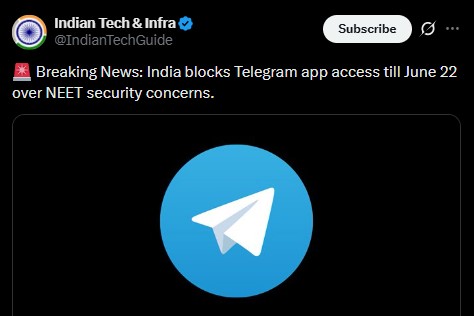
Source: X Post
The reason? NEET (UG) 2026 fraud. The original exam on May 3 was cancelled after a multi-state paper leak. A re-examination is now set for June 21.
Cheating rackets allegedly used the social media to sell fake access to exam papers, spread misinformation, and fabricate 'paper leak' evidence. Telegram's message-editing feature let admins alter old posts and attach actual question papers after exams — while keeping the original timestamp — creating false proof of leaks.
The NTA called this a 'last resort' after channel-level takedowns failed to stop the fraud. Channels operating under names like 'PAPER LEAKED NEET' and 'Private Mafia' demanded money from panicked students.
The block runs till June 22. Message editing stays disabled until June 30.
Toncoin Price Crash: How Bad Is It?
Toncoin (TON) — recently rebranded to GRAM — took a direct hit. The token dropped over 5% right after the Telegram ban news. It's currently trading at $1.69, with a market cap of $4.56 billion.
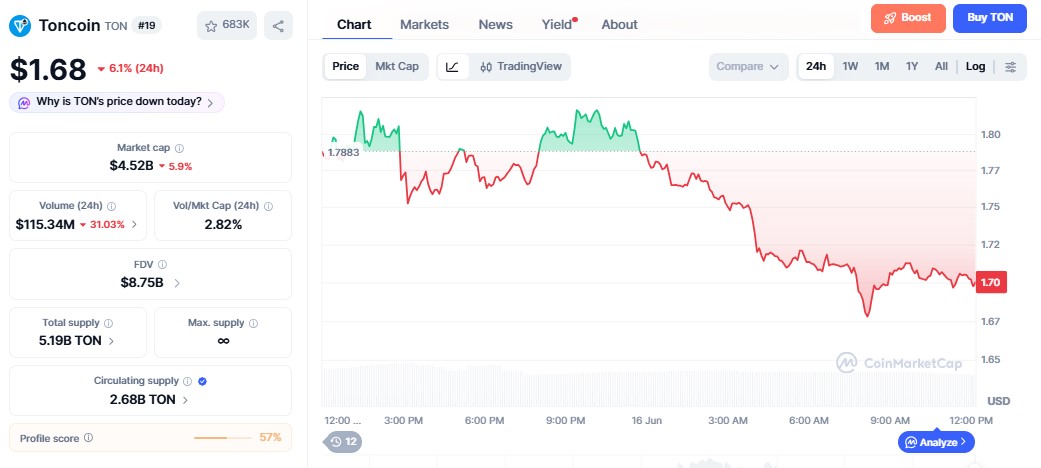
Source: CoinMarketCap Data
This isn't TON's first price shock. The token had already declined 83% from its June 2024 all-time high of $8.24, sitting at $1.30 in late April 2026 before a partial recovery.
Why does an India ban hurt TON so much? Simple. India has 104 million active users — the highest of any country in the world, making up roughly 22% of the platform's global base. Lose Indian activity, and the whole TON ecosystem feels it.
TON powers major Telegram-based projects, including:
- Hamster Kombat — one of the biggest tap-to-earn games globally
- Blum — a mini-app exchange built inside Telegram
- Notcoin — the viral clicker game that drew millions of users
- Tonkeeper — the primary TON wallet app
Tap-to-Earn Telegram Games and Daily Quiz At Risk?
This is where everyday crypto users feel the pain most directly. Millions of Indian players rely on social media for daily earnings. These aren't background processes — they need active participation every single day.
Here's what's now disrupted:
- Hamster Kombat daily combo — clues and codes shared through this channels
- Xenea Wallet daily quiz — quiz answers tracked via groups
- Dropee daily combo — task updates posted on Telegram
- Binance word of the day — shared widely through channels
- Binance red packet code — distributed primarily through Telegram
Miss a day on any of these, and you lose progress. Miss a week, and you fall behind for good.
Tap-to-earn (a game model where you tap the screen to earn crypto tokens) has exploded in the country over the last two years. India accounts for roughly 45% of Telegram's active user base by population penetration. That makes India the backbone of these games — not a side market.
Pavel Durov Hits Back
Telegram's founder didn't stay quiet. Pavel Durov posted a sharp response on X (formerly Twitter).
He compared the India ban to Russia's attempt to block the social media years ago. He wrote that when Russia banned the app, 95% of Russian teenagers simply switched to VPNs — and ended up accessing far worse content.
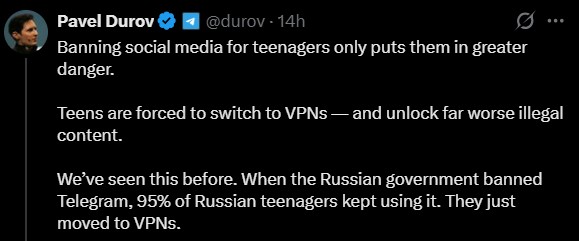
Source: X Account
Durov also pointed to the UK, where social media users face ID verification requirements and thousands are arrested annually for political posts. He questioned whether such bans are really about protecting people — or controlling them.
His core argument: blocking an app doesn't make its users disappear. It just pushes them into darker corners of the internet.
What Happens Next?
The ban is temporary — but the damage to daily Telegram tasks and crypto news cycles is real right now. The Telegram ban in India expires on June 22. If the NEET re-exam goes smoothly, access should return by June 23. Message editing returns on July 1.
But the crypto community is watching closely. If Ithe country chooses to extend restrictions — or repeat this move for future exams — tap-to-earn Telegram 2026 projects face a serious structural risk. India is simply too big a market to lose.
For now, Indian users can access Telegram via VPN. But that's not a long-term fix for daily combo players or quiz participants who need fast, stable connections to stay competitive.
Expert Opinion: The ban reveals how fragile Telegram-dependent crypto projects really are. Building an entire earning model on a single platform — especially one operating without a physical India presence — creates regulatory risk that no whitepaper fully accounts for. The Toncoin price crash after this news isn't panic. It's the market correctly pricing in concentration risk. Projects like Hamster Kombat and Notcoin need geographic diversification or alternative task-delivery channels to survive future disruptions of this kind.
Conclusion
The Telegram ban in India is a short-term government move with real short-term costs. Toncoin prices dropped. Daily quiz tasks stalled. Hamster Kombat combos went dark. With 104 million Indian users at stake, every day of this blackout matters for the tap-to-earn economy — and the broader crypto news landscape is watching every update closely.
YMYL Disclaimer: This report covers cryptocurrency markets, government policy, and financial platforms. Cryptocurrency investments carry significant risk, including total loss of capital. Nothing in this piece constitutes financial, legal, or investment advice. Prices and regulatory conditions can change rapidly. Always conduct your own research and consult a qualified financial advisor before making investment decisions. Government bans and regulatory actions may change without notice.










