VOLT Token Launch Today: Price Crashes More Than 50% the Same Day

VOLT Token Launch: NFT Marketplace, Price Crash and the Roadmap Ahead
VOLT Token launch today arrived with a bang and then a steep drop, as the newly minted $VOLT token lost more than 54 percent of its value within 24 hours of going live. The token, tied to the Robinhood Chain ecosystem, launched on September 2, 2026, through the Bulls Runners platform, and early trading has already tested the nerves of buyers who jumped in at the open.
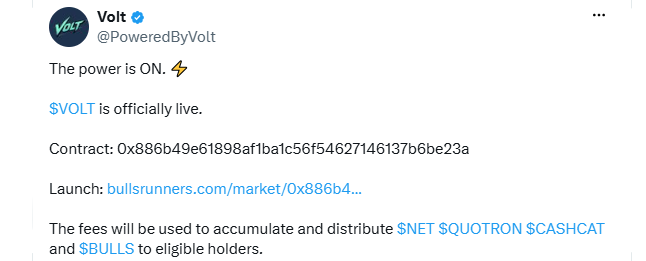
According to the official announcement from @PoweredByVolt, the contract went live with trading fees set to accumulate and distribute four partner tokens — $NET, $QUOTRON, $CASHCAT, and $BULLS, to eligible $VOLT holders. That structure sets this launch apart from a typical memecoin drop, though the price action so far has behaved like one.
VOLT Token Launch Today: How the Bulls Runners Debut Actually Unfolded
Volt is built around a 4,444-piece NFT collection minted on OpenSea in late August 2026, paired with the $VOLT token as the project's economic layer.
The token debuted through a bonding curve sale on Bulls Runners, a launch platform that pairs new tokens with vault and reward mechanics from day one.
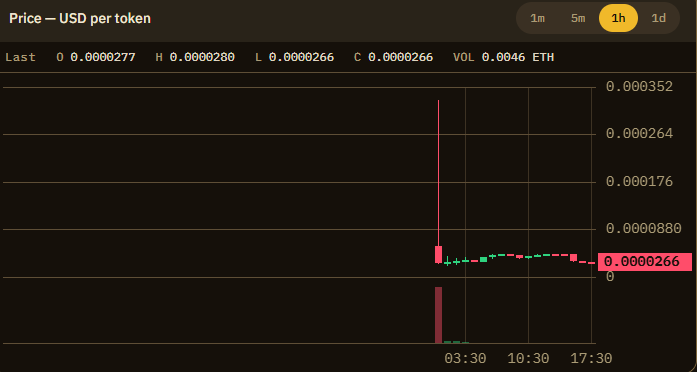
Current market snapshot:
Price: $0.0000277 per token
Market cap: $27,279
All-time high market cap: $325,252 (current price sits at roughly 8% of that peak)
24-hour trading volume: $416,295 across 4,088 trades
Price change: down 5.3% in one hour, down 24.0% over six hours, down 54.1% over 24 hours
Circulating supply: 984.40 million tokens
Pool trading fee: 1.00%
Why the VOLT Crypto Token Price Crash Caught Early Traders Off Guard
The steep pullback lines up with a pattern seen across many bonding-curve launches. Once a token graduates and liquidity locks permanently, early buyers often take profit fast, and that selling pressure shows up quickly on thin order books. Volume stayed heavy even as price fell, pointing to active trading rather than a token going quiet.
Reactions online have been mixed. Some observers flagged the usual early-launch caution signs, including fast sellers cashing out and a matching drop in the linked NFT floor price, which has slipped well below its mint level. Others treated the pullback as a normal cooldown after a hyped crypto token debut rather than a lasting problem.
Inside VOLT Tokenomics and the NFT Vault System Behind the Rewards
Each of the 4,444 Volt NFTs links to a fixed amount of $VOLT through an onchain vault, letting holders move NFTs in and out in exchange for tokens once the system activates.
 Source: Official Token Economy
Spending $VOLT to unlock or upgrade an NFT burns half of that amount permanently, while the remaining half flows back into the ecosystem and holder rewards.
Trading fees also feed a treasury used to back early-stage projects on Robinhood Chain, with any assets acquired distributed to eligible holders. Full supply figures and vesting details have not been published yet; the team has said some mechanics will roll out once the network is further along.
What the VOLT Roadmap Signals Next for the Robinhood Chain Ecosystem
The project frames its rollout in three stages: building the NFT and community base, powering the economy through the token launch and vault activation, and finally scaling by backing more projects across Robinhood Chain. That chain only reached mainnet in July 2026, making Volt an early bet on a young network rather than an established one.
VOLT Token Launch Today has shown a token finding its footing the hard way. Whether the fee-sharing model and vault mechanics hold up will likely depend on how much genuine activity Robinhood Chain generates in the months ahead, not on the opening-day chart alone.
Disclaimer: This article is for informational purposes only and does not constitute financial or investment advice. Crypto markets carry significant risk. Always do your own research before making any investment decisions.
Also read:






