World Chain Mainnet Upgrade To Go Live With EIP-7928 In August 2026

World Chain Launches EIP-7928 Mainnet Upgrade 2026 Ahead of Ethereum
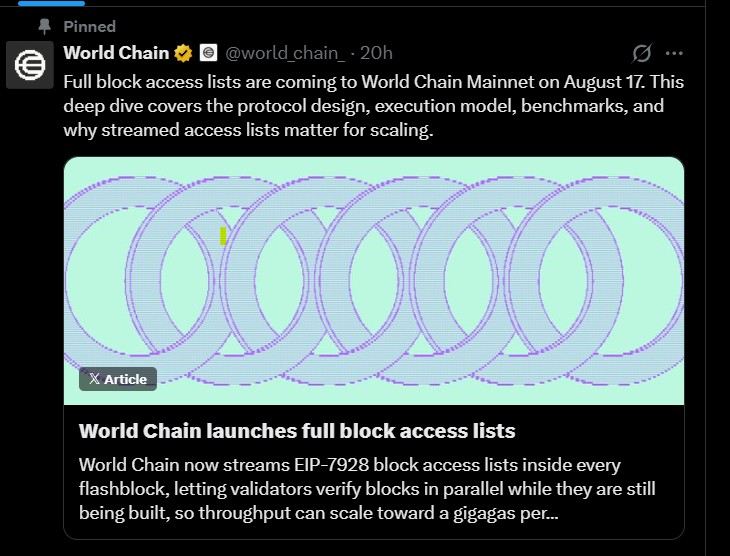
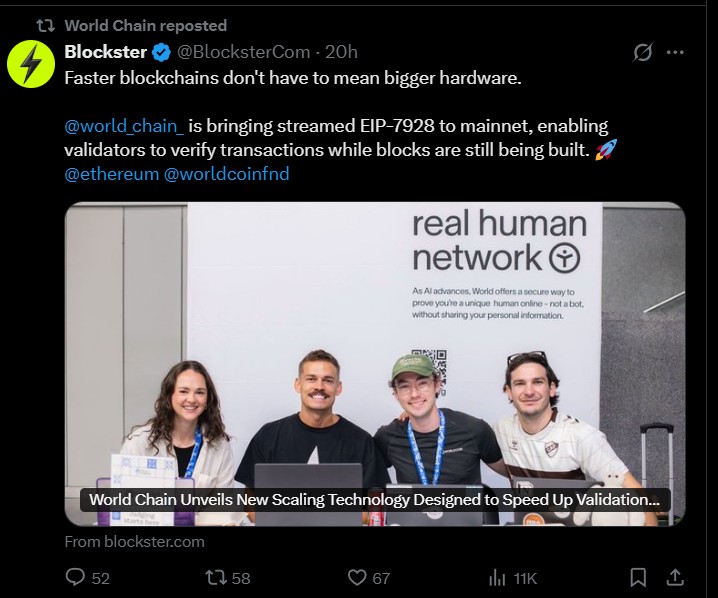
World Chain has confirmed it will deploy EIP-7928 on its mainnet on August 17, becoming the first production Layer-2 network to implement streamed Block-Level Access Lists (BALs). The update is designed to speed up block validation and push network throughput significantly higher, all without adding extra costs for independent validators.
What Is World Chain's EIP-7928 Upgrade?
EIP-7928 is an Ethereum proposal that introduces Block-Level Access Lists, a structured record of every account and storage slot touched during block execution.
Normally, validators must re-execute transactions one at a time because later transactions can depend on state changes made earlier in the block, creating a serial bottleneck that limits how large blocks can grow.
BALs remove that bottleneck by making state changes explicit in advance. Once a validator knows what each transaction will read and write, it no longer needs to guess dependencies through sequential execution — transactions can be checked at the same time across multiple processor cores.
World Chain layers this onto its existing flashblock system, streaming access-list data in small slices every 200 milliseconds rather than waiting for a full block to complete.
How Will the Upgrade Improve World Chain?
The core benefit is parallel transaction validation. Instead of one validator working through a block step by step, verification work spreads across available CPU cores as flashblocks arrive.
This is designed to support throughput of up to 1 billion gas per second, while keeping hardware requirements for independent validators unchanged. The result is lower latency and a validation process built to scale as network activity grows.
| Feature | Details |
| Mainnet Launch | August 17, 2026 |
| Upgrade | EIP-7928 |
| Network | World Chain |
| Key Feature | Streamed Block-Level Access Lists (BALs) |
| Flashblock Interval | Every 200 milliseconds |
| Target Throughput | 1 Billion Gas/Second |
| Activation Method | Runtime Flag |
| Hardware Requirement | No additional validator hardware |
Blockster X Post
World Chain vs Ethereum's Planned EIP-7928 Rollout
Ethereum intends to bring the upgrade to mainnet as part of its future Glamsterdam upgrade, which will require a coordinated network-wide hard fork. The platform is taking a different route, activating the feature through a runtime flag that client operators can adopt without a synchronized upgrade event.
That distinction is what allows World Chain to go live first, positioning it as the earliest production deployment of streamed block access lists ahead of Ethereum Network own rollout.
| Date | Event |
| July 27, 2026 | EIP-7928 enabled on World Chain Sepolia |
| August 6, 2026 | WorldChain announces August 17 mainnet deployment |
| August 17, 2026 | EIP-7928 goes live on World Chain Mainnet |
| Future | Ethereum expected to adopt EIP-7928 in Glamsterdam upgrade |
Why This Matters for Ethereum Scaling
Scaling a blockchain usually means asking validators to run on bigger, more expensive hardware. WorldChain's approach tries to avoid that trade-off by making verification a parallel process rather than a sequential one, which helps keep independent validators competitive and preserves decentralization even as throughput rises.
Faster block verification also reduces the lag between block construction and confirmation, a detail that matters for both everyday users and developers building on the network.
Once the mainnet upgrade goes live, it's worth watching whether real-world throughput and validator participation hold up outside of test conditions — and whether Ethereum's Glamsterdam implementation ends up following a similar streaming approach.
Conclusion
The platform is set to become the first production Layer-2 network to launch streamed block access lists, aiming to boost throughput without raising the bar for independent validators. With mainnet deployment scheduled for August 17, the rollout could stand as an early proof point for how the broader Ethereum ecosystem approaches scaling in the years ahead.
Disclaimer: This article is for informational purposes only and does not constitute financial, investment, or trading advice. Cryptocurrency markets are volatile and involve risk. Always do your own research before making any investment decisions.









