Crypto Hacks in 2026: How Hackers Steal Billions and How to Stay Safe


Crypto Hacks in 2026 Have Cost Billions. Why?
The blockchains themselves mostly held up.The trouble started with people, keys, and the apps wrapped around them. So why do platforms keep getting caught out?
Here's what happened, how thieves get in, and what they can do.
Can blockchain networks be hacked if platforms still fail?
The chain itself is hard to break, yet people still lose money on it. That surprises a lot of newcomers.
A blockchain is a shared ledger of payments, and old entries are hard to rewrite. Most people reach it through exchanges, apps, hardware wallets, and bridges.
Each one adds software, devices, and staff who can slip up. The network can run as designed while a service on top of it fails. That's why hackers went after staff logins and keys.
What happened in the $6.3 billion Binance hack?
On 29 October, Binance said hackers had made unauthorized withdrawals from its hot wallets. The exchange put the loss at about $6.3 billion. TRM Labs came in slightly higher at $6.36 billion across ten blockchains.
How the hackers got in is still debated. TRM said the evidence points to a breach of Binance's hot wallet signing system. Binance hadn't yet shared a root cause.
Binance promised to cover the hole with company funds and its Secure Asset Fund for Users (SAFU). It also says most stolen assets are now replaced, though nobody has audited that claim yet. Our Binance hack impact report tracks the open questions.
How did the Binance hack week unfold day by day?
Here's the order of events.
What happened on 29 Oct? Hot wallet withdrawals began; Tether and Circle started freezing funds.
31 Oct: The FBI linked the attack to North Korea's TraderTraitor group.
1 Nov Binance reopened withdrawals.
2 Nov Mercado Bitcoin reported an incident.
The FBI's alert tied the theft to Trader Traitor, a North Korean group. It's one of the state-linked cyber threat exchanges now planned for.
Freezes began the same day the money moved. That's why stablecoin freezing became a big part of the story.
Which other incidents shook the market this year?
Mercado Bitcoin disclosed its own incident on 2 November. Hypernative flagged more than $40 million in transfers, and Arkham tagged about $46 million.
The exchange said customers weren't affected, though some security experts disagreed. Singapore police also warned of at least two cases since 10 September.
What can past crypto hacks teach us about today?
None of this is new. Mt. Gox said about 850,000 bitcoin were missing in 2014. In 2016, the DAO lost around 3.6 million ether through a code flaw.
Coincheck lost 523 million NEM tokens in 2018. Poly Network, Wormhole, and Ronin later showed how risky bridges and approval keys can be.
Bybit lost about $1.5 billion in February 2025. The FBI tied that theft to the same North Korean group.
How do hackers steal crypto from exchanges and users?
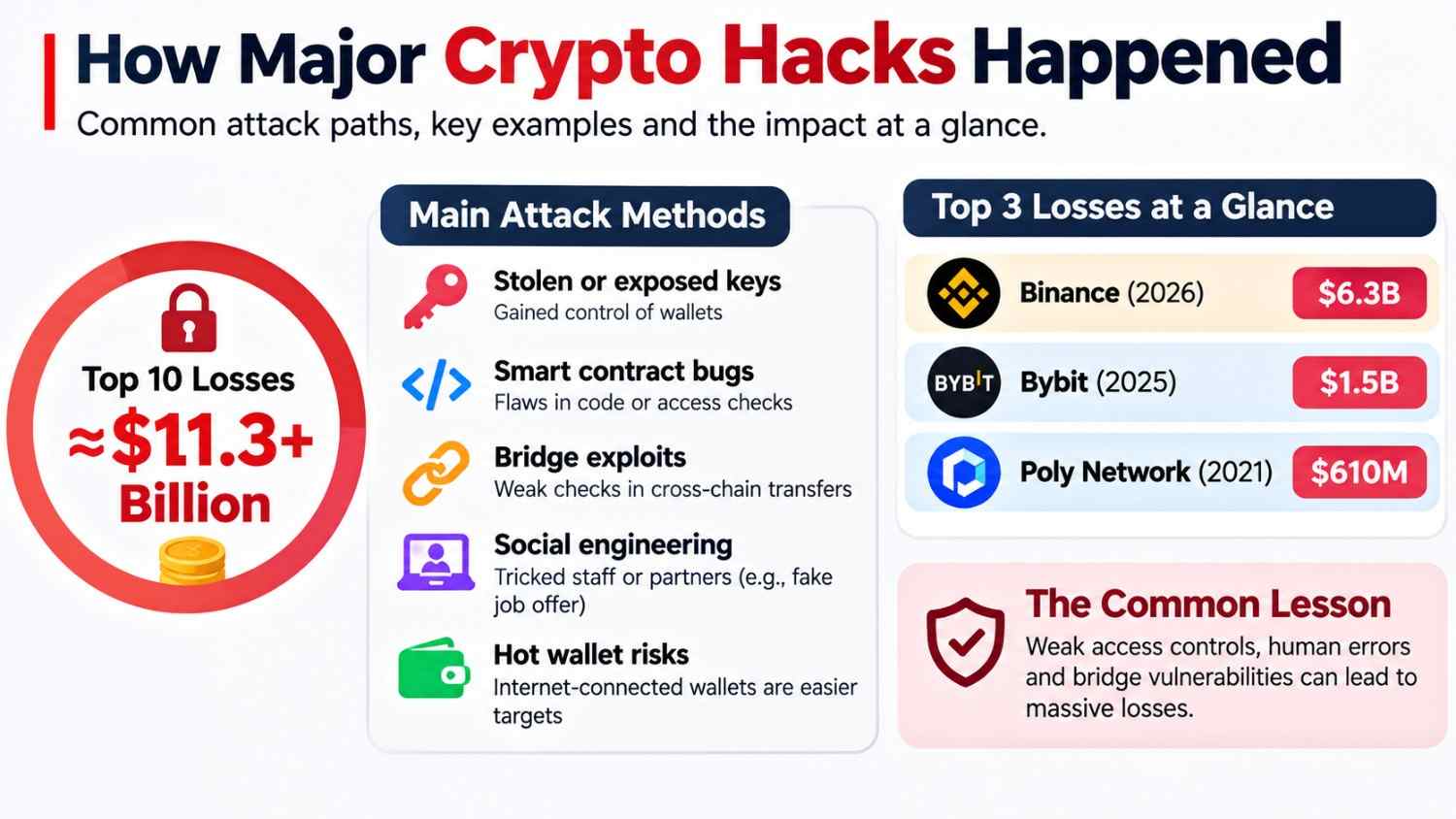
Why are cryptocurrency wallets vulnerable to attacks?
Anyone holding a private key or recovery phrase can move the funds. Stolen staff logins can unlock an exchange's internal systems too. The private key wallet guide covers the basics.
Hot wallets stay online so users can withdraw fast. That makes them a bigger target. Cold storage keeps keys offline. See hot vs cold wallets for the trade-offs.
Even then, unknown devices and unsafe transactions can cause losses. Staff slip up too. An employee might reuse a password or open a harmful attachment. A hacked supplier can open a fresh way in.
How do crypto bridge attacks happen in real life?
Sometimes, coding mistakes can leave a smart contract open, which makes it vulnerable to attack and ultimately can hurt holders.
Bridges fail the same way. They release tokens without checking for matching locked assets on the other network.
More networks mean more places for a mistake, so blockchain security gets harder.
Is AI making crypto attacks faster than before?
Security teams warn that AI can help criminals write convincing fake messages and study software faster.
That's a general worry. So far there isn't enough proof that AI caused any theft this year.
Each claim has to stay tied to its own source. A link to one attack doesn't prove who was behind another.
Can stolen crypto be recovered after a big hack?
Sometimes, in part. Investigators can often trace stolen funds on a public blockchain.
Stablecoin issuers can also freeze tokens when their rules and the law allow it. Reuters said over $2.38 billion was frozen by Tether and Circle. Binance later gave a verified frozen total of around $3 billion.
But a freeze isn't a refund. Full recovery is often harder. That's a big reason these hacks hurt users so badly.
How can you keep your crypto from getting hacked?
Buy hardware wallets only from the maker's official store, and never share your recovery phrase.
Verify every address before sending funds. Keep only trading money on exchanges, and move long-term holdings to cold storage.
These habits aren't optional now, because one slip can't be undone. Exchanges have also spoken up about offline storage, as in this Coinbase cold storage response.
What does expert analysis say about these attacks?
Expert analysis suggests that crypto hacks in 2026 point to weak links around blockchains, not failures inside them.
Strong code, safe key storage, and trained staff matter as much as fast networks. Big thefts weaken trust and tend to bring more checks from regulators. Exchange security and cryptocurrency security will get more attention.
Bitcoin traded near $78,000 on 2 November, per Reuters. The market took the shock in stride for now. That could change.
Crypto hacks in 2026 aren't the only thing that are shaking the market. If you want to learn how the US midterms could affect crypto, read US midterm effects on crypto.
Disclaimer: This article is for information only. It is not financial or investment advice. Crypto markets are volatile, and assets carry risk. No security step can remove every threat.