 BitMart
Pione Chain Listing on BitMart (SPOT): Key Details and Context
The Pione Chain Listing on BitMart (SPOT) adds a new crypto asset to a major centralized trading venue. This page explains the core facts about the Pione Chain (PIO) token listing, the schedule shared by the exchange, and what this new token listing may mean for users and the wider market. All information is based on public data available at the time of writing and may change as the project and exchange update their communications.
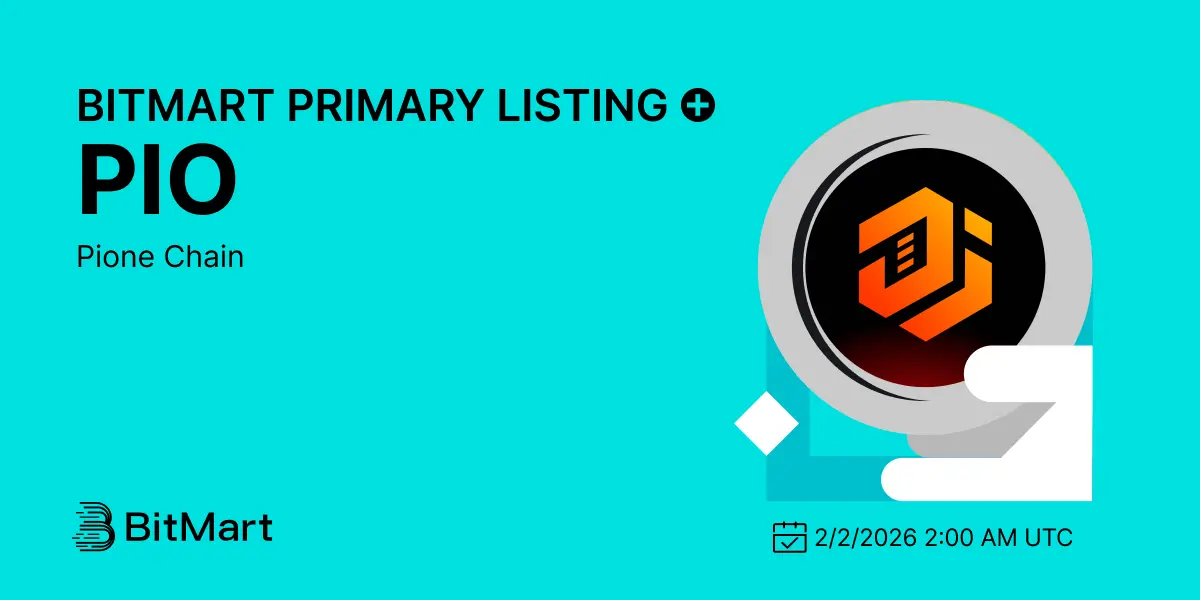
Listing Snapshot for the Pione Chain Listing
- Token Symbol: Pione Chain ($PIO)
- Exchange Name: BitMart (SPOT)
- Listing Date (Announced): 2026-02-02
- Trading Pairs: PIO/USDT
- Token Utility: As described by the project, focused on the Pione Chain ecosystem (details subject to project documentation)
Introduction to BitMart Exchange Listing - Pione Chain ($PIO)
The BitMart Exchange Listing - Pione Chain ($PIO) marks the token’s initial appearance on a global crypto trading platform. As part of the broader landscape of crypto exchange listings, this event places Pione Chain in front of a wider audience of traders who track new crypto listings and upcoming crypto listings on exchanges.
Because this is an early-stage listing, users should treat the Pione Chain Listing as one data point among many when researching the project. The presence of a token on a centralized crypto exchange does not, on its own, confirm its quality, viability, or long-term prospects.
Overview of Pione Chain (PIO) and Token Utility
Pione Chain (PIO) is presented by its team as a native token for the Pione Chain ecosystem. While full technical and economic details are best obtained from the project’s official documentation, the token is expected to play a role in supporting activities within that ecosystem.
Core Aspects of the Pione Chain Token
- Native ecosystem asset: PIO is described as a central token within the Pione Chain network, with potential use across products and services that the team may launch.
- Utility-driven design: Based on common token models, a utility token of this type may be used for payments, access rights, or participation in network-related features. Users should review the whitepaper and official resources to understand how this applies to PIO.
- On-chain operations: The project may use PIO for on-chain interactions such as transaction fees, rewards, or other incentives, depending on the final design of the network.
Because the Pione Chain Listing is still new, key parameters such as maximum supply, distribution model, and long-term token economics should be confirmed directly from the project website at pionechain.com and related official channels.
BitMart (SPOT) Listing Announcement Overview
The Pione Chain Listing on BitMart (SPOT) has been announced through an official BitMart support center article. According to the announcement, BitMart plans to list Pione Chain (PIO) under its spot trading segment, classifying this as a primary listing for the token on the platform.
Key elements from the Pione Chain Listing announcement include:
- Exchange segment: BitMart (SPOT)
- Planned listing date: 2 February 2026, as stated in the announcement
- Trading start date: 2 February 2026, aligned with the listing schedule
- Trading pair details: At the time of writing, the exact spot trading pair (for example, PIO/USDT) has not been fully detailed in the shared data and should be checked on the official BitMart announcement page.
Users can refer directly to the official listing notice at BitMart’s announcement page for the most accurate and up-to-date information, including exact listing time, supported trading pairs, and any region-specific restrictions.
BitMart (SPOT) – Centralized Crypto Exchange Overview
BitMart (SPOT) operates as a centralized crypto exchange and crypto trading platform that lists a range of digital assets from established cryptocurrencies to new token listings. It provides order-book based trading, custodial wallet infrastructure, and various account features designed for both retail and professional users.
Exchange Background and History
BitMart has positioned itself as a global exchange, serving users across multiple regions with a focus on spot markets and other digital asset products. Its platform allows users to engage in crypto exchange listing markets where coins and tokens, such as PIO, can be traded once live on the order books.
Core Exchange Characteristics
- Centralized platform model: BitMart (SPOT) functions as a custodial, centralized crypto exchange, holding user assets under its infrastructure and managing order execution.
- Global user base: The exchange targets users in various jurisdictions, subject to local regulations and access rules. Primary user geographies can evolve over time based on regulatory changes and market conditions.
- Diverse token coverage: BitMart often features newly listed coins and tokens, alongside more established assets, contributing to a broad crypto exchange list on the platform.
Because the exact figures for registered users, average monthly trading volume, and the total number of tokens listed are not provided in the current data, users should consult official BitMart resources or third-party analytics services for verified metrics on liquidity, volume, and activity.
Compliance and Security Posture
As a centralized trading venue, BitMart states that it applies security measures typical for large exchanges, such as multi-layered security architecture, internal monitoring, and wallet management procedures. However, security practices and compliance status can change over time.
Before engaging with the Pione Chain Listing or any other listing on crypto exchanges, users should:
- Review BitMart’s terms of service, risk warnings, and compliance documentation.
- Assess deposit and withdrawal policies, including any fees and limits.
- Understand what protections, if any, apply in their local jurisdiction.
Benefits of the Pione Chain Listing on BitMart (SPOT)
When a token becomes listed on a centralized crypto exchange, it typically gains increased visibility and more accessible secondary-market trading. For Pione Chain (PIO), the BitMart (SPOT) listing may provide several potential advantages, while also introducing risks users must evaluate.
Potential Benefits for the Pione Chain Project
- Improved accessibility: A token listed on exchange platforms is usually easier for users to access compared to over-the-counter or informal channels.
- Market price discovery: Centralized order-book trading can support more transparent price discovery, as buyers and sellers place limit and market orders in a shared order book.
- Broader audience reach: Appearance on a recognized trading platform can expose PIO to traders who monitor new crypto exchange listings and look for newly listed cryptocurrency projects.
These are general crypto exchange listing benefits and do not guarantee any specific outcome for Pione Chain or its token’s value.
Potential Benefits and Considerations for Users
- Unified trading interface: Users who already maintain accounts on BitMart may find it simpler to add PIO to their existing trading activities without opening accounts elsewhere.
- Standardized trading tools: Spot trading interfaces, charts, and order types allow users to interact with new coin listings via familiar tools.
- Centralized liquidity pool: Concentrating buy and sell orders in a single order book can, in some cases, support more efficient trade execution than fragmented peer-to-peer markets. Actual liquidity, however, depends on market participation and cannot be assumed.
Users should remember that a trusted crypto exchange listing does not remove market, smart contract, or project-specific risks. Every listing coin or token carries downside risk, including the possibility of total loss.
What the Pione Chain Listing Means for Users and Traders
The Pione Chain Listing on BitMart (SPOT) offers an additional venue for those interested in engaging with the PIO token. Traders and users who follow crypto listings may view this event as an opportunity to gain exposure, but it should primarily serve as a prompt to perform detailed research.
For Short-Term Traders
- Volatility awareness: New cryptocurrency listings can experience sharp price swings, wide spreads, and low depth in the early stages of trading.
- Order management: Short-term traders may need to use limit orders instead of market orders to manage slippage, especially during the first trading sessions after the token listed on exchange order books.
- Monitoring announcements: Exchange or project announcements can significantly influence order-book behavior around a new listing coin.
For Long-Term Oriented Users
- Project due diligence: Long-term participants should prioritize understanding the Pione Chain roadmap, governance model, and tokenomics.
- Utility assessment: Evaluating how PIO fits into real or planned network activity is crucial in assessing any long-term thesis.
- Custody choices: Users should decide whether to hold PIO on the exchange or withdraw to self-custody wallets, taking into account security, convenience, and personal risk tolerance.
Market Impact and Liquidity Context of the Pione Chain Listing
Every new crypto listing interacts with market structure, liquidity, and trader expectations. The Pione Chain Listing on BitMart (SPOT) introduces PIO to a new pool of potential market participants, but actual liquidity will depend on real trading behavior after launch.
Factors That May Influence Market Impact
- Trading volume: Early trading volume can help indicate how actively the token is being bought and sold, but it may fluctuate significantly during the first days.
- Order-book depth: Depth on both sides of the order book affects how easily larger orders can be executed without strong price impact.
- External markets: If PIO later appears on other platforms, cross-exchange activity could influence price alignment and volatility across listing cryptocurrency venues.
Market participants should approach new coin listings with caution, recognizing that liquidity can be uneven and price history limited. Comparing the Pione Chain Listing with other new crypto listed today or recently can offer context, but each token and project carries unique characteristics.
How to Trade Pione Chain (PIO) on BitMart (SPOT)
The exact user flow can vary over time as exchanges update their interfaces. However, trading a listing coin on a centralized platform like BitMart (SPOT) typically involves several core steps.
Step-by-Step Overview
- 1. Account creation and verification: Users generally need to register for a BitMart account and, where required, complete identity verification (KYC) before engaging in token listing on exchange markets.
- 2. Depositing funds: To trade PIO, users typically deposit either supported fiat currencies or cryptocurrencies such as stablecoins, depending on the available PIO trading pair.
- 3. Locating the trading pair: Once live, users can search for the PIO pair (for example, PIO paired with a stablecoin) within the spot market section of the crypto trading platform.
- 4. Placing orders: Users choose between limit orders, which specify a desired price, and market orders, which execute against the current order book. Limit orders can help control execution price in volatile conditions common to new token listings.
- 5. Managing positions: After trades are executed, users can monitor balances, set further orders, or withdraw PIO to external wallets if supported.
Exchange interfaces may also provide risk warnings related to listing crypto on exchange markets, including reminders that prices can change rapidly and that leverage or derivatives (if offered) significantly increase risk.
Conclusion
The Pione Chain Listing on BitMart (SPOT) introduces the PIO token to a broader trading environment and places it among a growing list of crypto exchange listings. While the event may enhance visibility and access for the project, it should not be interpreted as investment advice, an endorsement, or a guarantee regarding future performance.
Users should approach this and other new cryptocurrency listings with a structured research process. This includes reviewing the project website, technical documentation, community channels, and independent analysis. The decision to trade or hold PIO should align with personal financial circumstances, risk tolerance, and a careful understanding of the potential downsides.
Disclaimer
This article is intended for informational and educational purposes only. It does not provide financial, investment, legal, or tax advice, and it should not be used as the sole basis for any decision to buy, sell, or hold Pione Chain (PIO) or any other digital asset.
Cryptoassets are highly volatile and can lose value rapidly, including the possibility of total loss. New coin listings, including the Pione Chain Listing on BitMart (SPOT), may be subject to extreme price swings, limited liquidity, and sudden changes in market conditions.
Before engaging in any cryptocurrency listing, users should:
- Conduct independent research (DYOR) using multiple reliable sources.
- Evaluate their financial situation and risk tolerance.
- Consult with a qualified financial professional where appropriate.
No exchange listing crypto event, including the listing of PIO on BitMart (SPOT), should be viewed as a recommendation or endorsement. Availability of services and tokens may vary by jurisdiction, and users are responsible for complying with local laws and regulations.