Crypto Weekly News: Ledger Alert, Solana Upgrade And US Inflation


Crypto Weekly News Ledger Alert, Solana Upgrade and US Inflation Recap
Here is your crypto weekly news roundup for October 10 to 16, 2026. A hardware wallet tampering case, a major speed upgrade planned for Solana, a high US inflation reading, and new Australian rules all landed in one week.
Below, every story is explained in simple language, with official sources linked in each section.
Ledger Confirms Hardware Wallets Were Altered Before Reaching Buyers
Ledger published its response on October 15, 2026. It describes a well-funded criminal group that bought genuine Ledger devices, opened them, and fitted hidden parts built to capture the recovery phrase during setup.
The altered devices were then put back on sale through resellers in Southeast Asia, according to Ledger's official post.
A recovery phrase is the secret word list that unlocks a wallet, so whoever holds it can empty the funds.
Ledger says its chip, operating system, and servers were not compromised. It calls this a localized distribution attack, not a wide supply chain failure.
Its team bought and opened devices in markets such as Germany and checked warehouse samples, and every unit examined was clean.
The post does not say how many users were affected or how much was stolen.
What Ledger is changing:
-
Authorized resellers and distributors were asked to pause sales in Southeast Asia and Hong Kong.
-
Ledger is working with law enforcement and security groups to follow the stolen funds.
-
Returned devices can never be resold, even if they look new.
-
Devices should no longer sit on shelves or displays. Stock stays in the back and is handed over at purchase.
-
Resellers must report any unusual customer complaint promptly.
Among this week's crypto weekly news, this is the story buyers should read first. The practical lesson is simple: buy hardware wallets only from trusted, authorized sellers.
Solana Alpenglow Upgrade Targets 150ms Finality
Finality means the moment a transaction can no longer be reversed. According to Solana's official Alpenglow page, the upgrade aims to cut that time from about 12.8 seconds to 150 milliseconds.
It replaces the current agreement system between validators, called TowerBFT, with a faster one. How transactions run stays the same, and users need to take no action.
The first phase, called Votor, lets validators send votes directly to each other. A block can be finalized in one round if 80% of stake votes, or in two rounds if a 60% threshold is met.
The design can still reach agreement with 20% malicious stake plus 20% offline stake.
-
Votor: listed for Agave 4.3 in Q3 2026 and marked "in development."
-
Rotor: a later phase for faster block sharing, with no date set.
-
Validators: must prepare by running Agave 4.3 and registering a new key.
The page shows no exact mainnet date, so readers should watch Solana's official channels for the final timing.
US Inflation Hits 3.7% in September
The US Bureau of Labor Statistics released its September report on October 14.
According to the official CPI release, prices rose 0.6% in September and 3.7% over the past year.
Gasoline was highlighted as a key driver.
| Measure | Monthly change (September) | Yearly change |
| All items | 0.6% | 3.7% |
| Excluding food and energy | 0.3% | 2.6% |
The weekly roundup from Wu Blockchain describes the number as above market expectations.
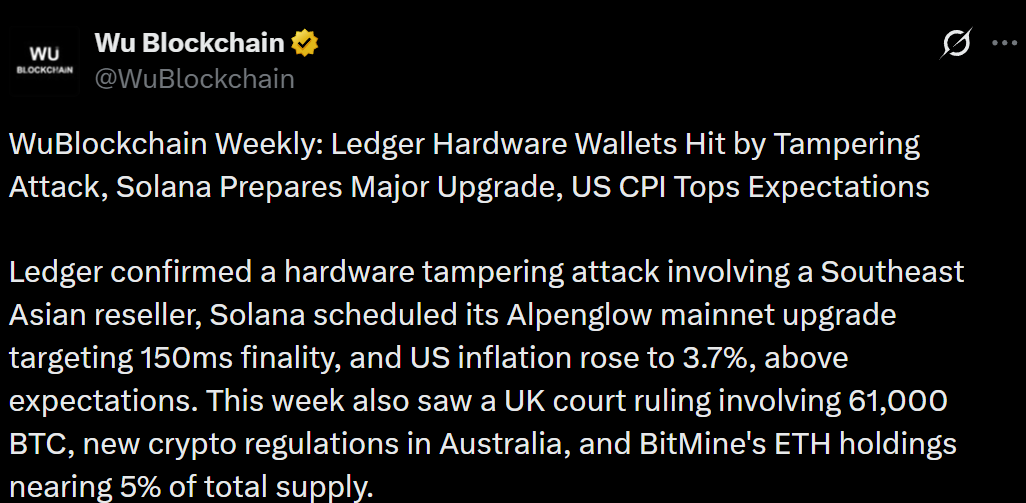
The government release itself does not publish forecasts. Traders often watch inflation closely because it shapes interest rate expectations, which can affect risky assets.
Australia Opens Consultation on New Digital Asset Laws
On October 15, ASIC began consulting on guidance and standards for new rules covering digital asset platforms and tokenized custody platforms.
The laws start on April 8, 2027, under the Corporations Amendment (Digital Assets Framework) Act 2026, per ASIC's media release.
| Item | Detail |
| Consultation paper | CP 392 |
| Laws begin | April 8, 2027 |
| Feedback deadline | 5pm AEDT, November 27, 2026 |
| Applications recorded | Over 140 |
Firms will need an Australian financial services licence, customer disclosure documents and platform rules.
They must also meet standards on holding assets, trading and settlement, and minimum financial requirements.
Commissioner Alan Kirkland said the approach follows "same activity, same risk, same regulatory outcome." ASIC also plans smoother licensing for existing licence holders.
BitMine Nears 5% of ETH Supply as Other Headlines Round Out the Week
BitMine's latest company update, covered in this crypto weekly news roundup, is dated October 11, 2026.
Per its official press release, it holds 6,028,946 ETH, or 4.9% of the 122.1 million total supply.
It bought 12,532 ETH last week and says it has bought every week since its ETH treasury plan began on June 30, 2025. About 5.07 million ETH is staked.
The same weekly roundup also listed these headlines:
-
A UK court ruling involving 61,000 BTC, reportedly applying Chinese law
-
France pushing for an EU crypto tax
-
Democrats possibly probing crypto ties
-
The Bank of England saying there is no rush for a digital pound
-
Brazil testing tokenized stocks
The Bottom Line
This crypto weekly news recap shows security, speed and regulation shaping the market.
Ledger's case is a reminder to buy carefully, Solana's upgrade could make transactions feel instant, and Australia's rules are moving toward a clear start date.
Disclaimer
This article is for educational and informational purposes only and is not financial or investment advice. Crypto assets are high risk, their prices can be very volatile, and you can lose some or all of your money. Always do your own research and consider speaking with a licensed financial advisor before making investment decisions.






