What Is Decentralized AI Inference? Research and Real Numbers


What Is Decentralized AI Inference? Research and Real Numbers
Almost every AI answer you read today was computed in a data center run by a handful of firms. Researchers now ask a simple question. Could thousands of ordinary computers do that job instead? The idea is called decentralized AI inference, and two papers give us real numbers to judge it.
One research system already ran very large models on volunteer machines, but slowly. A newer proposal tackles the harder job of checking a stranger's work.
Neither paper shows that a peer-to-peer network can match the cloud today.
What Is Decentralized AI Inference and How Is It Different?
Inference is the step where a trained model produces an answer. Training is the earlier step where the model is built. This guide covers only the first.
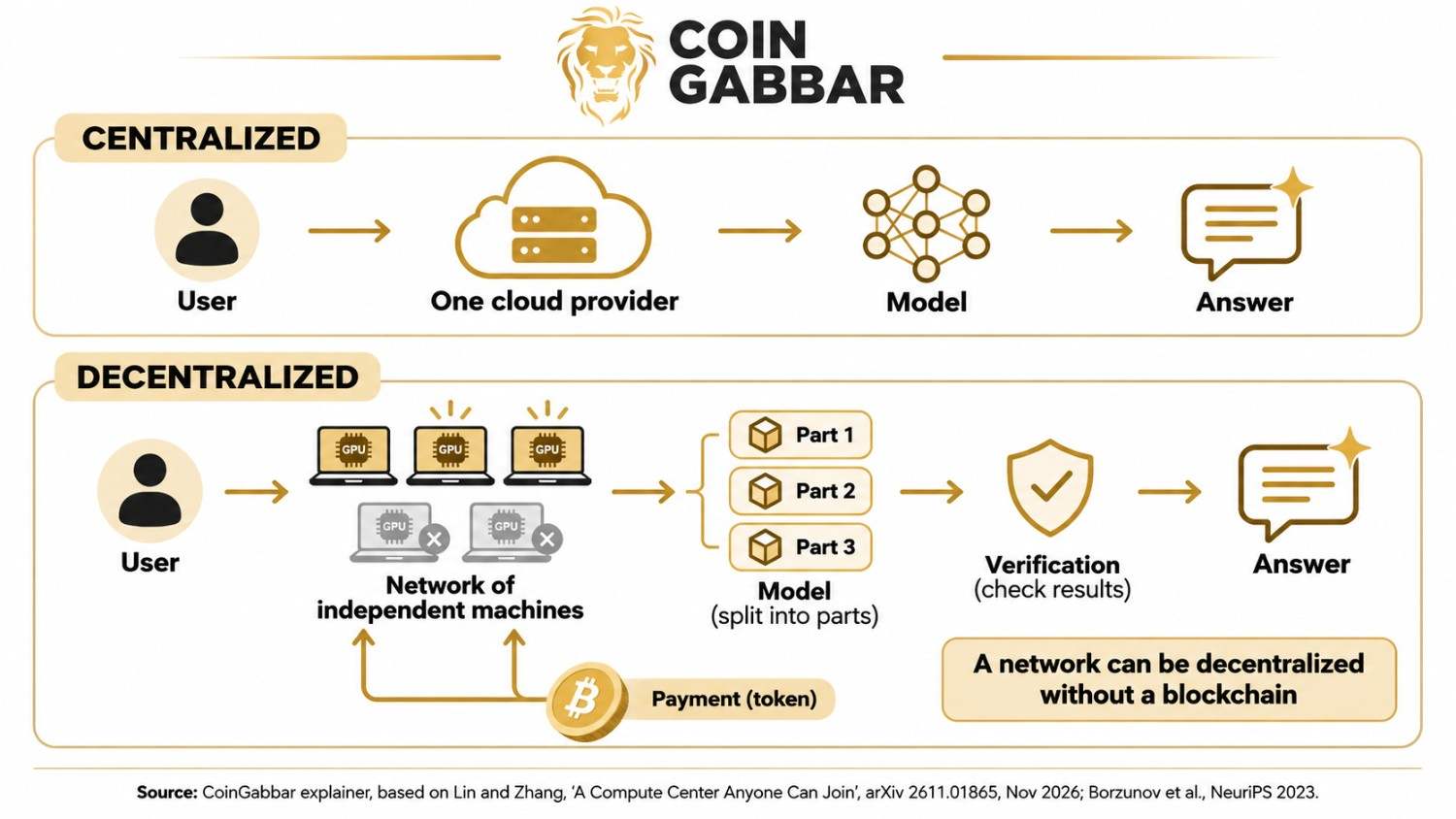
Three terms get mixed up. Distributed inference splits one job across many machines. Decentralized inference also spreads control across independent owners. A compute marketplace adds payment on top.
A network can be decentralized without any blockchain. That point matters later, when we reach payments and trust.
Why Is AI Compute Still Controlled by a Few Companies?
The Open Inference Market paper, by Yimo Lin and Zhen Zhang of Tsinghua University, starts with a plain fact. Most inference is bought from a few big data-center firms. Many privately owned GPUs sit idle.
Idle hardware is not free, though. Power and wear are real costs, as mining PC build costs guide shows.
So the test is not only whether a network can run a model. Owners must also earn more than the power costs them.
Can AI Really Run Across Computers on the Open Internet?
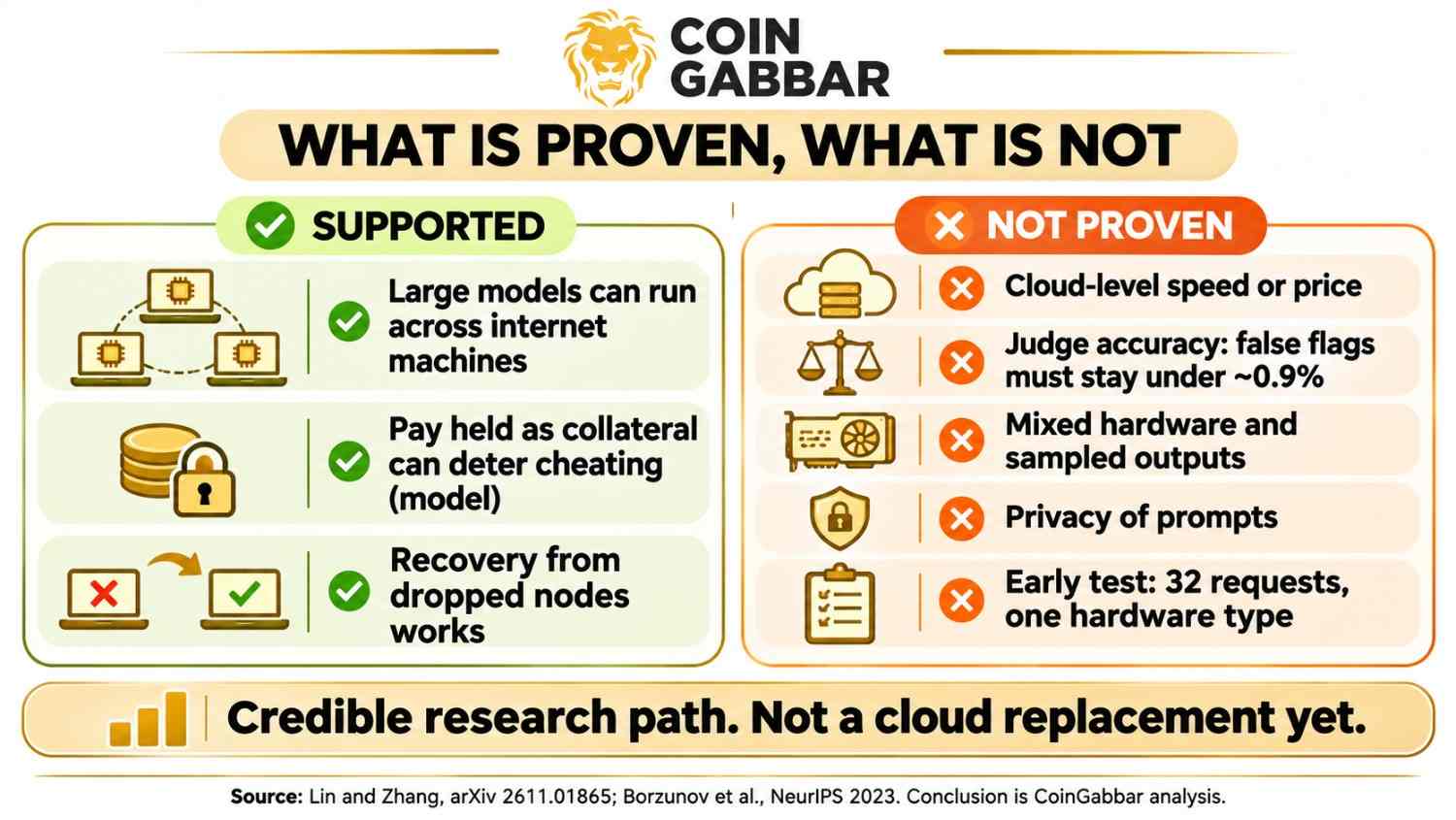
Yes, in a research setting. The Petals system, from a team including Yandex and Hugging Face researchers, ran Llama 2 at 70 billion parameters and BLOOM at 176 billion across machines on the internet.
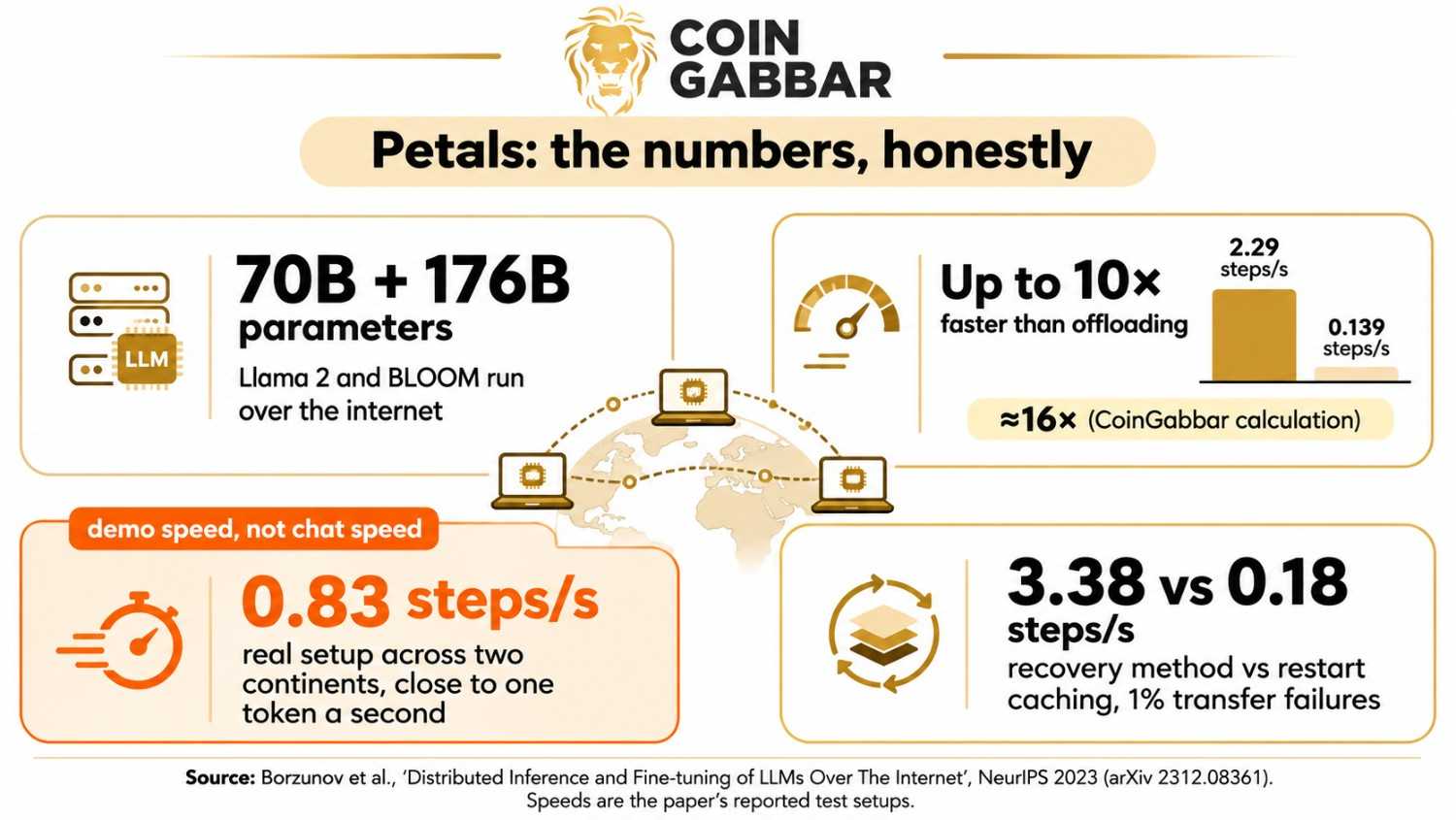
The authors report up to ten times faster generation than offloading. Offloading swaps parts of a model in and out of one machine's memory. On three T4 GPUs, one table shows 2.29 steps per second against 0.139. That is about 16 times by math.
The real-world number is the honest one. Across two continents, it hit 0.83 steps per second, close to one token a second. That is demo speed, not chat speed.
How Can a Network Check That a Remote GPU Did the Work?
Bitcoin mining is easy to verify. A block proves itself. A model's answer does not. The only sure check is to run the job again.
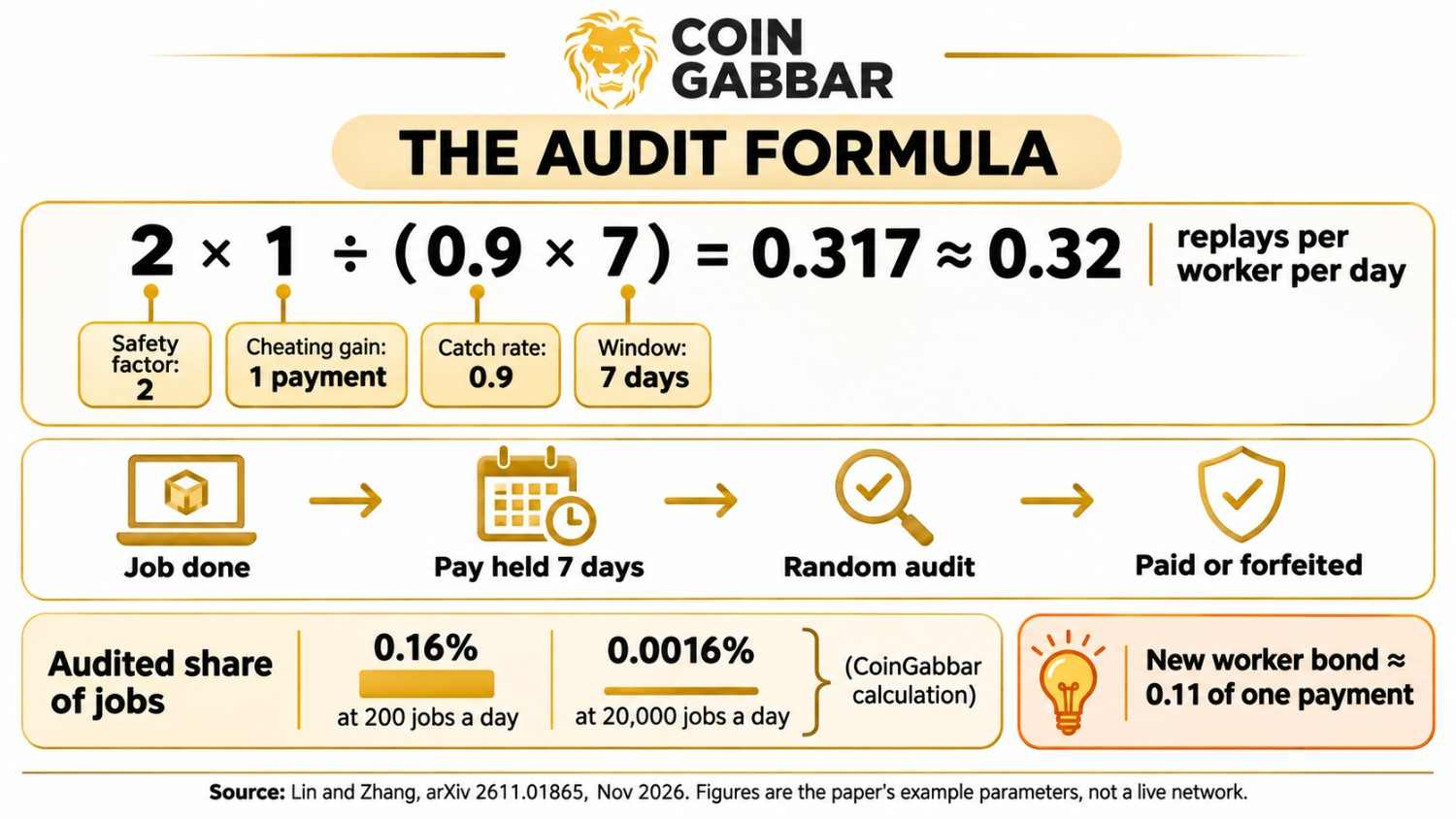
The Open Inference Market holds each worker's pay for a seven-day window, as collateral. Random audits replay some jobs. Confirmed cheating forfeits the held pay.
Its example needs about 0.32 replays per worker per day. We can check it: 2 × 1 ÷ (0.9 × 7) = 0.317. The inputs are a gain of one payment, a 90% catch rate and a safety factor of two.
How Would GPU Owners Get Paid for Serving AI?
A worker is paid per job, but the pay settles only after the window ends. A new worker would post a small bond, about 0.11 of one payment, and face more audits at first.
The audit load stays fixed per worker. So as volume rises, the audited share falls. At 200 jobs a day, 0.32 replays is about 0.16% of jobs. At 20,000 jobs, it is about 0.0016%. Both figures are ours.
Payments could run on stablecoins, as in our x402 protocol explained guide. Our DePIN crypto guide covers the wider model.
What Limits Decentralized AI Inference Today?
The audit judge must be accurate. The paper says false flags must stay under about 0.9% for a 1% income loss. Mixed hardware and sampled outputs are still unsolved.
Evidence is thin. The paper's early test used only 32 requests on one hardware type. The authors say it cannot show how devices from independent owners behave.
Privacy is a separate gap. Sending a prompt to a stranger's machine can expose it. Decentralized does not mean private.
Can Decentralized AI Compete With Cloud Providers Yet?
No paper here shows price, speed or reliability at cloud scale. We found no verified figure for idle GPU capacity or market size, so we give none.
Petals did show one useful result. When 1% of transfers failed, its recovery method reached 3.38 steps per second. Restart-based caching reached 0.18.
Watch three signs: independent operators beyond one company, published false-flag rates, and chat-grade speed.
Expert Opinion: Is Decentralized AI Ready to Replace the Cloud?
CoinGabbar analysis suggests it is a credible research path, not a cloud replacement yet.
This view rests on the Petals speeds, the audit model's stated assumptions and the thin early evidence.
The strongest idea is economic, not technical. Making cheating unprofitable matters more than making it impossible.
Disclaimer: This guide explains research. It does not recommend any GPU network token. Nothing here is promised or assured, and this is not financial, legal or tax advice. Crypto projects in this area carry high risk and volatile prices. You can lose all the money you put in. Check with a qualified adviser before you invest.