DODO DEX: How Liquidity and Slippage Affect DODO Token Risk

DODO DEX Liquidity Pools and the Risks Behind DODO Token Demand
DODO DEX is a decentralized exchange where trades run against pooled funds instead of an order book. Two things matter most there: how much liquidity a pool holds and how far one trade pushes the price.
Both decide what a swap really costs. They also shape the risk of the DODO token and the smaller assets traded beside it. A deep vault absorbs a large order quietly. A thin vault does not.
What Is DODO DEX and How Does It Work?
A decentralized exchange, or DEX, lets people swap tokens straight from a crypto wallet. Smart contracts run each trade. Liquidity providers supply the tokens that sit in every pool.
DODO DEX launched on Ethereum in 2020, and its token came through an offering on the platform itself. The official DODO website describes the project as an on-chain liquidity provider.
The pricing model is the main difference. Most crypto exchanges use a constant-product formula. DODO DEX uses the Proactive Market Maker, or PMM, which reads an outside price from oracles and concentrates liquidity near it. The team says this lowers slippage.
It also offers a swap aggregator, single-token liquidity provision, and Crowdpooling, which helps projects open a market for a new token. Details sit in the project's documentation.
How Does Liquidity Work Inside a DODO Pool?
Liquidity means how much of a token a treasury holds and how easily it trades without moving the price. More depth means steadier prices.
Standard pools spread funds across every possible price, so much capital sits idle. PMM adds a setting called k that flattens the curve near the market price. More capital than works where most trades happen.
The trade-off is oracle dependence. If the price feed lags or reports a bad number, swaps may fill at poor rates. Analyst interpretation: that dependence is a core risk of DODO DEX, not a footnote.
How Does Slippage Hit Prices on DODO DEX?
Slippage is the gap between the price a trader expects and the price a swap actually gets. It grows with order size and shrinks with pool depth.
Take illustrative numbers. A pool holds $50,000 of a token, and a $10,000 buy takes a big bite out of it. The price jumps. The same order in a fund ten times larger barely registers.
Wallets also offer a slippage tolerance setting that caps accepted price movement. Set too low, the swap fails. Set too high, the trade may fill badly and invite front-running by bots.
| Factor | What happens | Effect on token risk |
| Shallow pool | A small order moves the price. | Higher slippage, sharp swings |
| Deep fund | The order is absorbed. | Steadier price, lower cost |
| Wide tolerance | A larger price gap is accepted. | More front-running exposure |
| Oracle lag | The pool prices are off the true rate. | Mispriced swaps |
One large trade can distort the chart of a small asset. That is why liquidity data matters as much as price on DODO DEX. The same pressure often shows up in crypto presale projects once a first market opens.
How Does the DODO Token Connect to Liquidity Risk?
The DODO token covers governance votes, trading fee discounts, and crowdfunding allocations, per the project's published material. Holders can also lock tokens to mint vDODO.
The project's token economy documents list a fixed supply of one billion tokens, split like this.
| Allocation | Share | Purpose |
| Community incentives | 60% | Platform and community growth |
| Investors | 16% | Seed and private round backers |
| Core team, recruitment, consultants | 15% | Team and future hires |
| Operations, marketing, partners | 8% | Partnerships and operations |
| IDO liquidity | 1% | Initial market liquidity |
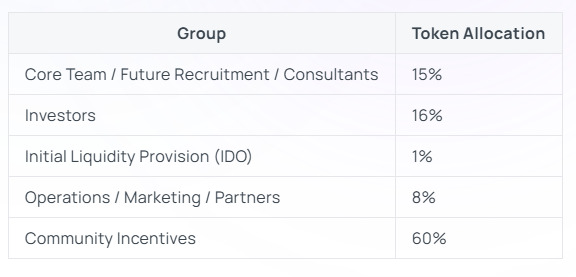
The community share is by far the largest slice. It funded liquidity mining, which pays people to deposit tokens. Rewards can pull in liquidity fast, but that capital often leaves when rewards shrink. Depth then falls and slippage rises. This is analyst interpretation, not a confirmed outcome.
Locking 100 DODO mints of 1 vDODO, which carries voting weight and a share of fee-funded buybacks. A community vote paused DODO emissions to the pool from 31 December 2023 to limit inflation.
Two figures often get mixed up. Market cap multiplies circulating supply by price. FDV multiplies the full supply by price.
The gap shows how many tokens remain locked. Exact unlock dates stay unverified here, so the official documentation should confirm them.
Which Risks Come With DODO DEX Liquidity?
Several risks sit on top of the DODO DEX pool design, and most of them trace back to how deep a pool is and how well it is priced.
-
Thin pools: Smaller pairs often hold very little liquidity. A modest trade can shove the price around, and getting out later may cost far more than expected.
-
Oracle dependence: PMM leans on outside price feeds. If a feed arrives late or reports a wrong number, the pool can drift away from the true market rate.
-
Contract flaws: Back in March 2021, a bug in the V2 Crowdpooling contracts let attackers drain about $3.8 million. The team later said it recovered roughly $3.1 million.
-
Incentive pressure: Large community rewards, plus team and investor tokens that are already fully unlocked, can add selling pressure just when a pool needs liquidity most.
-
Access limits: The official website carries a notice that related services may not be usable in some cases, and it points to the terms of service page for details.
Is DODO DEX Worth Researching Right Now?
The design has documented strengths. Supply is fixed, the exchange has operated since 2020, and the pricing model targets lower slippage. None of that makes a pool safe, and an audit never guarantees safety.
Depth varies widely between pairs, so a headline figure says little about one pool. Assets that open markets through crowdfunding often face the thinnest books, a pattern seen across new token launches.
Useful checks include pool depth for the exact pair, the oracle setup, circulating supply, upcoming unlocks, and recent governance votes. A crypto exchange listing may deepen liquidity, though it guarantees nothing.
What Stands Out About DODO DEX Risk?
DODO DEX pairs a pricing model built to cut slippage with a fixed supply of one billion tokens and a token tied to governance and fee sharing.
Less certain are pool depth under stress, oracle behavior in fast markets, unlock timing, and regional access rules. Changes usually surface first in crypto news and project updates.
Disclaimer:
This content is for information only and is not financial advice. Crypto assets are volatile and high risk, and DeFi protocols can fail. Independent research is essential before any decision.