ETH Institutional Staking Today: What It Means for ETH Holders


Ethereum and Institutional Staking: What It Means for ETH
What does ETH institutional staking mean for Ethereum? In short, a large share of ETH is locked up, and some funds now stake it through custodians. About 36.55% of the supply is staked per validator queue.
One large staked ETF held 76.4% of its ETH in staking on 30 September 2026. But more staking does not stop price falls. It is down about 26% in November.
This guide uses official filings and data pages, each with a date. Data was retrieved on 28 November 2026 at 13:40 IST (08:10 UTC). It is not a forecast. New to ETH? Read our guide to Ethereum first.
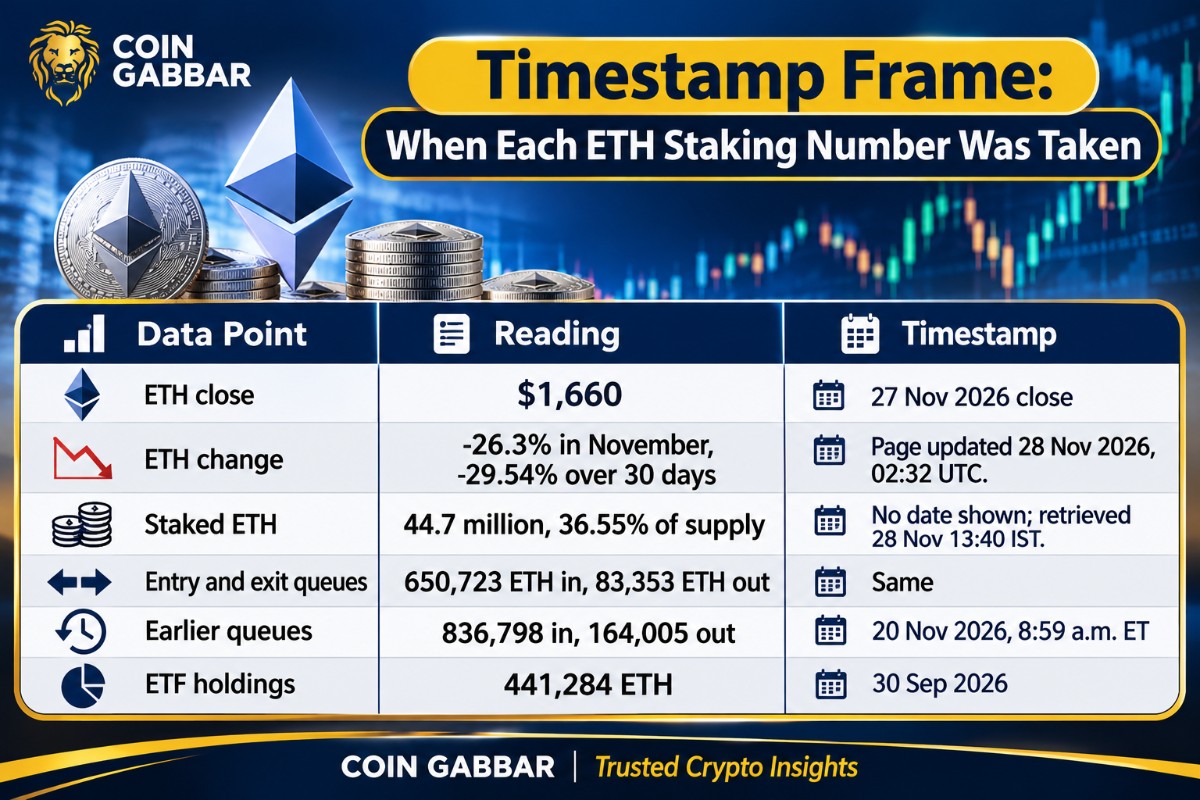
Timestamp Frame: When Each ETH Staking Number Was Taken
Data point | Reading | Timestamp | Source |
ETH close | $1,660 | 27 Nov 2026 close | |
ETH change | -26.3% in November, -29.54% over 30 days | Page updated 28 Nov 2026, 02:32 UTC. | |
Staked ETH | 44.7 million, 36.55% of supply | No date shown; retrieved 28 Nov 13:40 IST. | |
Entry and exit queues | 650,723 in, 83,353 out | Same | validatorqueue |
Earlier queues | 836,798 in, 164,005 out | 20 Nov 2026, 8:59 a.m. ET | GrowYourEthereum |
ETF holdings | 441,284 | 30 Sep 2026 |
Methodology note: ETH institutional staking totals differ by provider. Ethereum.org lists 44,188,630 ETH, 35%, and a 2.5% rate, with no data timestamp. ETH prices come from two feeds that differ slightly. I did not find a verified ETF flow figure, so none is shown.
What Is ETH Institutional Staking? Key Terms Explained
Staking means depositing ETH to run a validator, per Ethereum.org. A validator checks blocks and earns rewards. Solo staking needs at least 32 ETH. Bad behaviour can trigger slashing, which destroys part of the stake.
ETH institutional staking means funds and custodians do this at scale. They often use staking providers. Ethereum.org warns that delegated staking adds counterparty risk.
Here is a simple example. This is an illustration, not a forecast. At the 2.5% rate listed by Ethereum.org, 100 ETH earns about 2.5 ETH a year before fees. Fees, slashing, and rate changes would alter that.
This table compares the routes Ethereum.org describes. It is general guidance, not a ranking.
Route | Who holds the keys? | Main trade-off |
Solo staking | You | Needs 32 ETH and your own hardware |
Delegated staking | You hold withdrawal keys; a provider holds signing keys | Monthly fee and counterparty risk |
Pooled or liquid staking | The pool | Small amounts work, but rewards go to the pool. |
Exchange staking | The exchange | Highest trust needed |
Staked ETF | The fund's custodian | Fees and shares trade like stock. |
How ETH Institutional Staking Works Inside a Staked ETF
The iShares Staked Ethereum Trust shows how it works. Its 10-Q covers the period to 30 September 2026. Key facts:
Launch: shares listed on Nasdaq on 12 March 2026.
Holdings: 441,284, worth $1,188,766,519, which is about $2,694 per ETH by my arithmetic.
Staked: About 337,045, or 76.4% of the fund's holdings, was earning staking rewards.
Custody: Coinbase Custody Trust Company holds the ETH.
Rewards: From 14 January to 30 September 2026, the fund earned $4,261,912 in staking rewards. That figure is after provider fees.
Buffer: The sponsor keeps some ETH unstaked, so it can cover expected redemptions.
Another example is the Greyscale fund. Its fact sheet, dated 23 April 2026, shows 71% of assets staked at 31 March 2026. Staked shares vary by fund and by day.
What ETH Institutional Staking Means for Supply and Queues
Staking removes ETH from quick sale. At $1,660, 44.7 million ETH is about $74.2 billion, by my arithmetic. That is a large pool that cannot move instantly.
Queues show the flow. On 28 November, validatorqueue showed 650,723 ETH waiting to enter, about 11 days and 7 hours. It showed 83,353 ETH waiting to exit, about 2 days and 14 hours. On 20 November, the same site showed 836,798 and 164,005. So the entry queue fell about 22%, and the exit queue fell about 49%, by my arithmetic.
What does that tell us? Fewer people are queuing both ways. It does not show where ETH goes next. The same page lists 760,537 active validators and an 81,088 ETH consolidation queue of about 1 day and 4 hours. Ethereum.org says one validator can hold up to 2048 ETH, so merging validators changes the count more than the total.
Risks and Counter-Case for ETH Institutional Staking
Staking adds trade-offs. Use this checklist. It is general, not personal advice:
Counterparty: a provider or custodian may fail.
Slashing: serious faults can destroy part of a stake.
Delays: exit queues can take days.
Redemptions: the iShares trust's shares fell from 34.28 million on 30 September to 32.52 million on 31 October. That is about 5.1% lower, by my arithmetic.
Rules: the filing warns staking could be treated as an "investment contract".
Scams: fake "staking" sites target nervous holders.
Counter-case: ETH institutional staking did not shield price. ETH fell 29.54% over 30 days while about 36% stayed staked. Since the fund's first ETH purchase at $1,943.44 on 18 February, ETH is about 14.6% lower, by my arithmetic.
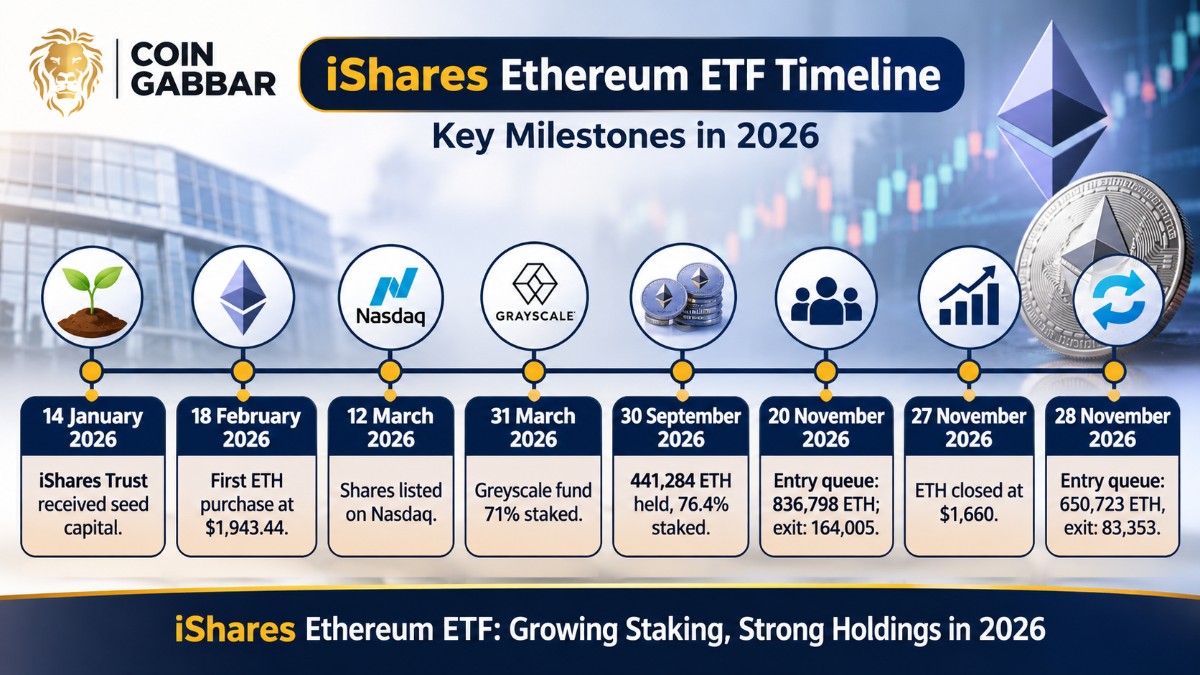
ETH Institutional Staking Timeline: What Happened on Each Date
Date | What happened? | Source |
14 January 2026 | iShares Trust received seed capital. | SEC 10-Q |
18 February 2026 | First purchase at $1,943.44 | SEC 10-Q |
12 March 2026 | Shares listed on Nasdaq | SEC 10-Q |
31 March 2026 | Greyscale fund 71% staked | Fact sheet |
30 September 2026 | 441,284 held, 76.4% staked | SEC 10-Q |
20 November 2026 | Entry queue: 836,798; exit: 164,005 | Validator queue via GrowYourEthereum |
27 November 2026 | Closed at $1,660. | ChartRow |
28 November 2026 | Entry queue: 650,723, exit: 83,353 | validatorqueue |
Expert view: Analysts who follow staking often say it makes ETH more like a yield asset. In that view, the key question is who holds the keys, not only how much is staked.
Before staking, review exchange security features and our crypto KYC guide. Our wallet guide explains self-custody, and you can follow transfers with an explorer.
Final Thoughts on ETH Institutional Staking Today
ETH institutional staking now runs partly through funds and custodians, and about 36% of supply is staked. Yet the price fell anyway. Read each fund's filing, expect queues and fees, and never invest more than you can afford to lose.
Disclaimer: This article is for education and information only. It is not financial or investment advice and makes no price prediction. Crypto is volatile, and staking carries risk. Data changes, so verify everything on official pages before you act.