Ethena Defends USDe Mint and Redeem Design Amid AML Concerns

Ethena Explains Its USDe Mint and Redeem Gate After AML Reports
In the latest crypto news from the stablecoin sector, Ethena said on November 19, 2026, that USDe mint and redeem has been permissioned, whitelist-only, and KYB/C-gated since day one. KYB/C means Know Your Business and Know Your Customer checks.
The update followed reports of illicit actors, including North Korea-linked groups, moving funds through a Peg Stability Module run by another on-chain dollar issuer.
The official statement on X says nobody can use the contract without passing KYB/C screening first. Each market maker and client is checked for sanctions and anti-money laundering (AML) risk, on-chain and off-chain, before access is granted.
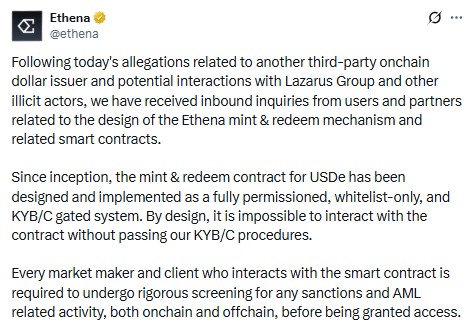
It gave two reasons. Letting only known entities use the most sensitive part of the system lowers attack risk. It also keeps the protocol away from sanctioned parties. Ethena says Tether and Circle have used a similar model for over a decade.
Ethena admits the gate is less attractive to some users and has hurt it against permissionless DeFi products. Even so, it says it has never considered an open design for USDe mint and redeem.
How Whitelisted Users Handle USDe Mint and Redeem Orders
Per the How USDe Works documentation, a whitelisted user who supplies about $100 of USDT gets about 100 new USDe, minus gas and execution costs. The protocol then opens a short perpetual position of about the same size. A perpetual is a futures contract with no expiry. The short offsets price swings. Ethena says it earns no profit from minting or redeeming.
The backing assets go straight to an off exchange settlement provider such as Copper or Ceffu, the backing asset custody page explains. Exchanges only receive delegated assets to margin the hedges. Custody is never handed over.
The regulated custodians that hold this collateral have their own compliance duties, and Ethena must make KYB/C claims to use them. It argued that exposing them to illicit funds would be unacceptable. Weak AML controls could also spread risk through shared collateral pools.
Who Can Join the Mint User List and Who Is Excluded
Direct access starts with signing up as a Mint User with Ethena BVI Limited under the USDe Mint User Agreement. Applicants give accurate identity or company details and name a wallet address for the whitelist. They must also accept ongoing AML and sanctions checks. Extra due diligence can be required.
The agreement, last updated in August 2025, says users in the United States are not eligible. It also bars restricted persons and residents of restricted territories, and North Korea is on the prohibited list. It can suspend or end Mint User status for violations or missing information.
| Group | Direct USDe mint and redeem? | Basis |
| KYB/C-cleared, whitelisted Mint Users | Yes | Mint User Agreement |
| Users in the United States | No, currently ineligible | Mint User Agreement |
| Restricted persons or territories | No | Mint User Agreement |
| Other USDe holders | No direct route; trade on open markets | Ethena statement |
Where Regular USDe Holders Can Still Buy and Sell
The issuer stressed that the limit covers only USDe mint and redeem. Tokens already issued still trade on automated market makers such as Curve, Uniswap, and Balancer. They also trade on centralized exchanges.
In practice, the gate decides who can enter and exit the primary channel. It does not decide who can hold or trade the token afterward. This is a reading of the design. The statement covers the contract, not every USDe transfer.
What the Ethena Statement Does Not Settle Yet
The statement is the issuer’s own account of its USDe mint and redeem controls. The reports it answered have not been independently verified here. Docs and legal terms can also change, so check the live docs before relying on any detail.
More stablecoin compliance news sits in the latest crypto updates.
Disclaimer: This article is for information only and is not financial advice. Stablecoins and synthetic dollars carry risks, including losing their peg and counterparty risk.






