Ethereum News: Foundation Backs Keccak-256 for Post-Quantum Security

Ethereum News: Foundation Backs Keccak-256 for Post-Quantum Security
This Ethereum News update comes from the Ethereum Foundation's research post "PQAI #1: One hash to rule them all," published November 24, 2026 at 10:00 PM UTC (official blog). The Foundation recommends keeping Keccak-256 as the hash function for Ethereum's hash-based post-quantum cryptography.
A hash function turns data into a short digital fingerprint. If it breaks, everything built on it breaks too. This is a research recommendation. It is not an approved EIP or a confirmed network upgrade.
At a Glance
-
The Ethereum Foundation (EF) recommended keeping its current hash function on November 24, 2026.
-
The goal is post-quantum security, backed by the hash's long track record.
-
Poseidon, BLAKE3, BLAKE2 and SHA2-256 were also considered.
-
It is a research recommendation only, and no upgrade is approved.
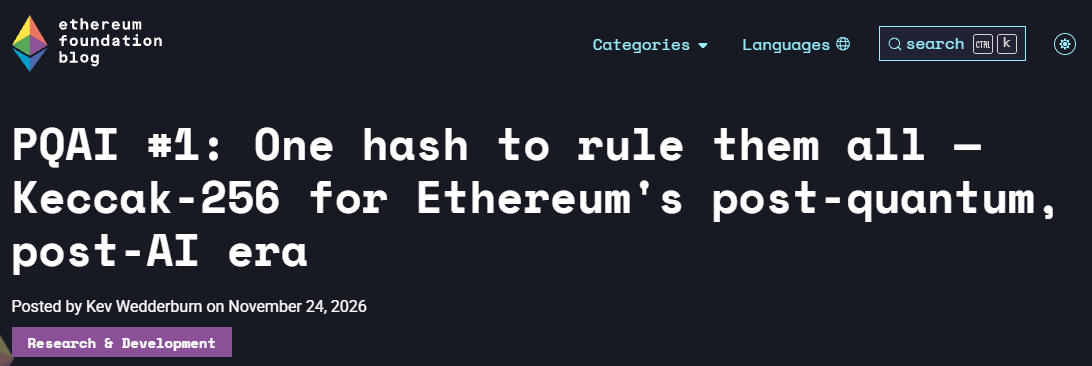
Source: Ethereum Foundation Blog Post on 24 November at 10:00 PM UTC
Why Is the Ethereum Foundation Recommending Keccak-256?
Security Takes Priority Over Speed
This hash has nearly two decades of cryptanalysis behind it. The Foundation wants a hash that can protect Ethereum for decades. It accepts that the hash is slower to prove than BLAKE3 and slower natively than SHA2-256.
Zero-Knowledge Proof Advances Changed the Decision
Zero-knowledge proofs let a network check work without redoing it. For years, standard hashes were too costly to prove inside a zkVM, so ZK-friendly options like Poseidon looked necessary. Binius, Flock and GKR-based provers have now eased that problem. The Foundation says leanVM proves above 500,000 Keccak-f permutations per second, enough for its aggregation target.
Keccak-256 vs Poseidon, BLAKE3 and Other Hash Functions
The Foundation compared five functions before making its pick:
-
Keccak-256: Nearly two decades of cryptanalysis support it.
-
Poseidon and Poseidon2: Built for efficient ZK proofs, but attacks on reduced versions raised concerns.
-
BLAKE3: Fastest to prove, but has limited cryptanalysis.
-
BLAKE2: Established and fast, but less studied.
-
SHA2-256: Widely used, but its design allows length extension, so protocols need extra care.
Neither Poseidon nor BLAKE3 is broken. The Foundation sees no reason to wait for their analysis to mature when proven hashes are fast enough. Keccak-256 and SHA3-256 share one core permutation and differ only in padding.
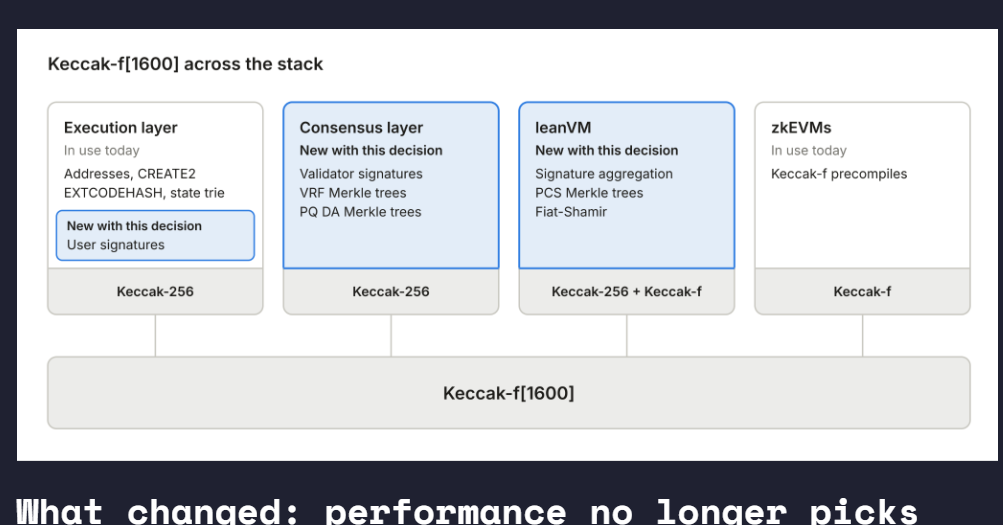
Source: Blog post
How Will It Support Ethereum's Post-Quantum Security?
Role Across the Technical Stack
The proposal covers the execution layer, consensus layer, leanVM and zkEVMs. Uses include signature verification and blob data commitments. The wider Keccak family also supports Fiat-Shamir proofs and key derivation.
Why Ethereum Prefers Existing Infrastructure
Ethereum already uses this algorithm for addresses, execution-layer state and the KECCAK256 opcode. Reusing it may cut implementation and audit work for client teams. It also shows a wish to avoid adding a third general-purpose hash.
What Changes for Developers and Clients?
Nothing is final. The EF says:
-
Execution-layer clients can reuse current code for signature verification.
-
It suggests the same function if SSZ reaches the execution layer.
-
Consensus-layer clients already use it for discv5 node IDs.
-
It recommends moving SSZ Merkleization from SHA2-256 to Keccak-256 over the long term.
What Does This Ethereum News Mean for ETH Price Today?
According to CoinGecko at 08:00 UTC on November 25, 2026, the Ethereum price is $1,639.77, down 3.2%. Market capitalization is about $200.27 billion. The 24-hour trading volume is about $10.15 billion. This is a long-term technical development. It should not be treated as the cause of the short-term price move.
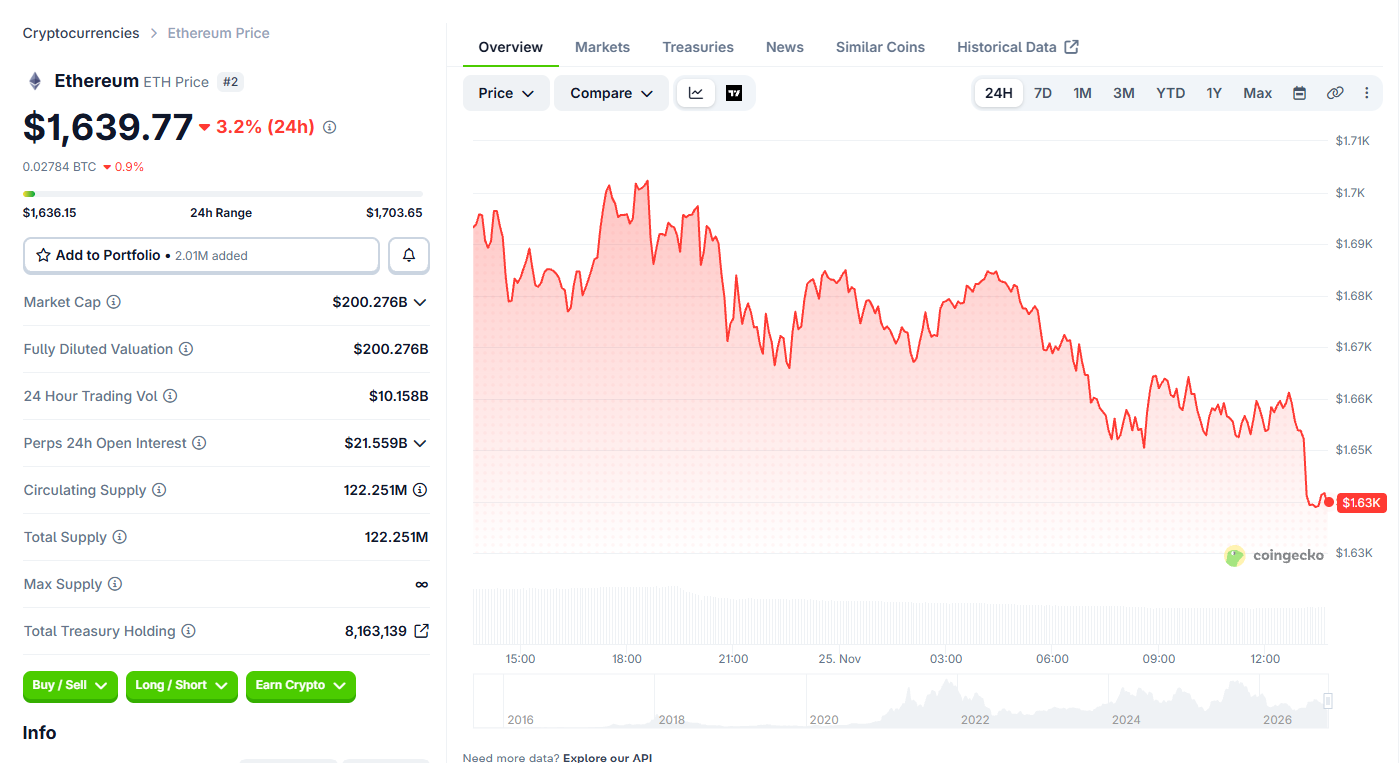
Source: CoinGecko Data on November 25, 2026 at 8:00 AM UTC
Conclusion
In this Ethereum News update, the EF prefers this algorithm for its long security record. Better proof-generation technology made that choice practical. Security and long-term reliability remain the central goals.
Further research and implementation decisions will determine how this recommendation translates into real development. Readers can follow Ethereum upgrade coverage and Ethereum security news on CoinGabbar.
Disclaimer: Cryptocurrency prices are volatile. Technical research does not guarantee future price performance. This article is for informational purposes only and is not financial advice. Do your own research before investing.


Frequently Asked Questions (FAQ)




