EU Tokenisation Standards Group: Who Will Set On-Chain Finance Rules?


EU Tokenisation Standards: Who Will Shape On-Chain Rules?
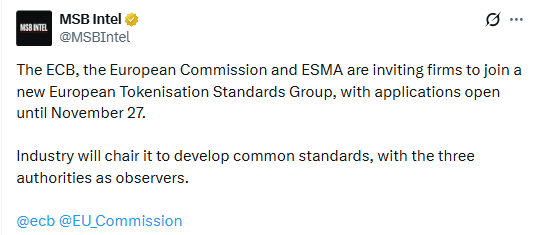
Europe is moving to write one rulebook for on-chain finance. The ECB, the European Commission and ESMA want industry to help build it.
This report on EU tokenisation standards uses ESMA's announcement of November 9, 2026 and the group's mandate. It's current as of November 11, 2026.
 Source: X(formerly Twitter)
The standards won't be law.
What Is the New Group and Who Can Join?
The European Tokenisation Standards Group (ETSG) is industry-led. Its members appoint a chair and co-chair. The ECB, the Commission and ESMA sit as permanent observers.
Tokenised assets are financial instruments recorded on distributed ledger technology (DLT), a shared digital database. The group targets wholesale markets, meaning institutions, not retail users.
Applications close on November 27, 2026, through an online form. Associations, private firms, fintechs, technical providers and public bodies can apply.
Applicants must meet three tests:
Expertise: technical or business standardisation experience
Presence: an entity with a European presence
Commitment: time to take part and authority to commit their organisation
The three authorities pick members jointly, and no stakeholder group should dominate. Applying doesn't guarantee a seat. The group is envisaged to start in January 2027.
Questions go to ETSG@ecb.europa.eu. Selected and unsuccessful applicants both receive feedback.
What Will the Group Actually Cover?
The mandate's aim is end-to-end interoperability. That means separate DLT platforms and older systems can work together. Fragmentation is the problem it targets.
Area | What the mandate says |
Interoperability | Define it, list existing standards, find gaps |
Settlement and holding | Agree common standards for DLT instruments |
Monitoring | Build a framework to track use of the standards |
Incentives | May recommend compliance measures to EU authorities |
The mandate doesn't mention transfers separately. Members decide by consensus under ISO rules, and the ECB publishes panel documents by default.
Proposed changes to the DLT Pilot Regime would also create an industry standards panel. That work may be done jointly with ETSG.
Initial standards linked to the Appia roadmap are due by early 2028. That's a target, not a finished rule.
EU Tokenisation Standards: How Do They Fit With MiCA and Appia?
Initiative | What it concerns |
ETSG | Common standards for tokenised wholesale markets |
Appia | Eurosystem roadmap for tokenised wholesale finance, blueprint due 2028 |
Pontes | Launched September 21, 2026; settles tokenised assets in central bank money |
MiCA | EU crypto-asset law; not mentioned in the mandate |
Digital euro | Retail digital cash; pilot planned for 2027 |
These EU tokenisation standards don't replace or amend MiCA. They don't launch a digital euro either. The group can recommend, not legislate.
Pontes is already live. Its first participants include Deutsche Bank, Santander and Clearstream.
Possible outcomes, not established results:
Possible benefit | Possible challenge |
Fewer isolated platforms | Consensus across industries may be slow |
Easier institutional RWA adoption | Compliance could raise costs |
Better links to existing infrastructure | Smaller providers may struggle |
The Bottom Line
This review of EU tokenisation standards finds a real institutional push and a planned process, not a finished rulebook. The documents don't address non-EU markets, so any effect on Indian RWA investors would be indirect.
Watch the member list and the first outputs.
YMYL Disclaimer: This article is for informational purposes only, not financial, legal, or investment advice. It is based on official EU and ECB sources reviewed as of November 11, 2026. ETSG timelines are provisional, and the group cannot legislate. Tokenised and crypto assets carry a risk of loss, including total loss. Verify details through official sources before making decisions.






