European Central Bank Seeks Tokenized Deposits Partners


The European Central Bank is looking for partners to test tokenized deposits, according to an invitation it published on November 20, 2026 under its Appia initiative, which aims to design a joint European Digitized financial system.
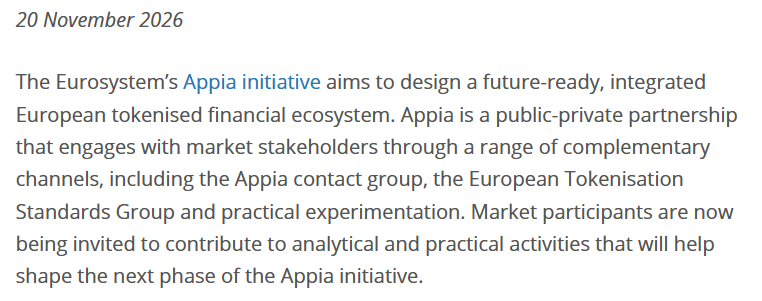
This report explains what the call covers, who can apply, and why it matters for crypto and blockchain finance in Europe.
Key Takeaways
The European Central Bank is inviting market groups to join its Appia work on tokenized deposits, securities, and shared network governance.
Applications for the first experiments are due by December 11, 2026, at 12:00 CET.
Firms must apply as part of a group, not on their own.
The call is for analysis and experiments, which is not a product launch.
What Is the European Central Bank Asking Market Groups to Do?
The ECB says market participants are now invited to join analytical and practical activities that will shape the next phase of Appia, which it describes as a public-private partnership, in its official announcement.
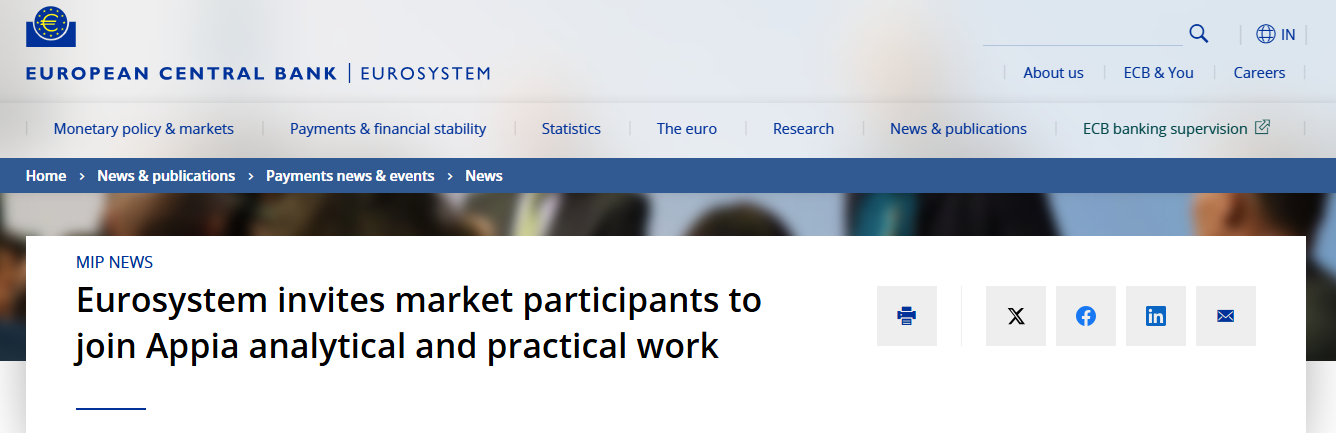
The invitation covers three "design streams": tokenized deposits and related payments, Digitized securities, and shared network governance, which means the rules for how a shared blockchain-style network would be run.
Who Can Apply and When Is the Deadline?
According to the same ECB announcement, anyone who wants to join one or more streams must apply as a member of a group rather than alone, and first-round applications are due by 11 December 2026 at 12:00 CET.

Later applications will be reviewed on a rolling basis, and each stream has its own requirements, so groups should read the annex for the stream they want before they apply.
What Are Tokenized Deposits in Simple Terms?
A tokenized deposit is a normal bank deposit that is recorded as a digital token on a shared network, so it can move between parties faster while still being a claim on a bank.
This is different from a typical stablecoin, which is usually issued by a non-bank firm and backed by reserves, and it is one reason regulators and banks are testing the idea before any wide rollout.
Why Does the European Central Bank Care About Tokenized Markets?
The ECB published its Appia roadmap on 11 March 2026 and describes Appia as a strategic initiative to shape a European Digitized financial system in which central bank money keeps a pivotal role.
It says the aim is integrated, innovative, and resilient Digitized wholesale markets, which are the markets where banks and large firms trade with each other.
What Should Crypto Readers Watch Next?
Readers following the European Central Bank's work can watch for three things: the December 11 deadline, any ECB update on which groups take part, and any new rules on how tokenized assets are treated in Europe.
The Bottom Line
With the European Central Bank asking industry groups to test deposits, the next step is for groups to form and apply by December 11. This is a call for experiments rather than a launch, so it shows the direction of travel and not a finished product.
Disclaimer: This article is for information only and is not financial or investment advice. Crypto assets carry risk, including the loss of funds, so verify current details with official sources.






