Filecoin Private Share Skill Lets AI Agents Send Encrypted Files

What Is the Filecoin Private Share Skill for AI Agents?
Crypto news update: the Filecoin private share skill lets an AI agent encrypt a file or folder, store it on the network, and share it with one person. The recipient needs two items to open it, a share link and a separate access key.
Filecoin said on X on Nov 20, 2026, that password-protected links are now live and pointed users to the new skill.
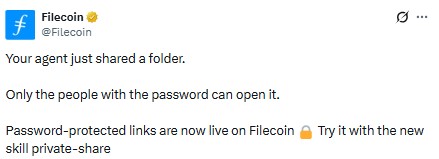
The official Filecoin post frames it as an agent that shares a folder, which only people with the password can open.
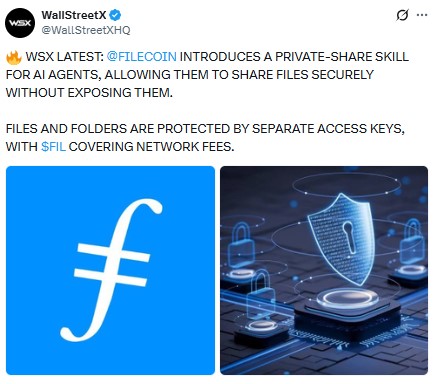
WallStreetX also covered the launch. It said files and folders are protected by separate access keys and that $FIL covers network fees. The fee detail comes from that post; the project's blog does not state it.
How Filecoin Private Share Encrypts and Shares a File
The skill is listed on skills.sh, the directory that hosts it. It uses the filecoin-pin command line tool to encrypt the content, store it on the network (mainnet by default), and return the share details. It can also open a share that someone else sent.
The skill page shows passes from three security scanners: Gen Agent Trust Hub, Socket, and Snyk. Those are scans of the skill itself, not a review of the encryption design.
The encryption comes from the new privacy tools in the Filecoin Synapse SDK, which the Filecoin blog announced on Nov 19, 2026. Two components do the work: the Filecoin Encryption Envelope and Keysmith.
Key creation: The user's wallet makes the key after one approval. Each file gets its own key, and keys are not stored on the network.
Local locking: Data is encrypted on the device before upload. Storage providers hold it and prove they still have it, but they cannot read it.
Tamper checks: A file altered in storage will not open. The same wallet can rebuild the key on a new device.
The project contrasts this with central key services, which make and keep everyone's keys. Here, the user's crypto wallet acts as the user's own key maker.
Share Link and Access Key: What the Recipient Needs
The blog advises sending the link and the key through different channels, such as the link by email and the key by message. That way the link alone opens nothing.
The person receiving the share does not need a wallet, an account, or special software. The file opens in a browser, according to the blog. Developers can follow the encryption guide for setup details.
Item | What it is | How to send it |
Share the link. | Carries a #v1 marker, per the skill page | Email, for example |
Access key | Starts with fak1_ | A separate channel, such as a message |
Wallet | Used by the sender to make the key | Never shared |
Anyone who holds both pieces can open the file. Sending them together in one message weakens the protection.
Why the Filecoin Private Share Skill Matters for AI Workflows
The blog says agents already store and publish their work on the network. The new skills let them do it privately with a single request, such as asking an agent to share a report privately with a colleague.
The project lists several safeguards that matter when an agent handles private files:
Nothing is saved or shared unless the user asks.
Keys never pass through the chat.
A full transcript is shared only if the user opts in.
A restored handoff is treated as information, not instructions.
A companion skill, session-share, saves a private summary of an agent's work. A teammate or another agent can then continue on another machine. Both skills sit under the Filecoin GitHub repository for agent skills.
The project names IT and security teams, finance companies, and groups sharing documents with auditors as likely users.
What the Launch Means for FIL, Storage, and Readers
The blog does not discuss FIL price or token demand, so no price effect should be assumed. The practical change is that sensitive files can sit with independent providers while the user keeps the keys.
Some details need a recheck. The Nov 19 blog described the agent skills as coming soon, while the Nov 20 X post called the feature live. The skill's preview status and fee details should be confirmed on Filecoin's own pages.
Readers who try the Filecoin private share skill should follow the official instructions and test with a non-sensitive file first. For more crypto currency news on storage and AI agents, check back for updates.
Disclaimer: This article is for educational and informational purposes only and should not be considered financial or investment advice. Always conduct your own research before making investment decisions.






