Float Token Airdrop: How Traders Can Take Part and Get Paid in USDC


Float Token Airdrop: How to Trade, Qualify and Receive USDC
Float runs a recurring airdrop for traders. A fixed 30% of every standard coin’s fee goes into a vault, turns into USDC and is sent to the wallets with the highest trading volume. This guide covers the Float token airdrop from start to finish: how to take part, who qualifies and how a payment can be checked on-chain, using the project’s official docs and airdrops page.
Key Takeaways
Float airdrops reward trading volume on Float coins, and they are paid in USDC.
Trades count on any Solana terminal, and bots, wash trading and volume bots are excluded.
Each payment can be traced on Solscan, but the Float program has no outside audit yet.
About Float
Float is a Solana launchpad where every new coin is paired with another token. The partner can be a tokenized stock such as NVIDIA or Tesla, a pre-IPO name, a privacy coin like ZEC or XMR, or plain SOL or USDC.
Launches run on Raydium LaunchLab. Each coin has a fixed supply of 1,000,000,000 with no mint or freeze authority, and it starts near a $20,000 market cap. A creator can make a first buy inside the launch transaction itself, capped at 2% of supply, so nobody can buy ahead of them. The price follows a bonding curve as people buy. At about 7.5x, close to $150,000, the coin graduates, and its liquidity moves into a Raydium pool that is locked forever through Burn & Earn.
Source: official website.
Float Launchpad Airdrop: Where the Money Comes From
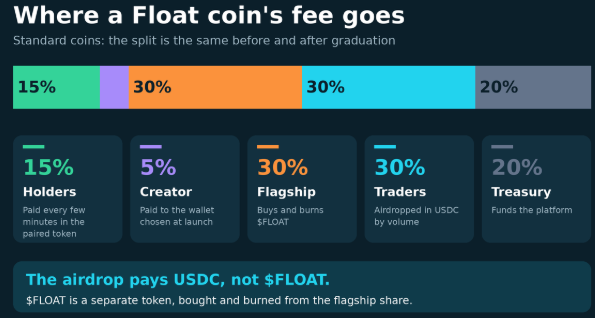
Creators pick a trading fee of 1%, 2% or 2.5% per buy and sell. After Raydium takes its part, Float splits the rest the same way for every standard coin:
Share | Goes to | Paid as |
15% | Holders | Paired token |
5% | Creator | Paired token |
30% | Flagship | Buys and burns $FLOAT |
30% | Traders | USDC airdrop |
20% | Treasury | Platform funding |
Fees pile up in Raydium’s vaults until someone presses “Cycle fees” on a coin’s page. Anyone can do it, and the payout bot does it automatically.
How to Take Part in the Float Airdrop
Taking part needs no sign-up form. Volume on Float coins is what counts:
Set up a Solana wallet and fund it. The airdrop is sent to the wallet that trades.
Browse coins on floatlaunch.xyz and pick any listed Float coin.
Trade it on the terminal of choice, such as Axiom, GMGN or Jupiter. Every terminal counts.
Check the leaderboard on the Analytics page. It shows each wallet’s estimated share and when the next airdrop goes out.
Wait for the snapshot. The USDC is sent straight to the trading wallet after the list is reviewed.
Each round counts volume from the previous round’s snapshot onward. The first round paid the top 100 wallets and the second paid the top 250. Later rounds are announced on X, so list sizes and dates can change.
Float Airdrop Eligibility
Ranking follows volume, but some activity never counts:
Bots, meaning wallets with more than 300 trades in an hour, or more than 100 an hour in five or more different hours.
Wash trading and volume bots.
Trades on a newly added pair, which start counting 7 days after the pair is added.
Trades by a builder coin’s own creator and builder wallets.
Only coins listed on the Float site feed the airdrop. Coins launched on Float’s public Raydium tiers by other apps do not get the fee split.
Float Airdrop USDC: How the Payout Works
The traders’ share collects in one vault and is swapped to USDC as it arrives. At snapshot time, it is divided among wallets in proportion to their volume. Builder coins use a different split: half of the fee goes to the builder, 15% to airdrops, 15% to the buyback and 20% to the treasury.
Float Token Airdrop vs $FLOAT: What Gets Paid
The airdrop pays USDC. The $FLOAT token is separate, and no $FLOAT giveaway appears in the official docs. Anyone seeing a claim otherwise should check the project’s X account before connecting a wallet.
Is There a Float Holder Airdrop?
Holders earn through a different channel. Every few minutes, a payout bot sends each coin’s 15% holder share to its holders in the paired token. That is a reward for holding, not an airdrop. A wallet’s token account is created automatically once it is owed at least $2, and a holder who sells before a payout loses what was still owed.
$FLOAT Buyback and Burn Explained
$FLOAT is the flagship token, launched separately on Raydium LaunchLab. The 30% flagship share is swapped to SOL and spent buying $FLOAT, which is then burned on-chain. Buys happen at about 5 SOL, or whatever has built up after four hours, and no single buy can move the price by more than 1%.
Source: official documentation.
How to Verify Float Airdrop Payments
Anyone can check the trail without trusting a screenshot:
Open the airdrop vault (JEK3Wr…3y3snH). It belongs to the Float program, and no one holds its key.
Open any payment listed on the airdrops page. The USDC leaves the vault and lands in the trader’s wallet in the same transaction.
Look at the sending wallet (6LYf…fw6E). It only signs, and the USDC never comes from its own balance.
Compare the leaderboard and each wallet’s estimated share on the Analytics page.
The airdrops page lists every payment with its transaction, so past rounds can be reviewed too. The Burns page works the same way for buybacks, and every buy links to its transaction.
What Volume Really Costs
Every trade pays the creator’s 1% to 2.5% fee, and that fee is what funds the airdrop. Chasing volume therefore has a real price. Nothing guarantees that a payout will exceed the fees a wallet paid.
Other risks apply too. When fees are cycled, a trader who moves the price just before can take up to about 2% of that swap, because the program swaps between tokens with a price guard. Float coins are highly speculative, and most lose value. Tokenized stocks come from third-party issuers who can pause transfers. The Float program has no outside audit yet, and upgrades need two of three keys on a Squads multisig.
Final Thoughts
A Float token airdrop is a USDC reward for real trading volume, funded by a fixed 30% of fees and checkable on-chain. Dates, list sizes and amounts change from round to round, so readers should confirm the current round on the official site before acting.
Disclaimer: This article is for information only and is not financial advice. Crypto is volatile, so readers should do their own research before they buy, trade or hold any token.
















