What FOMC Meeting Minutes Say About December Rate Hike and AI Risks?

Fed Holds at 3.75% to 4%, but FOMC Meeting Minutes Hint at More Hikes
The Federal Reserve released the FOMC meeting minutes from its October 27 to 28 session on November 18. The document shows a central bank that held rates steady but is not relaxed about rising prices.
Almost all officials said more rate increases would likely be appropriate. They also spent significant time on the debt behind the AI boom.
Most participants backed a hold in October, yet some wanted an immediate hike. The result is a cautious policy outlook and growing worry about financial stability.
At a Glance
-
The Fed kept the federal funds rate at 3.75% to 4.00% in October.
-
The decision passed 10-to-2.
-
Two officials preferred a 25 basis point hike.
-
September PCE inflation was estimated at 3.6%, and core PCE at 3.1%.
-
Almost all officials saw further hikes as likely appropriate under their baseline outlooks.
-
Officials flagged AI-related debt, hedge fund leverage and possible forced selling as risks.
Fed Minutes Reveal Divided Views on Interest Rates
The Committee voted 10 to 2 to hold the target range at 3.75% to 4.00%. Lisa D. Cook and Beth M. Hammack dissented. Both preferred a quarter point increase.
So why hold when inflation is elevated? Many of the officials who backed the hold said they wanted more information first. They pointed to the need to judge how durable AI investment demand is, how financing conditions are changing, how the September rate increase is working through the economy, and where geopolitical events are heading.
Several participants also noted that markets already expected tightening in December and next year. That reduced the risk of waiting. Still, a few called the decision a close call. Many stressed that the hold did not signal a weaker commitment to getting inflation back to 2%. The Fed’s own statement says it “will deliver price stability.”
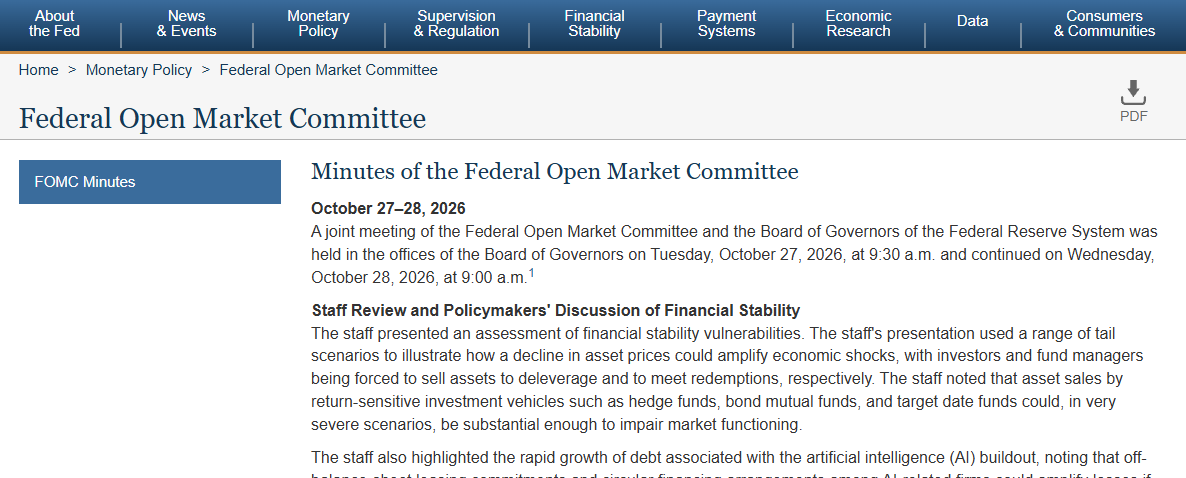 Source: Federal Reserve, Minutes of the FOMC, October 27 to 28, 2026, released November 18, 2026
Inflation Remains Above Target as Officials Consider More Rate Hikes
Staff estimated that September PCE inflation rose to 3.6%, helped by rapid gains in energy prices. Core PCE, which strips out energy and many food prices, edged up to 3.1%. Both sit well above the 2% goal.
The minutes name several drivers. These include earlier tariff increases, high energy costs, and demand tied to the AI buildout, which is straining supply and lifting prices of tech-related goods. Most participants said price pressures were broad-based. Some worried that a long stretch of above-target inflation could become built into what households and businesses expect.
| Indicator | Latest Figure | Fed’s Assessment |
| Headline PCE inflation | 3.6% | Elevated |
| 3.1% | Above target | |
| Fed inflation target | 2% | Policy objective |
| Unemployment rate | 4.2% | Broadly stable |
| Monthly payroll gains | About 50,000 average | Reasonably broad-based |
| Federal funds rate | 3.75% to 4.00% | Maintained in October |
These are estimates available to policymakers at the October meeting, as described in the minutes.
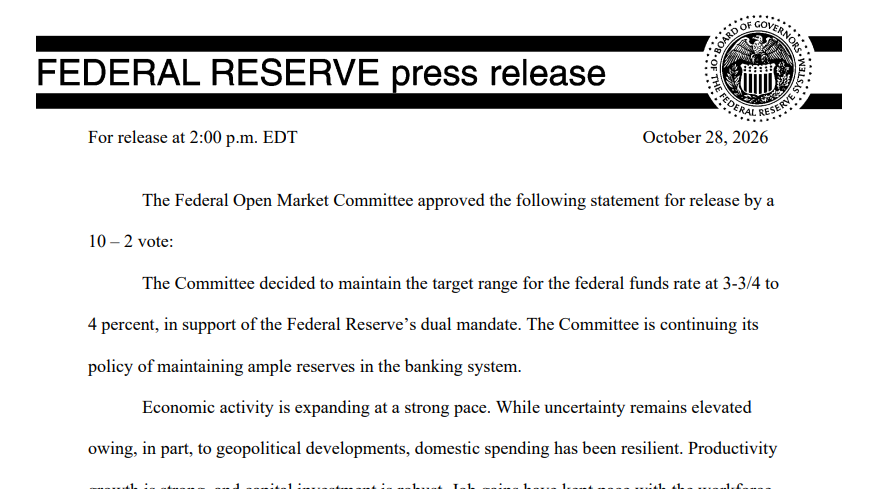 Source: Federal Reserve Press Release
December Fed Rate Hike Outlook: What Officials Signaled
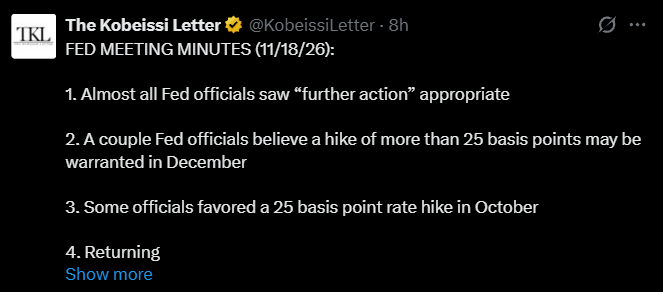
This is the part of the FOMC meeting minutes that markets will watch most closely. Almost all participants said that under their baseline outlooks, further increases would likely be appropriate to bring inflation back to 2% in a timely way. Some favored raising rates in October.
A couple of participants said a move of more than 25 basis points could be considered at the next meeting if inflation data come in unfavorably. A few added that inflation could prove more persistent than expected.
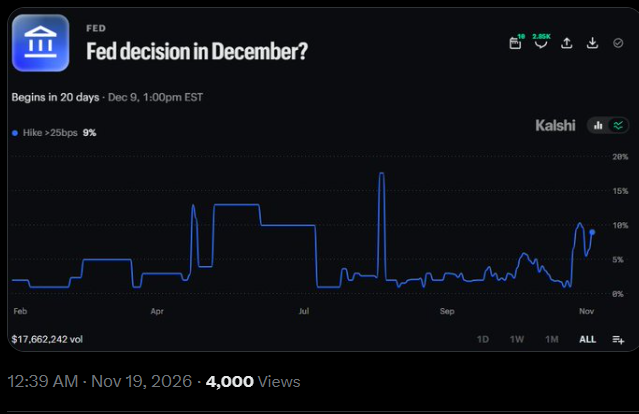
Market pricing was close to this view. Futures showed a high probability of a quarter point hike by year-end. The Desk survey median expected a fed rate hike in December and another in March 2027.
The minutes do not confirm a December hike. Officials said future decisions would depend on incoming data and the balance of risks. The next meeting is December 8 to 9, 2026.
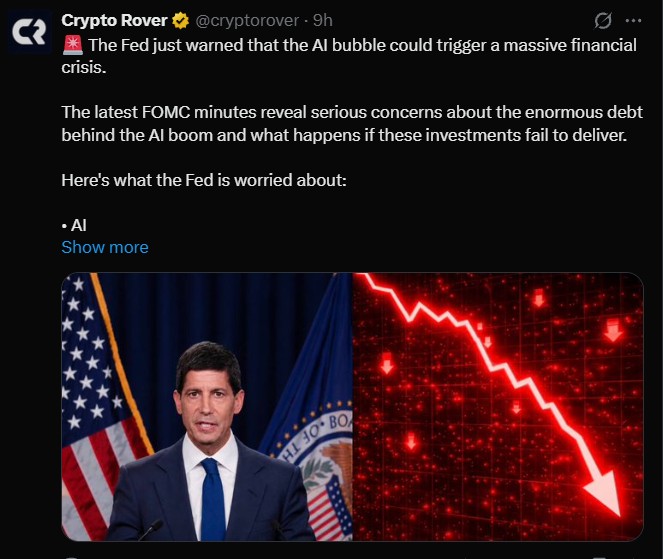 Source: Crypto Rover X Post
Fed Warns AI Investment Boom Could Create Financial Stability Risks
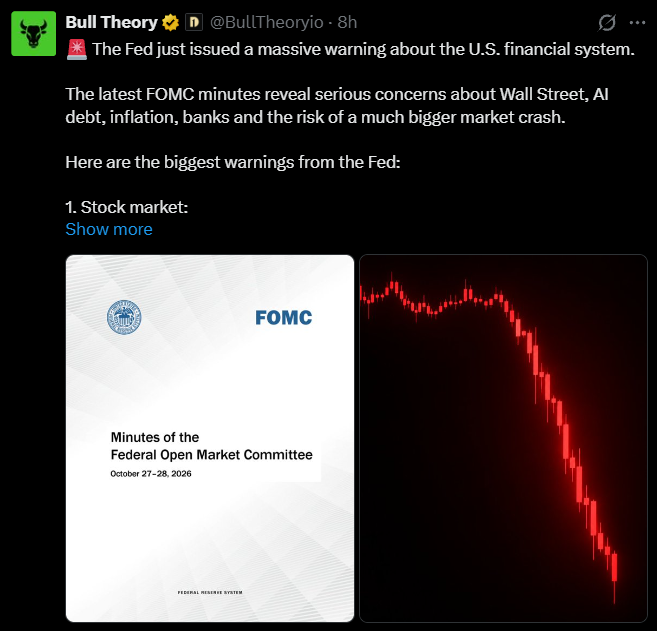
Almost all participants discussed what could happen if returns on AI investment disappoint. Most said AI-related debt had grown quickly, often through complex and opaque financing structures. A few noted that exposures were becoming concentrated among a small number of firms.
Staff added that off-balance-sheet leasing commitments and circular financing among AI firms could amplify losses. Several participants warned the investment surge could prove excessive, and a couple said it might crowd out other types of investment.
The impact could run in several directions. Weaker returns could cut corporate earnings and make borrowing harder. Tech stocks could fall, and slower spending could hit growth. Some participants noted that a pullback in AI spending might also ease inflation pressure.
 Source: Bull Theory X Post
Hedge Fund Leverage, Banks and Forced Selling Add to Market Risks
The concerns reach beyond AI Bubble. Staff said elevated asset valuations and hedge fund leverage were the most salient vulnerabilities. Strong bank and household balance sheets were seen as a buffer.
Most participants highlighted hedge fund leverage or limited dealer capacity as ways stress could spread. In a severe scenario, forced asset sales could impair market functioning. Several worried that supervisors may not fully see banks’ indirect exposure through nonbank lenders, including credit lines to private credit funds.
Some participants also raised the link between high government debt, rising long-term yields and financial stability. Some named cyber risk as a critical concern. Taken together, the minutes describe linked markets where trouble in one area could move into others.
 Source: The Kobeissi Letter
How FOMC Meeting Minutes Could Affect Crypto and Financial Markets
The minutes are a record of past discussions, not a forecast of price moves. Any Impact on crypto market depends on incoming inflation data and on what investors had already priced in.
In general, expectations of higher rates can pressure equities and support Treasury yields and the U.S. dollar. Tighter liquidity can also reduce appetite for risk. That is one reason higher rates can weigh on Bitcoin and other cryptocurrencies. AI-related volatility could also shape crypto sentiment, since both trade on risk appetite.
This article cites no live prices. Anyone using market data should verify it independently and check its timestamp.
 Source: Wise Advice X Post
FOMC Timeline: October Decision to December Meeting
-
October 27 to 28, 2026: The FOMC meets and holds the rate at 3.75% to 4.00%, with two dissents.
-
October 29, 2026: The unchanged policy rate takes effect.
-
November 18, 2026: The Fed releases the minutes.
-
December 8 to 9, 2026: The next scheduled FOMC meeting.
Conclusion: Inflation and AI Risks Remain Central to Fed Policy
The FOMC meeting minutes show a Fed that paused but kept its guard up. Inflation is above 2%, and most officials expect more tightening if the data stay on their current path. They also see real risks if AI financing sours. The December decision will depend on upcoming data. Investors tracking rates, equities, bonds and crypto should watch the next inflation reports.
Disclaimer: This article is for informational and educational purposes only. It is not financial, investment, trading or legal advice. Cryptocurrency and financial markets carry risk. Do your own research and consult a qualified professional before making any investment decision.






