GENIUS Act Compliant Stablecoins to Know Before January 18, 2027

GENIUS Act Compliant Stablecoins: What Changes on Jan 18, 2027?
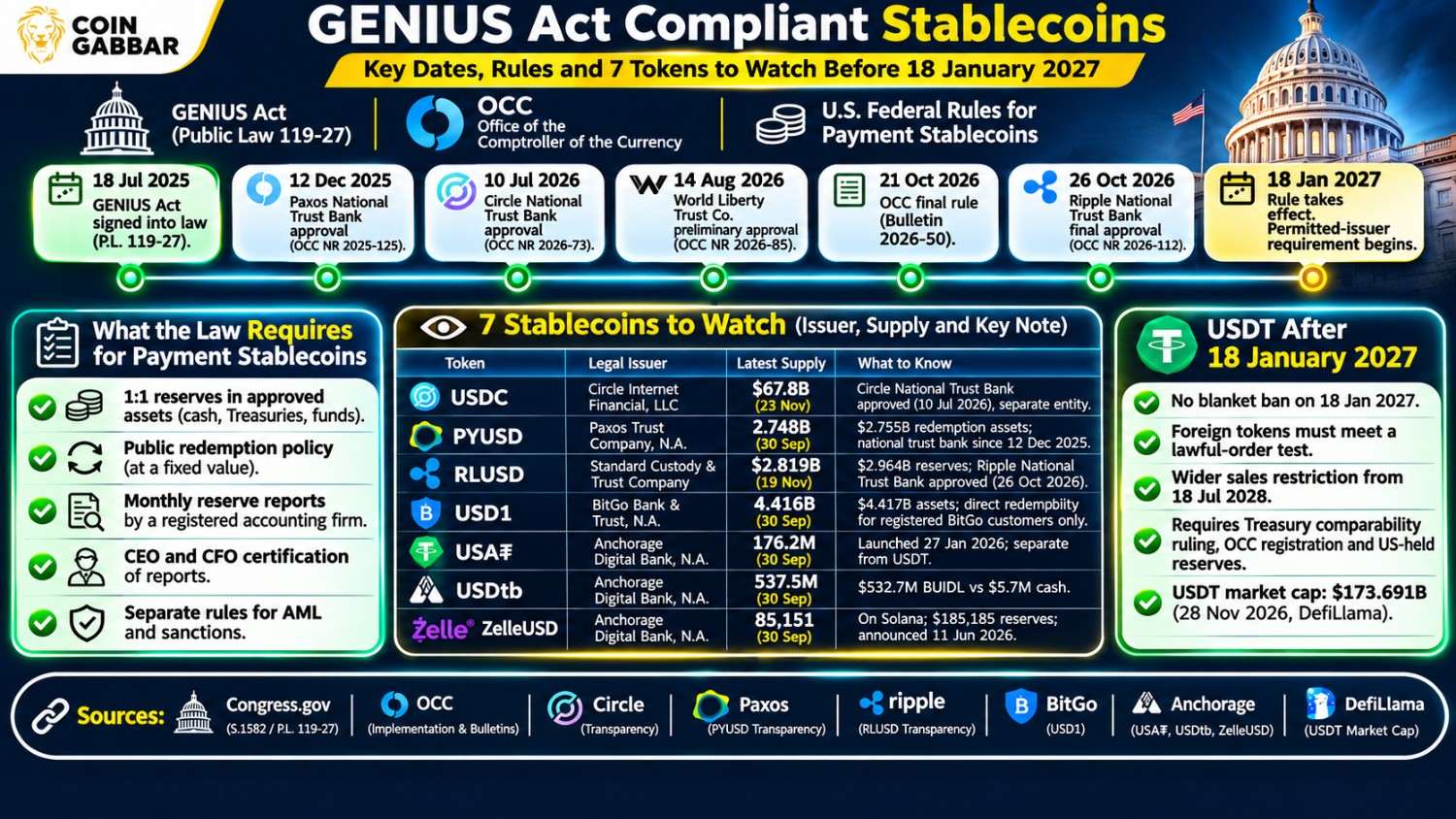
The GENIUS Act is the federal law for US payment stablecoins. It became Public Law 119-27 on 18 July 2025.
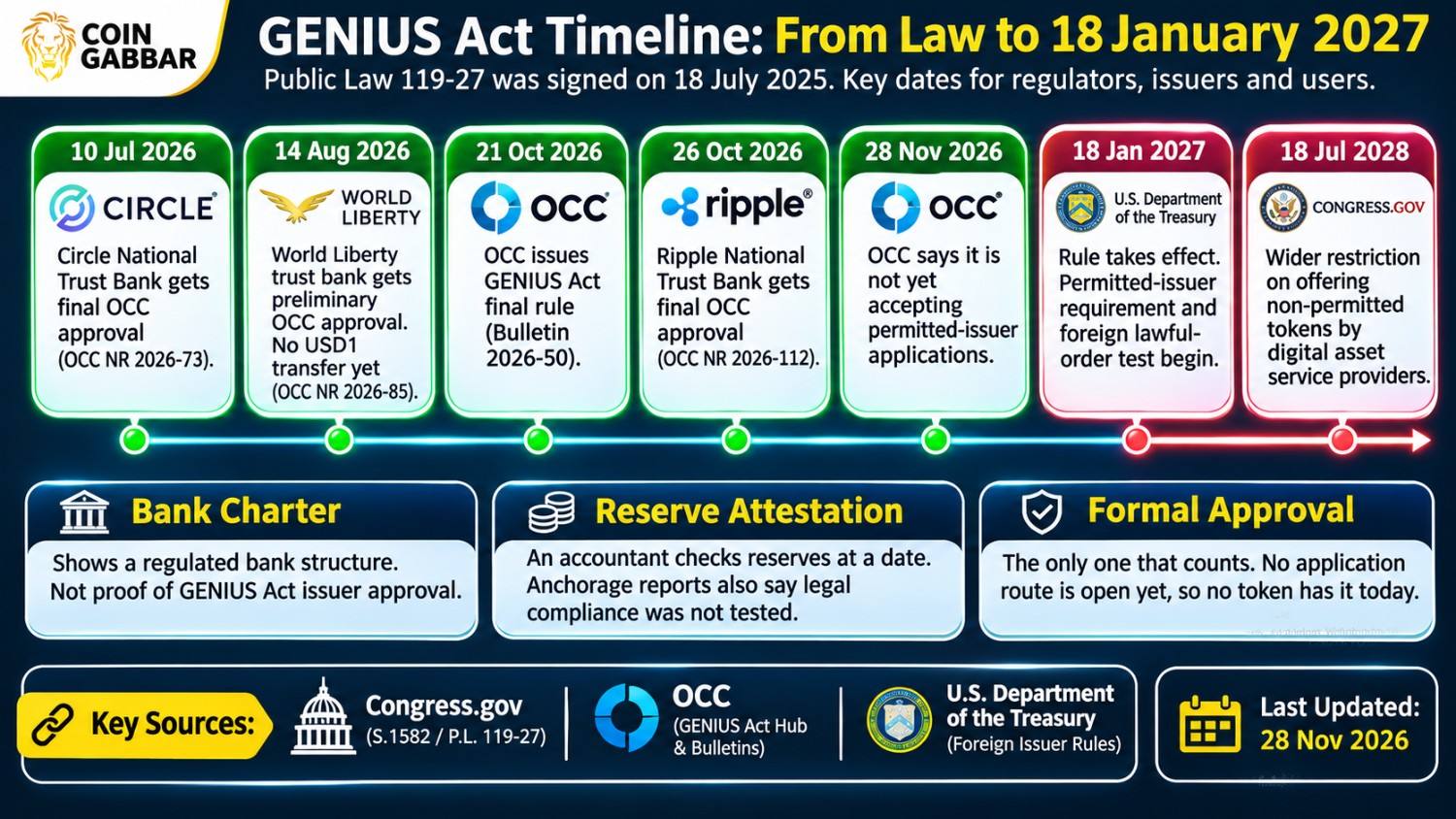
The OCC issued its final rule on 21 October 2026. That rule takes effect on 18 January 2027.
From that day, a person generally needs approval as a permitted issuer to issue a payment stablecoin in the US. Foreign tokens face a separate test, which will be covered below.
Glossary
Payment stablecoin: a token meant for payments, redeemable at a fixed dollar value.
Permitted issuer: a company approved to issue payment stablecoins in the US.
Attestation: an accountant's report on an issuer's reserves at a set date.
Comparability ruling: a Treasury finding that a foreign regime is similar to the US one.
Redemption: swapping a token back for dollars with the issuer.
GENIUS Act compliant stablecoins: What Makes Them Different?
The law sets a clear test. A payment stablecoin is built for payments or settlement, and its issuer must redeem it at a fixed value. Bank deposits and securities don't count.
Issuers need at least 1:1 reserves in approved assets and a public redemption policy. They also publish monthly reports, examined by a registered accounting firm and certified by the CEO and CFO.
What an issuer has | Proves formal approval? |
Bank charter | No, not alone. |
Reserve attestation | No |
Formal issuer approval | Yes |
As of 28 November 2026, the OCC says it isn't yet taking applications. So no token below has confirmed formal approval.
Which Stablecoins Should Users Watch Before 2027?
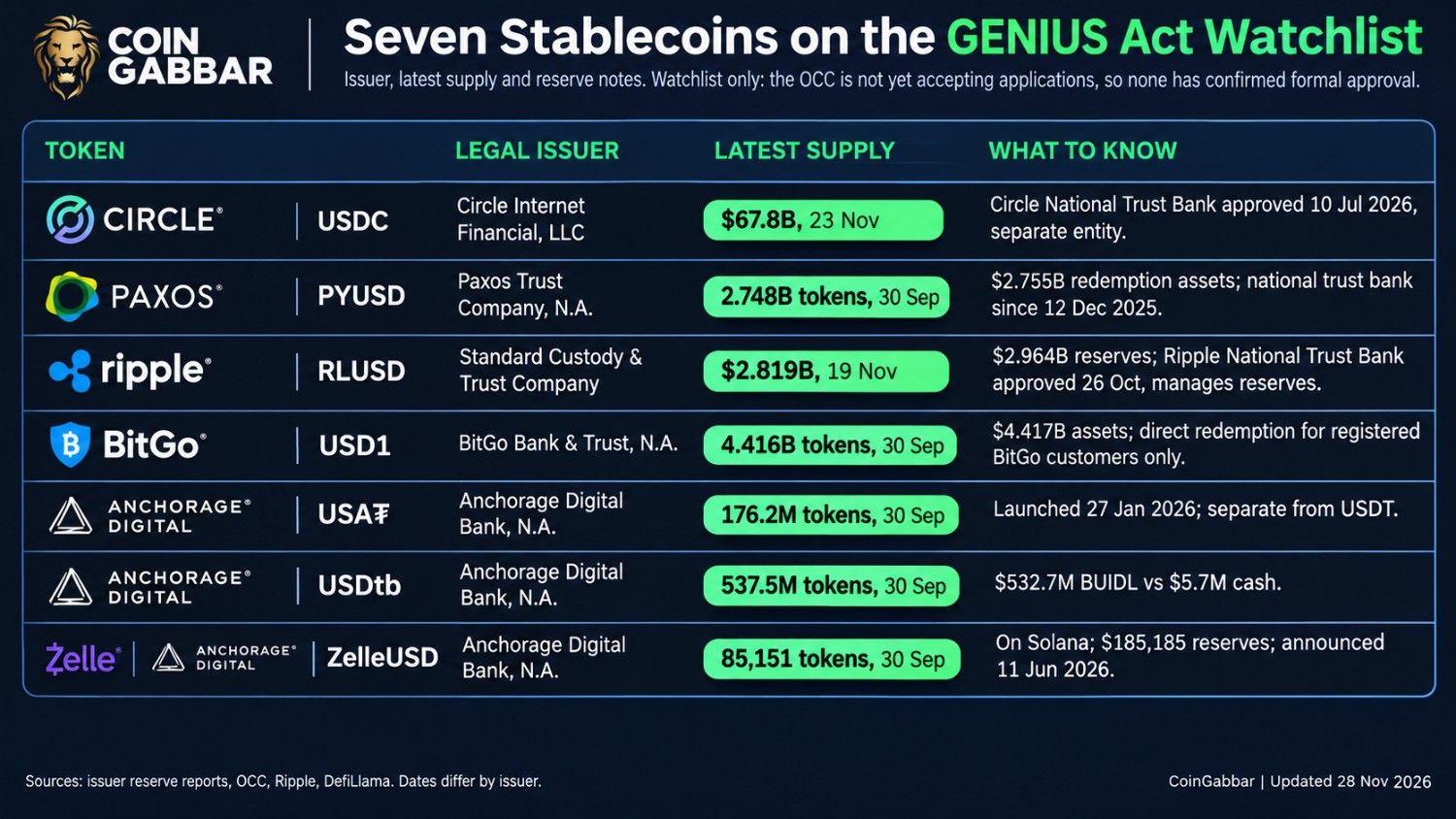
Think of this as a watchlist, not an official list. Each figure is an issuer snapshot, and the dates differ.
Token | Legal issuer | Latest supply |
USDC | Circle Internet Financial, LLC | $67.8B, 23 Nov |
PYUSD | Paxos Trust Company, N.A. | 2.748B, 30 Sep |
RLUSD | Standard Custody & Trust Company | $2.819B, 19 Nov |
USD1 | BitGo Bank & Trust, N.A. | 4.416B, 30 Sep |
USA₮ | Anchorage Digital Bank, N.A. | 176.2M, 30 Sep |
USDtb | Anchorage Digital Bank, N.A. | 537.5M, 30 Sep |
ZelleUSD | Anchorage Digital Bank, N.A. | 85,151, 30 Sep |
GENIUS Act compliant stablecoins: Which issuers sit under OCC supervision?
Circle won final OCC approval for Circle National Trust Bank on 10 July 2026. But that bank isn't the USDC issuer. Circle Internet Financial, LLC, is, so the approval doesn't settle USDC's status.
Paxos became a national trust bank on 12 December 2025. Its 30 September report applied the Act's reserve rules to $2.755 billion in PYUSD redemption assets.
BitGo issues USD1, backed by $4.417 billion on 30 September. Only registered BitGo customers can redeem directly. A World Liberty trust bank got preliminary OCC approval on 14 August 2026, but no transfer has happened.
What Should Users Know About the Anchorage Tokens?
Anchorage Digital Bank issues USA₮, USDtb, and ZelleUSD. That's three tokens, one bank.
USA₮ is Tether's separate US token, launched 27 January 2026. USDtb leans on BlackRock's BUIDL fund, about $532.7 million, against $5.7 million in cash. ZelleUSD runs on Solana and had only 85,151 tokens out.
Anchorage's reports also say accountants didn't test legal compliance.
GENIUS Act compliant stablecoins: Where Does RLUSD Fit Among These Issuers?
A New York regulated trust company, Standard Custody & Trust Company, issues RLUSD. Ripple's data for 19 November 2026 showed $2.819 billion circulating against $2.964 billion in reserves.
Ripple National Trust Bank won final OCC approval on 26 October 2026 at 4:13 p.m. ET (20:13 UTC). It manages the reserves, but it doesn't issue RLUSD.
GENIUS Act compliant stablecoins: What Happens on January 18, 2027?
Nothing dramatic. No law bans USDT that day.
Tether International in El Salvador issues USDT and holds local authorization. From 18 January 2027, foreign tokens offered through US platforms must meet a lawful-order test. The wider sales restriction starts on 18 July 2028 (05:00 UTC).
A foreign issuer also needs a Treasury comparability ruling, OCC registration, and US-held reserves. We found no public proof of those steps for Tether. USDT's market cap was $173.691 billion on 28 November 2026, per DefiLlama, and USA₮ is a different token.
GENIUS Act compliant stablecoins: How to Check a Stablecoin Issuer?
Don't trust the ticker. Start with the company that actually owes you the dollars. For background on how these tokens work, the OCC GENIUS page carries the official updates.
Here's the order I'd follow:
Pull the issuer's full legal name from its latest reserve report.
Look that name up in OCC and state regulator records.
Note the date on the report, because an old one tells you little.
Find out who can redeem directly and what it costs them.
Compare the contract address with the issuer's own documents.
Come back and recheck before you lean on any status.
Do Compliant Stablecoins Still Carry Risks?
They do. Approval doesn't make a token safe.
What backs a token matters a lot, since cash, Treasuries, and fund shares each carry their own risks. Redemption is another weak spot. USD1 shows it well, because only registered BitGo customers can redeem directly. Issuers can freeze tokens too, and a smart contract bug can cause real losses.
The Act is blunt on two points. Payment stablecoins aren't backed by the US government, and they aren't FDIC insured. Issuers also can't pay yield just for holding a token.
Expert Opinion: What Should Readers Watch in 2027?
CoinGabbar analysis suggests readers should treat GENIUS Act compliant stablecoins as a status check, not a label. Issuer, reserves, and redemption rights differ for every token.
Watch the OCC page for approvals and each issuer's monthly report. This view rests on the statute, OCC and Treasury notices, and issuer reserve reports.
Disclaimer: This is strictly for informational purposes. This is not tax advice or legal or financial advice. Stablecoins can de-peg, and laws change. Nothing's guaranteed. Research for yourself.