How to Add a Hardware Wallet Passphrase After the Coldcard Flaw

How to Add a Passphrase to Your Hardware Wallet After Coldcard
A hardware wallet passphrase is an extra secret you type on top of your recovery words. It creates a separate wallet that only the exact passphrase can open. After the Coldcard seed flaw in 2026, many owners want a hardware wallet passphrase. The short answer has a catch. A passphrase helps, but it does not repair a weak seed. First check whether your seed was affected, then add the passphrase. This guide uses official pages. Each source shows its own date and the date I retrieved it, 25 November 2026. New to wallets? Read our guide to crypto wallets first.
What the Coldcard Flaw Means for Your Hardware Wallet Passphrase
Coinkite's security advisory, published on 30 July 2026 and retrieved on 25 November 2026, says a firmware bug caused weakened seed generation. The devices were not hacked or accessed remotely. Instead, attackers rebuilt private keys offline from weak seeds and stole funds. A follow-up technical post, dated 4 August 2026 and retrieved on 25 November 2026, says a build error made a random number function use a default generator instead of the hardware one.
The advisory lists these affected releases:
Model | Affected firmware | Fixed in |
Mk2 and Mk3 | 4.0.1 through 4.1.9 | 4.2.0 or later |
Mk4 and Mk5 standard | Before 5.6.0 | 5.6.0 or later |
Q standard | Before 1.5.0Q | 1.5.0Q or later |
Source note: the Coinkite advisory, with guidance dated 14 August 2026, retrieved on 25 November 2026. It also lists Edge versions, so check the page for yours. For Mk4, Mk5 and Q, it says seeds carry about 72 bits of entropy instead of 128. Entropy is a measure of how hard a secret is to guess.
What does a hardware wallet passphrase do here? The advisory says a strong, unique passphrase forces an attacker to find it too. But a short, common or reused one may be guessable. It adds that passphrase users should still migrate "as soon as practical." Updating firmware alone does not repair an affected seed.
Should You Add a Hardware Wallet Passphrase or Migrate First?
Use this simple table. It is general guidance based on the advisory, not a promise of safety.
Your situation | Suggested first step |
Coldcard seed made on affected firmware, no passphrase | Update firmware, then migrate to a new seed. |
Affected seed with a strong, unique passphrase | Still plan a migration soon |
Seed made with 50 or more private dice rolls | The advisory does not treat it as at risk from this issue alone. |
Trezor, or Ledger, new or unaffected seed | A passphrase is optional extra protection. |
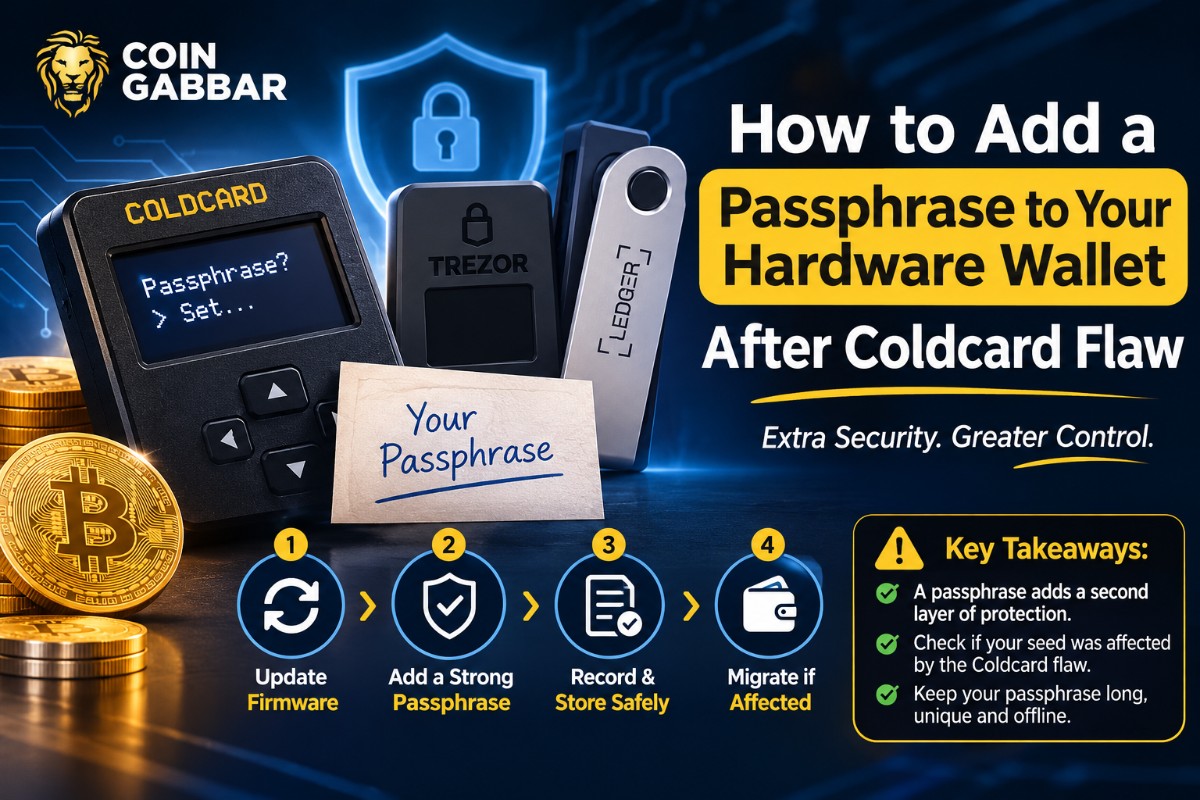
Because a hardware wallet passphrase cannot fix a weak seed, migrate first if you are affected. The advisory's order is clear. Generate a new seed, verify the backup and receive the address, send a small test, then move the rest. Keep the old backup until the move is confirmed. You can follow test transfers with a Bitcoin block explorer.
Here is a worked example. Say you hold funds on a Mk4 with firmware below 5.6.0. Update to 5.6.0 or later. Create a new seed. Add your hardware wallet passphrase to the new wallet. Record its fingerprint. Send a small test amount. Then move the rest.
How to Add a Hardware Wallet Passphrase on Coldcard
The Coldcard passphrase docs, last updated on 1 October 2026 and retrieved on 25 November 2026, give these steps for Mk4 and Mk5:
Power on, enter your PIN, and select Passphrase.
Build the passphrase with Edit Phrase, Add Word, and Add Numbers.
Review it, then select APPLY.
On the confirmation screen, view the passphrase and note the 8-digit XFP, a fingerprint of the wallet.
Press the check mark to use it, or press 1 to save it to microSD.
On the Q, you select Passphrase, type it or scan a QR code, and press ENTER. The docs set a limit of 100 ASCII characters. They also say a lost or mistyped passphrase cannot be recovered. A wrong entry simply opens a different, empty wallet, so compare the XFP to your written record. The passphrase wallet stays active until you use Secure Logout or power off. Backup files do not include the passphrase.
How to Add a Hardware Wallet Passphrase on Trezor and Ledger
For a hardware wallet passphrase on Trezor, see its passphrase guide, retrieved on 25 November 2026. The page shows no date. It says the feature is off by default. On desktop, go to Settings, then Device, then Passphrase. Then open the wallet menu and choose + Passphrase wallet. Enter the passphrase in Suite or on the device, and confirm it. Safe 7, Safe 5, Model T, and Safe 3 support on-device entry. Model One does not.
Trezor's Suite update post, dated 1 November 2026 and retrieved on 25 November 2026, says the limit rose from 50 to 128 characters. You must update your device to use it. The post discusses the Coldcard flaw as background but does not say it caused the change. Trezor's passphrase page, also retrieved on 25 November 2026 and undated, adds that Model One still allows 50 and that a passphrase "cannot be changed, removed, or recovered."
Ledger's Academy guide, updated on 5 August 2026 and retrieved on 25 November 2026, calls it a 25th word of up to 100 characters. You can use a temporary passphrase, which stays active while the device is on. Or you can link it to a secondary PIN. With that PIN, the device resets after three wrong attempts, so you must restore from your recovery phrase.
Hardware Wallet Passphrase Safety Checklist and Risks
Expert view: security writers generally say a hardware wallet passphrase raises safety only if it is long, unique, and stored well. In that view, a weak or reused one adds little.
Make it strong: Avoid names, dates, and common phrases.
Write it down: Store it apart from your recovery words and device.
Test it: Fund the wallet only after you confirm you can reopen it.
Check each character: One changed letter or space opens a different wallet.
Beware autofill: Trezor warns that browser autofill can open a wallet without you knowing.
Check availability: Features differ by model and firmware, and by country.
Avoid scams: Never type your passphrase or recovery words into a website.
Compare device types in our crypto wallet comparison or our wallets for beginners.
If you keep coins on exchanges too, review their security features.
Final Thoughts on Your Hardware Wallet Passphrase
A hardware wallet passphrase adds a real second barrier, but it cannot fix a weak seed. Check your firmware, migrate if you are affected, then add a strong hardware wallet passphrase and test it. Store it safely, and never put in more than you can afford to lose.
Disclaimer: This article is for education and information only. It is not financial, investment, legal, or security advice. Passphrase mistakes can cause permanent loss of funds. Firmware, menus, and rules change, so verify every step on official pages before you act.












Frequently Asked Questions (FAQ)




