How to Switch Bitcoin Mining Pool After Binance Pool Shut Down


How to Switch Bitcoin Mining Pool After Binance Pool Shut Down
Binance Pool stopped accepting miners on November 10, 2026. Any rigs still pointed there are earning nothing. This guide shows how to switch a bitcoin mining pool. It also covers protecting unpaid rewards and saving records.
A bitcoin mining pool shutdown is rare, but it hits miners fast. Income stops, and payout history can vanish. Miners who are also moving coins can read our exchange to wallet steps too.
What Happened to Binance Pool?
Binance announced on October 13, 2026 that it would close Binance Pool and related services. According to the announcement, the decision followed an ongoing review of its products and services. The company gave no other reason.
Mining connections began disconnecting at 07:00 UTC on November 10. Stratum URLs and mining endpoints stopped working that day. Cloud Mining, Pool Savings, the Transaction Accelerator, hashrate alerts, email notifications, and the pool API closed as well.
Key Dates Matter Most Before Binance Pool Access Ends
Date | What happens |
Nov 10, 2026, 07:00 UTC | Mining endpoints disabled; new shares no longer credited |
Nov 10, 2026, 23:59 UTC | Deadline for required account steps, such as identity verification, to receive outstanding payouts |
Nov 24, 2026, 07:00 UTC | Historical mining records, transactions, and payout status become permanently inaccessible |
The November 24 date is close, so download your records first.
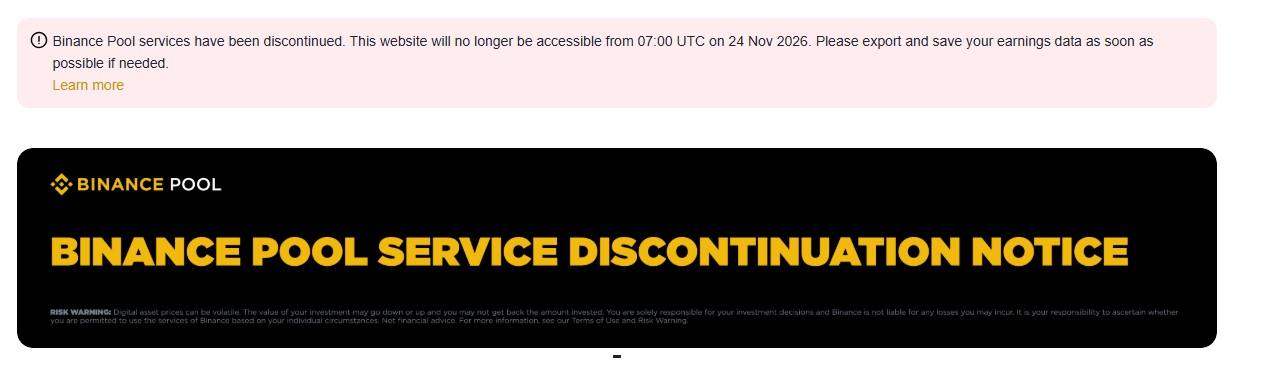
Source: Official Notice
How to Switch Bitcoin Mining Pool After Binance Pool Shut Down
The process is short. Pick a new pool, create an account, and set your payout address. Then copy the new stratum URL, enter it in each miner, and restart.
Confirm your workers show as active. After that, download your Binance Pool records and follow up on any unpaid balance. Your hardware and wallet stay the same.
What a Bitcoin Mining Pool Actually Is
A bitcoin mining pool is a group of miners with equipment pointed at the same server. The group combines hashrate and works together instead of alone.
When the group finds a block, the reward is split by contribution. Pools track that work through shares. Without pooling, a small miner would rarely find a block alone.
Before You Start
Download the records. Save payout history, worker reports and transaction details before November 24. They may be needed for taxes and for any balance dispute.
Check the unpaid balance. Shares sent before the cutoff stay eligible for final rewards. The notice says eligible balances will keep processing, subject to account status and compliance checks.
Confirm account status. Binance set a November 10 deadline for steps such as identity verification. If it was missed, contact Binance support and keep the records.
Use a wallet with a self-controlled key. Verify every character of the payout address, because payments can't be reversed. Learn how to secure a crypto wallet before starting.
Secure the new account. Use a strong, unique password and app-based two-factor authentication.
Safe Steps to Switch Your Bitcoin Mining Pool
Screens differ by pool and miner. Follow the new pool's setup page alongside this checklist.
Choose a replacement bitcoin mining pool. Compare fees, payout scheme, minimum payout and server locations.
Create an account. Use the pool's official site from a bookmark, not a search ad.
Set the payout address. Paste it from the wallet's receive screen. Check the first and last characters.
Copy the stratum URL and port. It looks like stratum+tcp://pool.example.com:3333. Note any backup URLs.
Open each miner's settings. For most ASIC miners, type the local IP address into a browser and log in.
Replace the Binance Pool details. Enter the new URL, the worker name (usually account.worker1) and the password field (often just x).
Fix the backup slots. Binance Pool no longer works as a fallback. Every backup slot needs a live pool.
Save and restart. The miner should reconnect within a minute or two.
Confirm on the dashboard. Check that workers are active and hashrate is building. Dashboards can take a few minutes to update.
Test first on big farms. Move a few miners, confirm shares are accepted, then move the rest.
Binance Pool Alternatives and Their Official Terms
Here are bitcoin mining pool options with published terms. Only official pool pages were used. Terms change, so check the live page before committing.
Pool | Payout scheme and fee | Payout details |
Braiins Pool | FPPS, 2.5% fee | On-chain minimum 0.0002 BTC. Lightning from 1 satoshi. |
ViaBTC | PPS+: 4% on block reward, 2% on transaction fees. PPLNS: 2% | Minimum withdrawal not stated on the pricing page. |
F2Pool | FPPS (default) or PPLNS, set per account | Fee and minimum not listed in the article we checked. |
EMCD | Fee not stated on the page we checked | You set the payout threshold. A new address gets a 24-hour hold. |
According to Braiins, on-chain payouts under 0.005 BTC cost 0.0001 BTC, while Lightning payouts are free. See the Braiins payout rules.
ViaBTC publishes its rates on its pricing page.
F2Pool says schemes can be changed once a day, effective at 00:00 UTC the next day. Details are in the F2Pool guide. EMCD explains payout timing in its help center.
FPPS pays a steady amount per share. PPLNS pays by shares in a recent window, so income varies more. Neither suits everyone.
Switching on Different Setups
ASIC miners: change the pool in the web interface, then repeat for each machine.
Custom firmware: update pools in the firmware's own interface.
Software miners: edit the pool URL and login in the config file, then restart.
Hosted mining: ask your hosting provider, since access is often restricted.
What Changes After Switching
Item | Changes after switching? |
Hardware hashrate | No |
Payout wallet | Only if a new address is set |
Share and luck history | Yes, it starts fresh |
Pool fee and payout terms | Yes |
Binance alerts and API | Yes, they're discontinued |
Unpaid Binance balance | Stays with Binance until processed |
Common Mistakes to Avoid
Leaving miners on Binance Pool. Shares sent after the cutoff earn nothing.
Skipping records. Payout history disappears on November 24.
Forgetting backup slots that still point to Binance Pool.
Using a fake pool URL from a phishing site or search ad.
Typing the payout address wrong. Payments can't be reversed.
Using the wrong worker format. Many pools need account.workername.
Missing a few machines during the switch, which leaves hashrate idle.
Ignoring taxes. Mining income can be taxable, and rules differ by country. See the guide on crypto tax in India.
If Something Goes Wrong
Miner shows offline: recheck the URL, port and worker name. Try a backup URL.
Hashrate looks low: wait a few minutes, since dashboards estimate over a time window.
Rejected shares: check firmware, clock and network, then try a closer server.
Binance balance missing: check the account status, then contact Binance support with the saved records.
Cloud Mining or Pool Savings: Binance's notice gives few settlement details, so ask support directly.
Expert Opinion: What Miners Should Take Away
A bitcoin mining pool closure shows a basic risk in mining. Income depends on one operator's decisions. Miners who keep a backup pool avoid a full stop.
Records matter just as much as hashrate. Binance's timeline gives miners two weeks to save payout data after the shutdown. Analysts often advise exporting statements monthly, not at the last minute.
Spreading hashrate across two pools adds small setup work. It also limits damage if one pool changes terms or closes.
Final Thoughts: Key Steps for Miners
Changing a bitcoin mining pool takes minutes, but the deadlines are real. Save the records, move the miners, and check every backup slot. Then confirm the payout address and threshold on the new pool.
Disclaimer: This article is for educational and informational purposes only and should not be considered financial or investment advice. Always conduct your own research before making investment decisions.
















