Hyperliquid Centralized Exchange: Does Paid Access Alter Fair Trading?

Hyperliquid Centralized Exchange Who Gets Faster Trade Data, and Why?
The Hyperliquid centralized exchange debate has picked up after Dfinity founder Dominic Williams questioned how the platform describes itself.
His comments focus on paid auctions that let traders receive trade data a little earlier than others.
This article explains his argument, what the project’s own documentation confirms, and where the HYPE price stands today.
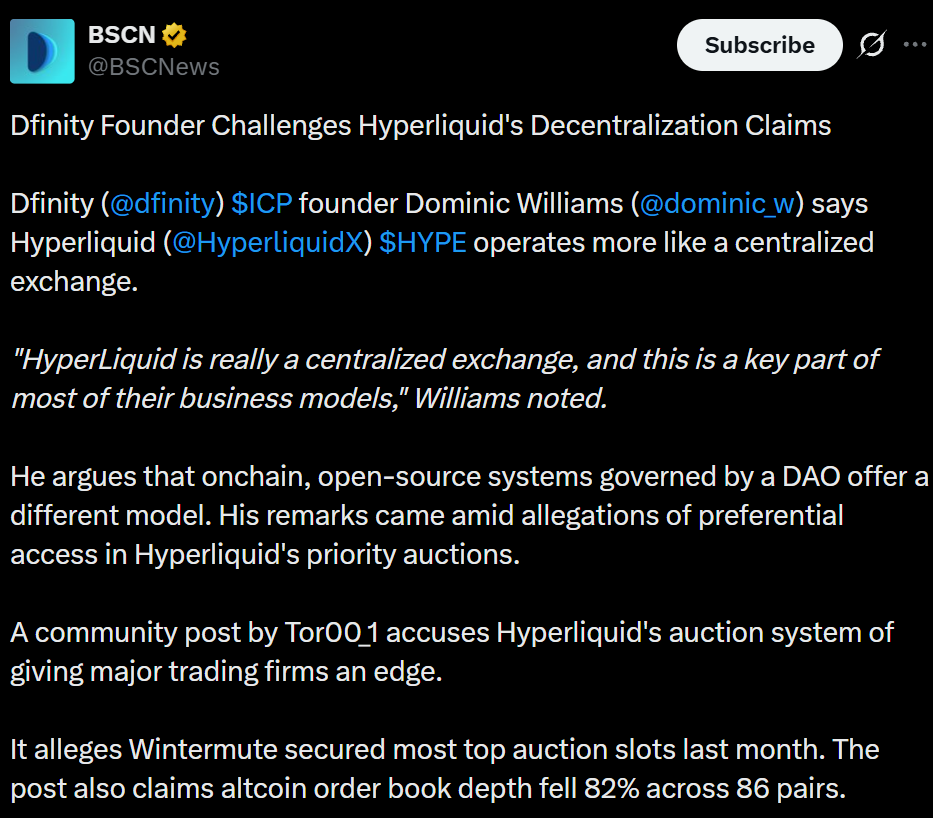
Source: BSCNews Post
What the Dfinity Founder Said
Dominic Williams wrote that the platform is “really a centralized exchange.”
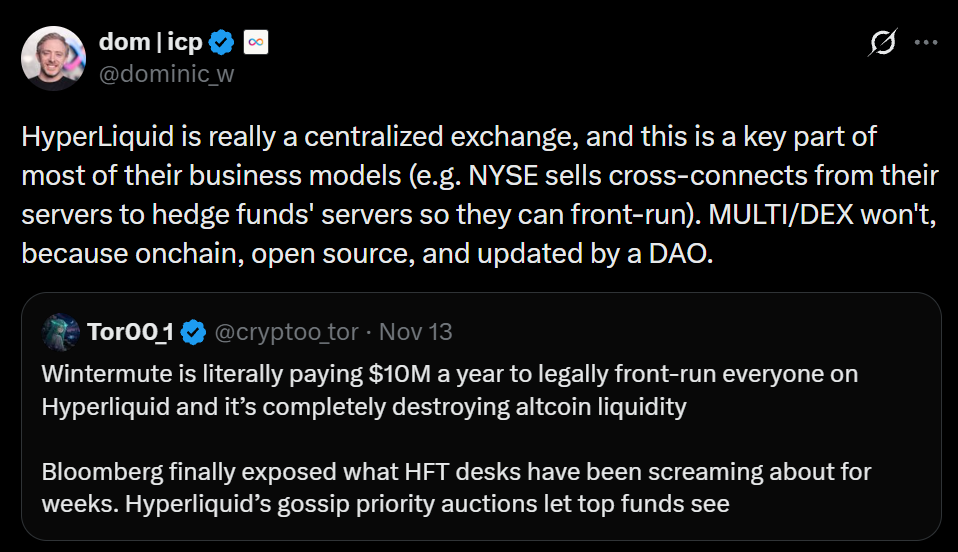
Source: Dominic Williams
He added that selling faster access is a key part of how such venues earn money.
He compared it to a stock market operator selling server connections to hedge funds so they can front-run others.
He said a platform that is onchain, open source and updated by a DAO, which is a community-run organization, would not do this. This is his opinion, not an official finding.
It matters because the Hyperliquid centralized exchange claim targets the project’s core promise of an open, onchain market.
How the Paid Bidding Rounds Work
The project’s official documentation calls the feature gossip, or read, priority. It uses Dutch auctions, where a price starts high and falls until someone accepts it.
Three independent auctions run on the same three-minute schedule. A winner registers a network address, and nodes may deliver pending trade data to it earlier than to others.
The documentation says the project’s own foundation node will follow the ordering, but other nodes may or may not respect it.
| Feature | What the documentation says |
| Slots | 3 independent auctions |
| Schedule | Every 3 minutes |
| Speed gain | About 20 milliseconds per slot on mainnet |
| Starting price | 10 times the slot’s previous winning price, with a floor of 0.1 HYPE |
| Who can bid | Any address, for any network address |
| Payments | Burned, meaning removed from supply |
The same page says this feature reduces the need for market makers to over-optimize their infrastructure.
A separate “write priority” fee lets traders pay for faster order entry, and cancels always go before orders that can execute immediately.
What Is Confirmed and What Is Not
The documentation confirms that bidding is open. Anyone can also check past winners through a public request called gossipPriorityAuctionStatus.
The official About page describes the platform as a layer-one blockchain with fully onchain order books, where every order, cancel, trade and liquidation is visible.
What to Watch Next
Several signals will show how the debate develops:
-
Documentation changes: any update to the auction rules or the number of slots.
-
Public winner data: the open request above lets anyone check who wins each round.
-
Project response: any official statement from the team on the founder’s comments.
-
Wider reaction: whether other builders and traders take up the criticism.
HYPE Price Snapshot
CoinMarketCap’s live page shows the token at $66.27 on 16 November, down 1.54% in 24 hours.
On the chart, the price traded mostly between about $66 and $68.4, with three peaks near $68.4.
The data does not show whether the debate moved the price.
| Metric | Value | In simple words |
| Price | $66.27 | Down 1.54% in 24 hours |
| Market value | $16.74B | Price multiplied by coins in circulation |
| 24-hour trading | About $842M | Down 51.7%, so fewer trades than the day before |
| Coins in circulation | 252.61M | Out of a 949.73M maximum, about 27% |
| Fully diluted value | $62.94B | Value if all coins were in the market |
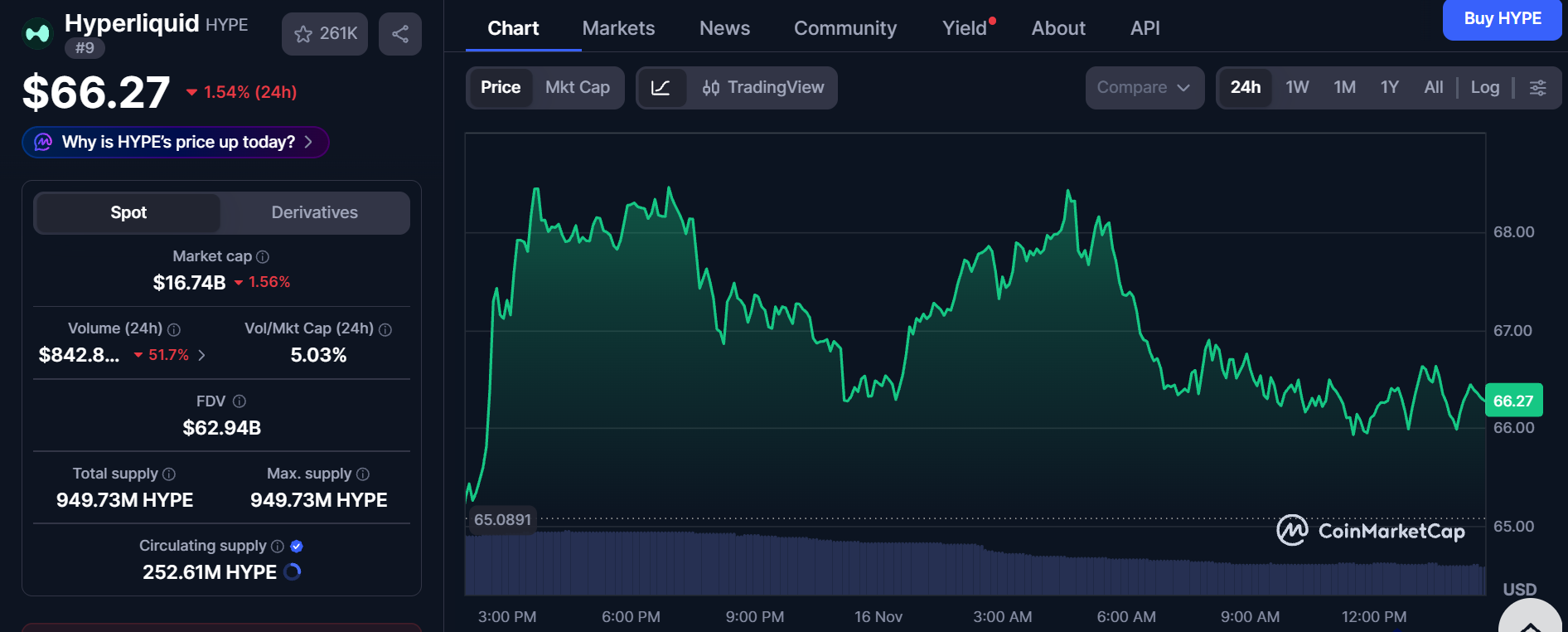
Source: CoinMarketCap’s live page
Conclusion
The Hyperliquid centralized exchange question will not be settled by a single post.
The documentation confirms open, paid bidding for earlier data, while claims about who wins most rounds remain unverified.
Readers should rely on the official documentation and public auction data, and wait for a response from the project before drawing conclusions.
Disclaimer
This article is for educational and informational purposes only and is not financial or investment advice. Crypto assets are high risk, their prices can be very volatile, and you can lose some or all of your money. Always do your own research and consider speaking with a licensed financial advisor before making investment decisions.






