InterLink ITLG Staking: How Will Fee-Funded Vaults Work?

Will Staking Vaults Pay ITL, ITLG or Another Reward Token?
InterLink says ITLG staking vaults are coming, paid from fees. Can you check how the rewards and the 100 billion cap will work?
This InterLink ITLG staking report checks the latest posts against InterLink's whitepaper and blog as of November 18, 2026. It looks at what's confirmed, not price.
A plan isn't a live vault.
How Will the Vaults Work?
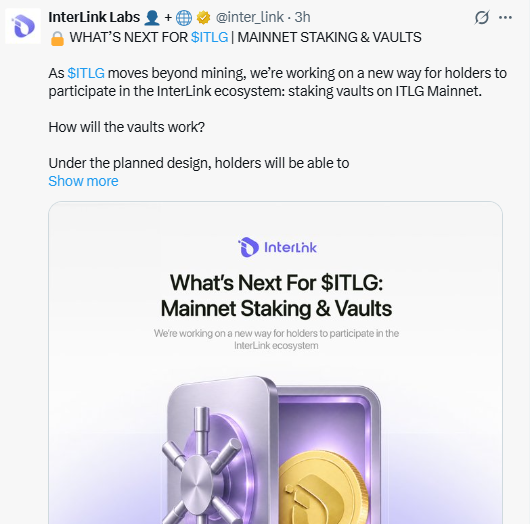
The November 18 post says holders will pick from different vaults and stake ITLG. Rewards are meant to come from fees collected across InterLink. Individuals and institutions can both take part, and staking is meant to be trackable on-chain.
Item | In the post | Not stated |
Vaults | Several to choose from | Terms, lock rules, start date |
Rewards | Paid from fees | Token, formula, APY |
Verified status | Random chance | Odds, selection rule |
Companies | 100+ targeted | Names, signed stakers |
Tracking | Meant to be on-chain | Dashboard or contract |
The post calls the 100-company goal for late 2026 and 2027 a target, not confirmed participants. Verified status is separate from vault rewards, and staking doesn't guarantee it.
These InterLink staking vaults have no APY, lock period or withdrawal rule in the sources reviewed.
InterLink ITLG Staking: Which Token Pays the Rewards?
InterLink's whitepaper says only ITLG staking produces ITL in the initial phase. ITL comes from a 10 billion supply, under a program InterLink Labs runs. That program sets the lock and vesting terms.
The official blog adds that staking Verified ITLG earns ITL without slashing. Only the earned ITL is locked.
The vault post says rewards come from fees, but it doesn't name the reward token. It doesn't say whether the vaults replace, add to or sit beside ITL rewards.
Those are different funding sources for InterLink ITLG staking. Issued tokens come from a fixed supply, while fee income depends on activity. No fee totals were found in the sources reviewed, so ITLG staking rewards can't be sized yet.
Can the 100B Supply Cap Be Verified?
The ITLG Supply Invariant Protocol aims to cap total supply at 100 billion across bridging, staking and token-state changes. The ITLG 100 billion supply isn't new, since the whitepaper already lists it. It's a cap, not circulating supply.
The November 17 post says the protocol is designed to make supply verifiable on-chain. It calls that the goal. It also says much is still to be built before the end of 2026.
No official contract address, supply dashboard or audit for the protocol was found in the sources reviewed. Tracker pages list ITLG-named tokens with different supply figures. Don't treat any as official until InterLink publishes its own.
Before you rely on any vault, look for:
Reward token: ITL, ITLG or another asset
Fee sources: which services pay, and what share reaches vaults
Terms: APY, if any, lock rules and exit rules
Supply: an official contract and an on-chain supply view
Proof: an audit of the vault and supply code
The Bottom Line
This InterLink ITLG staking plan is clear on direction and thin on terms. No reward token, fee formula, lock rule or supply proof is public yet.
Treat the vaults and the supply cap as plans until you can check them on-chain.
Disclaimer: For information only, not financial, investment, or trading advice. Based on InterLink's November 17 and 18, 2026 X posts as supplied, its whitepaper tokenomics chapter and official blog as indexed. No APY, vault terms or contract address was found. Staking and crypto carry risk of full loss. Verify with official sources and consult a licensed advisor.






