Lighter CFTC License Plan Update: What Happens Next for LIT?

What Did Lighter Say on the Q3 Investor Update Call?
LIT token jumped about 20% to $3.90 this week. Two things pushed it: a new Delphi Digital report and Lighter’s plan to apply for a U.S. derivatives license. The Lighter CFTC license plan is the bigger story, so here is what the project said, what the terms mean, and what is still uncertain.
Why Did LIT Jump 20% to $3.90 in a Single Day?
According to CoinGecko on X, LIT rose nearly 20% to $3.90 over 24 hours.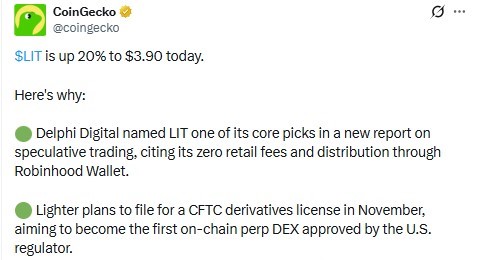
The post named two catalysts, and one came from Delphi Digital:
A new Delphi report on speculative trading listed LIT among its core picks. It cited zero retail fees and distribution through Robinhood Wallet.
Lighter plans to file for a CFTC derivatives license in November. It aims to be the first on-chain perp DEX approved by the U.S. regulator.
Neither item changes how the protocol works today. The Lighter CFTC license plan is an intention, not an approval, and prices that rise on news can fall just as fast.
Readers following on-chain perpetuals should treat the move as a sentiment signal for now.
What Lighter Told Investors on the Q3 Update Call
Lighter held its Q3 Investor Update call on October 21, 2026, and its official X account posted the full recording the next day. A clip from the call was also shared by Crypto Banter, where Founder and CEO Vladimir Novakovski laid out the licensing plan. The key points:
Lighter plans to apply to the CFTC in November 2026.
It will seek two licenses: a Designated Contract Market (DCM) and a Derivatives Clearing Organization (DCO).
The first target is U.S. institutional clients, not retail users.
The team has spent months talking with CFTC staff about how existing rules fit on-chain trading and clearing.
After a formal filing, the CFTC has up to 280 days to review it, as reported from the call.
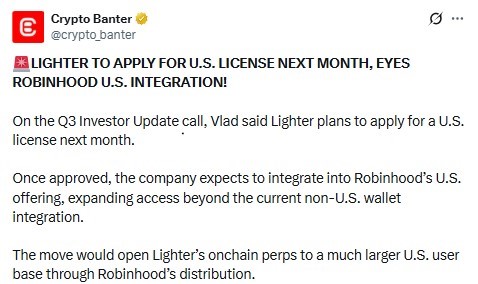
Reports from the call also cite more than $137 billion in Q3 trading volume and $8.55 million in revenue directed to buybacks and burns.
These figures come from the project’s own update, so check the recording before relying on them. They also show why DEX derivatives have become a serious competitor to centralized venues.
Lighter CFTC License: DCM and DCO Explained Simply
Both names sound technical, but the idea is simple. A DCM is a regulated marketplace where contracts trade. A DCO clears those trades and manages risk. The CFTC oversees both in the U.S.
License | What it does | Why Lighter wants it |
DCM | Runs a regulated trading venue | Let U.S. institutions trade perps on a supervised platform. |
DCO | Clears trades and manages default risk | Handles settlement under U.S. rules |
Lighter would need both to run a fully regulated perp venue. If it files in November, the 280-day review window could stretch into late summer 2027. Approval isn’t guaranteed, and the regulator can ask for changes along the way.
From an analyst’s view, the real test isn’t whether Lighter files. It’s whether a fully on-chain order book can meet clearing rules that were written for traditional exchanges.
How the Robinhood Link Could Widen Lighter Reach
Lighter is a perpetual futures DEX that runs on its own ZK rollup, zkLighter, and settles on the Ethereum. According to the project, standard retail accounts pay zero fees, and major pairs offer up to 50x leverage.
Non-U.S. users can already reach Lighter through Robinhood Wallet. Reports say that integration went live in July 2026 on Robinhood Chain, with USDG as collateral and a 50/50 revenue split.
What Risks and Open Questions Should Traders Watch?
Crypto licensing rarely moves as fast as the headlines. Anyone following crypto regulation should keep a few things in mind:
Lighter hasn’t filed yet. It only plans to, and once it does, the CFTC can take up to 280 days to respond.
The first target is institutions, so it’s unclear when U.S. retail users could get access.
Robinhood hasn’t confirmed a U.S. rollout.
Delphi itself calls LIT a speculative pick, and a price spike driven by news can fade quickly.
With leverage up to 50x, a small price move can wipe out a position.
Conclusion: The Lighter CFTC license filing could be a notable step for regulated on-chain derivatives, but it is still a plan. Watch for the actual November application, any CFTC response, and any word from Robinhood. Until then, LIT’s rally reflects expectations more than results.
Disclaimer: This article is for educational and informational purposes only and should not be considered financial or investment advice. Always conduct your own research before making investment decisions.









