Lynq and ZeroBeta Make Tokenized Treasury Collateral Earn Yield

Latest Crypto News: Lynq and ZeroBeta Announce Partnership
Crypto news today brings a deal between Lynq and ZeroBeta. On October 27, 2026, the two firms said clients can lock tokenized Treasury collateral to borrow or trade on margin. The asset keeps paying interest the whole time.
This latest update goes after an old problem. Until now, a pledged asset usually stopped earning yield.
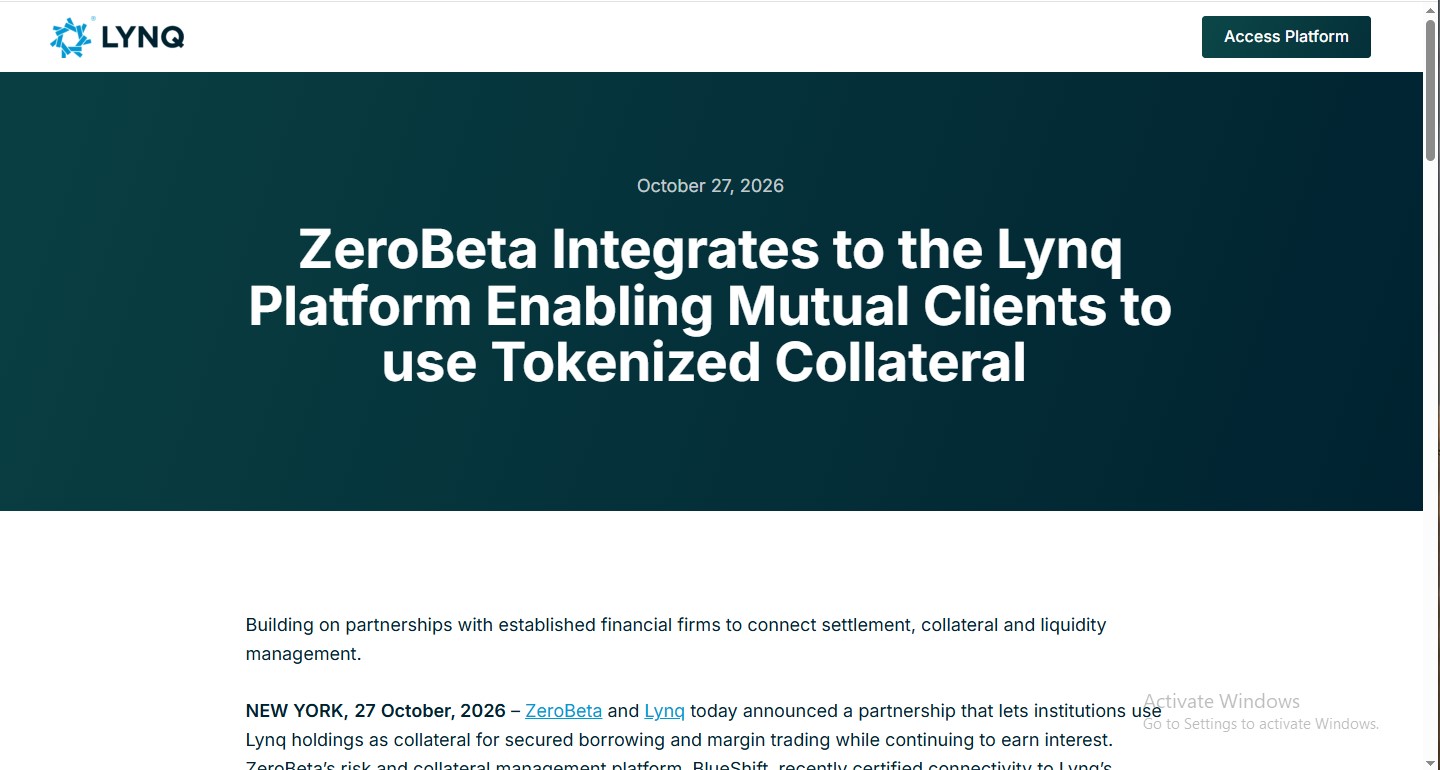
The details come from the official Lynq's announcement, dated New York, October 27. It says the deal builds on ties with established financial firms to link settlement, collateral, and liquidity.
How the Lock Lets Treasuries Keep Earning Interest
Lynq built a new lock, also called escrow, for tokenized real-world assets. Clients move eligible tokenized Treasury collateral into escrow. These are mainly tokenized U.S. Treasuries.
While the asset sits in the lock, it keeps earning. Lynq says its patented Yield-in-Transit system works out the interest and pays it out in real time.
Each side has a clear job:
Party | Job |
Client | Locks eligible tokenized Treasuries in escrow on Lynq |
ZeroBeta BlueShift | Sets the terms and limits, tracks margin, and tells Lynq when to pledge, top up, or release |
Lynq | A neutral network that settles every instruction |
A typical cycle runs like this:
The client locks the asset in escrow on Lynq.
BlueShift sets the terms and tracks margin.
If values move, BlueShift tells Lynq's to add more or free some.
Lynq's runs each step on its own network, and the asset keeps earning until release.
A few plain terms help here:
Collateral: an asset pledged to back a loan or a trade.
Escrow: a lock that holds the asset until it is freed.
Margin: the deposit that backs a trade.
Tokenized Treasury: a U.S. Treasury recorded as a digital token.
Two Ways to Use Tokenized Treasury Collateral: Loans and Margin
ZeroBeta’s BlueShift platform handles two uses. Both follow the same threshold rules.
Loans: BlueShift tells Lynq to pledge the Treasury to a lender. As prices move, it adds more or frees some.
Trading margin: BlueShift checks how much margin open positions and new orders need. It counts the tokenized Treasury as valid margin, then passes the instruction to Lynq.
In plain terms, the lender gets cover for the loan, and the borrower keeps earning on the asset that provides it.
Values change all the time, so top-ups matter. For firms in crypto trading, margin can now come from tokenized Treasury collateral that still earns.
Lynq and ZeroBeta Profile on Avalanche Layer 1
The collateral stays on Lynq’s Avalanche Layer 1 network from the moment it is pledged until it is freed. Nothing has to leave the network.
Lynq is run by tZERO Securities, LLC, an SEC-registered broker-dealer and a FINRA/SIPC member. Arca Labs, Tassat Group, and tZERO Group built it. Lynq describes itself as a real-time, interest-bearing network for settlement and collateral moves in institutional digital assets.
ZeroBeta works on real-time risk, collateral, and liquidity across traditional and digital assets. BlueShift is cloud-native and serves buy-side, sell-side, and market infrastructure firms.
WallStreetX also covered the news on X. Its post called the move another step toward linking traditional finance with blockchain markets.
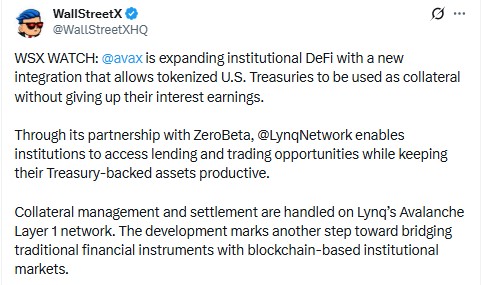
Source: WallStreetX Post
Quick fact | Detail |
Announced | October 27, 2026 |
Network | Avalanche Layer 1 |
Lynq's assets under management | More than $89 million |
Firms onboarded | Over 40 |
Why Earning While Pledged Matters for Big Firms
Pledged assets used to sit idle. Now they can back a loan or a trade and still earn. That lifts capital efficiency, a theme in RWA adoption on institutional chains.
Collateral rules shape how much cash a firm can raise and how many trades it can open, so earning on the locked asset matters. For lenders, the pledged asset stays on one network under set limits. For traders, margin can come from an asset that pays.
Jerald David, CEO of Lynq's, said firms should not have to pick between using an asset as collateral and earning on it. Varuna Wijesundera, CEO of ZeroBeta, called collateral one of the strongest uses for tokenized assets.
It reported more than $89 million under management and over 40 firms onboarded at the time. That is still a modest base.
Some details are still open. The announcement does not name the eligible Treasury products, fees, or haircut levels. Readers can follow updates on the Lynq's platform.
To sum up, this crypto news update shows tokenized Treasury collateral staying productive while it backs loans and margin on Avalanche. Real client use will show how far it can scale.
Disclaimer: This article is for educational and informational purposes only and should not be considered financial or investment advice. Always conduct your own research before making investment decisions.









