EU MiCA Regulation Revision 2026: France CCSF Urges Strict Crypto Ads


CCSF Urges Tighter Limits in MiCA Regulation Revision 2026
France wants tougher crypto advertising rules across Europe. On November 17, 2026, the French Financial Sector Advisory Committee (CCSF) published recommendations for a possible EU MiCA Regulation Revision 2026.
The proposals focus on high-risk crypto promotions aimed at retail investors. The European Commission has not yet decided whether to adopt them.
At a Glance
-
Recommendation Date: November 17, 2026
-
Issuing Body: French Financial Sector Advisory Committee
-
Main Proposal: Tighter advertising rules for high-risk crypto-assets
-
Regulatory Framework: A possible MiCA Regulation Revision 2026
-
Key Targets: Influencer promotions, referral rewards, gamification and misleading wording
-
Current Status: Awaiting review by the European Commission
Why France Wants Stricter Crypto Advertising Rules Under MiCA
The Committee is attached to the Bank of France. It brings together financial professionals and consumer associations. The Minister of the Economy asked it to review its 2023 recommendations, and it produced six new proposals for the European Commission.
The committee worries that promotional campaigns can pull ordinary savers toward speculative tokens. It points to France’s Sapin II law of 2016 as a model. That law bans online advertising to individuals for certain highly speculative financial products. The CCSF does not ask for a full advertising ban. It wants stronger transparency and a fair balance between benefits and risks in every message.
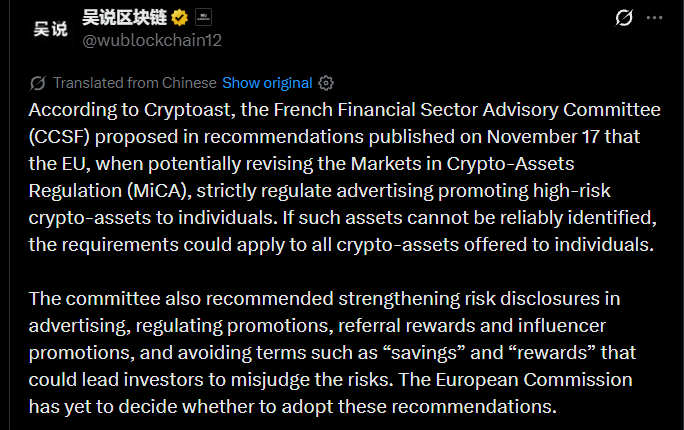
Source: Wu Blockchain X Post
High-Risk Crypto Promotions Could Face Tougher Requirements
The committee supports strict rules for ads about the riskiest crypto-assets when they target individuals. Identifying those assets may prove hard. If so, the CCSF says the same framework should cover all crypto-assets offered to individuals.
In practice, a MiCA Regulation Revision 2026 could change how exchanges, token issuers and ad platforms write their campaigns. Each ad would need clear, balanced risk information instead of a focus on possible gains.
Influencer Marketing, Referral Rewards and Gamification Under Scrutiny
The CCSF names several common industry practices. Algorithmic promotion targets users based on their behavior. Referral and reward programs encourage sign-ups. Gamification can push people into fast decisions during new token launches.
Influencer posts should show both benefits and risks, with warnings that are easy to see.
Wording matters too. The committee calls “savings” and “crypto-asset savings account” misleading, because they suggest low risk. It also wants platforms to drop “reward” for staking. It prefers “compensation” or “remuneration,” which sound less like a guaranteed gift.
Stronger Risk Disclosures for Lending, Borrowing and Staking
The CCSF wants platforms to explain the risks of each service separately. A general warning is not enough. Clearer disclosures would help retail investors understand what can go wrong before they commit money.
| Crypto service | Key risks requiring disclosure |
| Crypto lending | Loss of loaned funds and counterparty risks |
| Crypto borrowing | Collateral liquidation thresholds |
| Staking | Slashing penalties and withdrawal delays |
| Promotional reward programs | Misleading impressions of guaranteed or low-risk returns |
Data Protection and Non-EU Platforms
Attacks and extortion attempts against crypto holders are rising. The CCSF asks any entity holding identifying data to improve protection. That means access controls, records of who consults files and secure storage.
The committee also wants to limit “reverse solicitation.” This lets platforms outside the EU serve European clients without MiCA approval. It proposes stronger powers for ESMA, the European Securities and Markets Authority, to tackle the practice. Non-EU platforms with European customers could face closer supervision.
What Happens Next? The Commission Will Weigh MiCA Recommendations
These are recommendations, not binding law. The European Commission will decide whether any of them enter a future MiCA Regulation Revision 2026. No new advertising rule is in force today.
Exchanges, advertisers, influencers and investors should watch for Commission announcements. If adopted, the proposals could reshape how crypto products are promoted across the EU. The CCSF position also signals what France may push for in coming talks.
Timeline: France Push for Tighter Crypto Advertising Oversight
| Date | Development |
| 2016 | France introduces Sapin II, restricting ads for certain speculative financial products |
| 2023 | CCSF issues earlier crypto-related recommendations |
| November 17, 2026 | CCSF publishes six new recommendations for the European Commission |
| November 20, 2026 | Cryptoast reports on the proposed changes |
| Future | Commission decides whether to include them in a MiCA Regulation Revision 2026 |
Conclusion
France is pushing for stricter crypto advertising standards in Europe. The CCSF targets influencer marketing, referral campaigns, staking promotions and weak risk disclosures. Still, these ideas remain proposals. The European Commission has not adopted them, and they are not EU-wide rules. Readers should follow the official EU MiCA Regulation Revision 2026 debate for official updates.
Disclaimer: This article is for informational purposes only and is not investment, financial or legal advice. Cryptocurrency investments carry significant risk, including the loss of all capital. Always do your own research and consult a licensed professional before making decisions.






