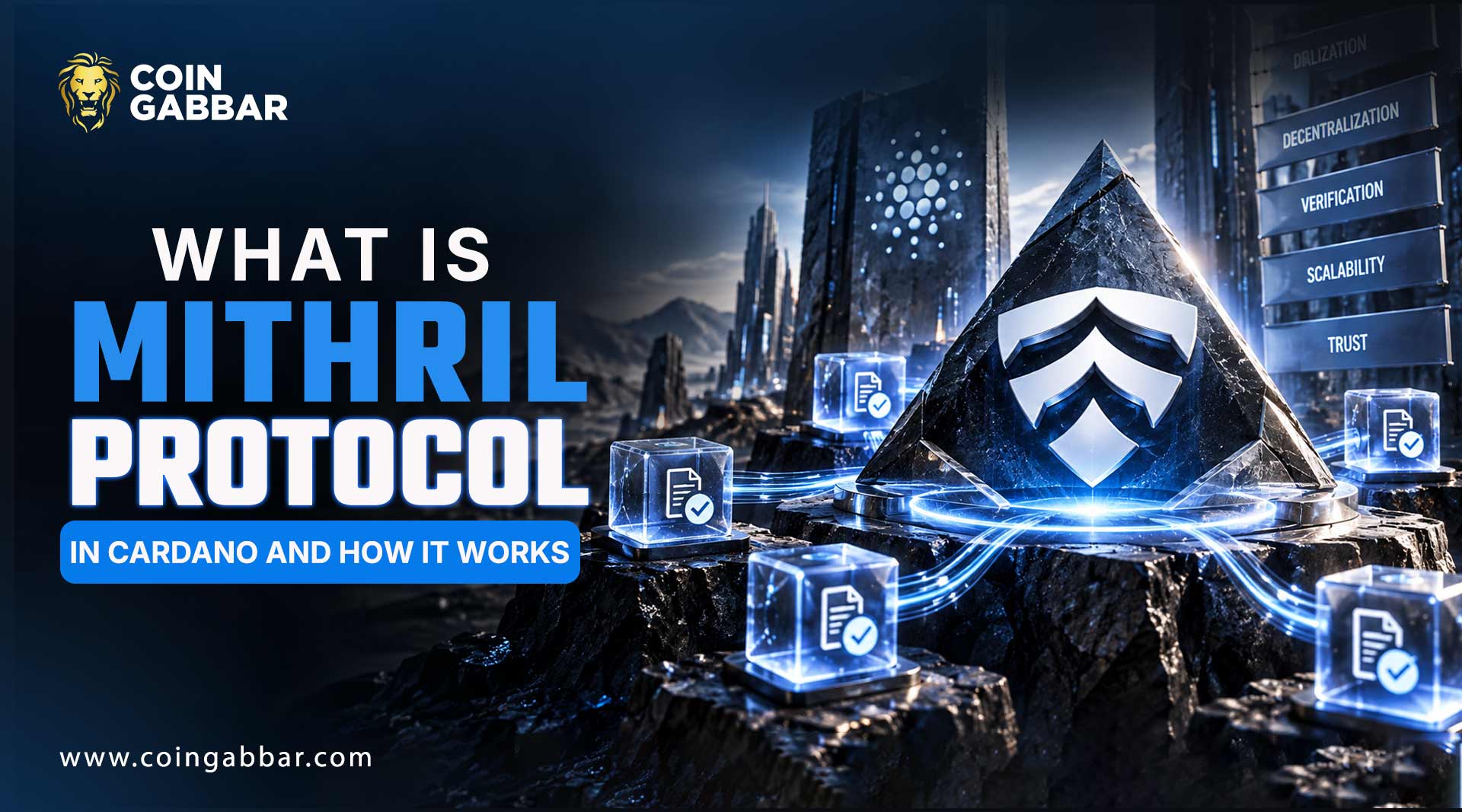
What Is Mithril Protocol in Cardano and How It Works

Why Is Mithril Protocol Important for Cardano?
Syncing a full Cardano node can take hours, sometimes longer depending on hardware and connection speed. That's fine for a stake pool operator running dedicated infrastructure. It's not fine for someone who just wants to open a light wallet on their phone. This is the gap the Mithril Protocol in Cardano was built to close.
Mithril lets a client trust a snapshot of the blockchain's state without downloading and replaying every block since genesis. It does this through a stake weighted signature scheme rather than a full re-validation process. For readers trying to understand why Cardano keeps mentioning Mithril in its development updates, this article breaks down what it is, who runs it, and where it fits into the network today.
What Is Cardano and How Does It Work?
Cardano is a proof-of-stake blockchain built on the Ouroboros consensus protocol, developed through research from Input Output Global (IOG), the Cardano Foundation, and Intersect. Its native token is ADA, and the network supports smart contracts, stake pool delegation, and a growing set of decentralized applications.
Mithril was originally designed during Cardano's Basho development phase, the stage focused on scaling, optimization, and interoperability.
What Is the Mithril Protocol in Cardano?
According to Cardano's own documentation, Mithril is a protocol and network built for proof-of-stake blockchains. Its goal is to give lightweight, secure access to blockchain data without asking every user to store and verify the full chain history.
In practice, Mithril allows Cardano's stake pools to collectively sign a snapshot of the blockchain state. Each pool contributes a partial signature weighted by how much stake it holds. Once enough stake has been signed, those partial signatures combine into one compact multi-signature that a client can verify quickly. That verified snapshot is what powers faster node bootstrapping and lighter wallet software.
Why Does Cardano Need the Mithril Protocol?
Full nodes are secure, but they're heavy. New users, mobile wallets, and layer 2 systems like bridges and rollups don't always need to re-validate the entire chain themselves. They need a fast way to confirm that a given piece of data is genuine.
That's the specific problem Mithril addresses. Instead of trusting a single server or a centralized API, a client can check a Mithril certificate against a known aggregate key and a trusted genesis certificate. The verification is mathematical, not based on blind trust in whoever is serving the data.
How Does the Mithril Protocol Work?
The Mithril protocol runs in three phases, as laid out in the official documentation:
Protocol establishment: Core parameters are set, including how many lottery attempts each signer gets and the minimum number of winning entries needed to form a valid signature.
Initialization: Participating signers generate and broadcast their keys along with proof of possession. This happens at the start of every new epoch, which lasts five days on Cardano. These keys are condensed into an aggregate verification key (AVK).
Operations: Signers create individual signatures, aggregators combine them into a multi-signature once a quorum of stake is reached, and the result is sealed into a Mithril certificate.
How Do Mithril Signers and Aggregators Work?
Three participants keep the system running: signers, aggregators, and clients.
Stake pool operators (SPOs) can run a Mithril signer. When a new message, such as a blockchain snapshot, needs certification, each signer takes part in a lottery. The odds of winning are tied directly to the signer's stake, so pools with more delegated ADA get more chances to contribute a valid signature.
Signers who win at least one lottery round produce an individual signature and send it to a Mithril aggregator. The aggregator's job is to collect these signatures and merge them into a single multi-signature once the required quorum of stake has been reached.
What Are Mithril Certificates and Snapshots?
Once the quorum is met, the aggregator packages the multi-signature, the signed message, and supporting metadata into a Mithril certificate. This certificate is the proof that a sufficient share of Cardano's total stake has endorsed that particular snapshot.
Snapshots typically represent the state of the Cardano node database at a given point. A wallet or new node operator can download this snapshot alongside its certificate and confirm authenticity without re-executing years of transaction history.
How Does Mithril Verify Cardano Blockchain Data?
Verification on the client side is designed to be lightweight. A client checks the multi-signature against the known aggregate verification key and traces the certificate back through a chain to a trusted genesis certificate. No block-by-block replay is required.
This matters for stake pool delegators too, since Mithril's security depends on honest participation from a broad set of pools rather than a handful of large ones.
What Are the Main Mithril Use Cases?
Cardano's documentation lists several practical applications for Mithril beyond just faster node sync:
Use Case | What It Solves |
Light wallets | Verify balances and transactions without a full node |
Full node bootstrapping | Cuts initial sync time from hours to minutes |
Layer 2 bridges | Gives external systems a verifiable view of Cardano state |
Sidechains and rollups | Supports secure data exchange without full replication |
Mobile applications | Reduces the resource footprint needed to interact with the chain |
These cases connect with broader ecosystem applications on Cardano, where lighter infrastructure lowers the barrier for new products.
What Are the Benefits of Mithril for Cardano?
Faster access: New nodes and wallets can trust recent chain states in minutes instead of hours.
Lower resource use: Mobile and light clients don't need to store the full ledger history.
Stake-weighted security: Signing power scales with actual delegated stake, keeping the process aligned with Cardano's proof-of-stake design.
Composability: Bridges and layer 2 tools can plug into a verifiable data source rather than building their own trust assumptions.
Mithril isn't Cardano's only scaling-adjacent project. Readers may also want to see how Hydra scales transactions, since Hydra focuses on throughput while Mithril focuses on data access and sync speed.
What Are Mithril's Limitations and Security Risks?
Mithril's security model depends on honest participation from a meaningful share of stake. If too few signers take part, reaching quorum takes longer. The project's own threat model analysis notes that, like any stake-weighted system, assumptions shift if stake becomes heavily concentrated among very few pools.
It's also worth separating what's confirmed from what's still developing. The core signer, aggregator, and client components are described as production-ready in the official documentation, but newer additions, such as SNARK-based genesis certification, appear in recent development updates and count as ongoing engineering work.
Mithril doesn't replace full node validation for everyone. Operators who want the highest level of independent trust still run full nodes. Mithril suits cases where speed and lower resource use matter more than replaying every historical block.
What Is the Future of Mithril in Cardano?
Cardano's public development reports continue to reference Mithril alongside other scaling work such as Leios and Hydra. The stated direction is broader adoption across wallets, bridges, and infrastructure that needs quick, verifiable access to chain data. Treat specific timelines as plans, not guarantees, since pace depends on continued research and SPO participation.
What Should Users Know About Mithril?
The stronger signal here is technical, not speculative. Mithril's stake-weighted multi-signature design is a conservative cryptographic approach, and its documentation is detailed enough to verify independently.
The main concern for newer readers is not to overstate what Mithril does. It speeds up data verification and node sync. It does not change Cardano's underlying consensus mechanism, and it is not a token or an investment product.
The data suggests a steady, incremental rollout rather than one dramatic launch event. The biggest unknown remains how quickly bridge and wallet developers integrate Mithril certification outside of IOG's own reference tools, something worth tracking through Cardano's public development reports.
Conclusion
The Mithril Protocol in Cardano gives light wallets, new nodes, and layer 2 tools a fast, verifiable way to trust recent blockchain state without downloading the entire chain history. It works through a three-phase signing process involving signers, aggregators, and certificates, with security tied directly to stake participation.
The core components are already running in production, while some newer features are still evolving. Anyone building on or interacting with Cardano's lighter-weight tools should check the official Mithril documentation directly for the current technical specifications before relying on secondhand summaries.
Disclaimer
This article is for informational purposes only and does not constitute financial or investment advice. Cryptocurrency markets and blockchain infrastructure carry risk, and readers should verify technical claims through official sources before making decisions.