Will Vesting Pressure the Token After the Mutuum Presale Ends?

Mutuum Presale End: What Could Happen to MUTM?
The Mutuum presale is close to finishing Phase 7, yet the bigger question starts after the final phase closes.
The documentation sets a six-month unlock schedule for buyers. This report asks how that timeline could shape the MUTM outlook.
Latest Dashboard Reading Before the Next Step
As of November 15, 2026, the dashboard shows:
Total raised: $26,532,744.25
Phase progress: 98%
Current rate: $0.04 per MUTM
Holders listed: 19,461
Countdown timer: 14h 20m 30s
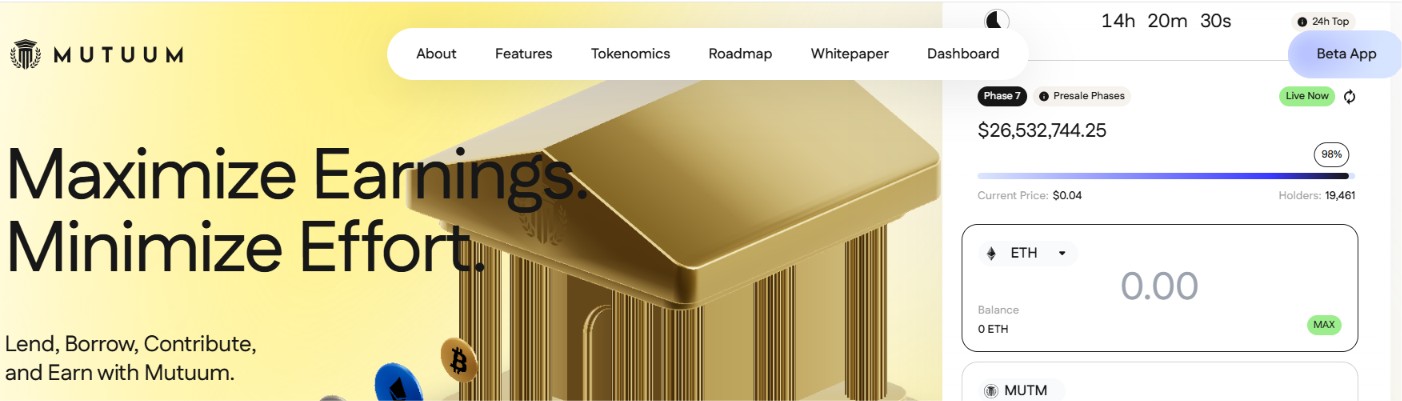
Source: Official Dashboard
Will Vesting Pressure MUTM After the Mutuum Presale Ends?
The allocations page sets a six-month vesting plan for buyers. Nothing unlocks at launch or through the first month. After that, 20% unlocks at the end of each month.
Stage | Unlocked share | Forecast relevance |
Launch | 0% | No sellers |
Cliff end | 0% | Float stays tight |
Second release mark | 20% | First selling window |
Fourth release mark | 60% | Float builds |
Sixth release mark | 100% | Full float |
This design may limit early selling. It also means the heaviest supply pressure arrives later, not on day one. A buyer sitting on gains would need to wait before taking profit.
Suppose the token lists near $0.06. A buyer who paid $0.04 would hold a 50% gain at that level. That gain gives a reason to sell once releases begin.
Locked Liquidity and Team Cliff Shape the Supply Timeline
Other allocations in the same document run on their own clocks:
Liquidity allocation: 400,000,000 MUTM, locked for an initial six months
Team and founders: nothing unlocked for six months, then linear release through month 18
Leaderboard rewards: released on the same schedule as buyer tokens
The liquidity lock and team cliff cover the same early window. That reduces insider supply while buyer tokens stay locked.
The picture changes once all three schedules begin releasing together. Each date is a checkpoint that traders can watch in the documentation.
Price Outlook Scenarios Across the Unlock Window
The table below ties each stage to a possible trading range. It uses the documented $0.06 listing figure from the MUTM token page as its anchor.
Window | Market backdrop | MUTM outlook range |
Listing and cliff | No early releases, liquidity locked | $0.05 to $0.07 |
First unlock steps | 20% steps begin, selling risk rises | $0.04 to $0.065 |
Full unlock | All presale tokens free to move | $0.035 to $0.08 |
The widest range sits at full unlock. Supply and demand both peak there, so outcomes spread out.
These are scenarios, not targets, because the token has no trading history yet. Each Mutuum presale scenario also depends on whether holders sell at the first release.
Each range rests on a simple logic:
Listing and cliff: few sellers keep trading near the $0.06 anchor, with demand setting the range
First release steps: each 20% step adds 364,000,000 MUTM, based on the 1,820,000,000 allocation on the docs page
Full unlock: the entire allocation can move, so sentiment drives the outcome more than supply
Open Questions That Could Decide the Outlook
Several questions remain before any range looks firm:
Will early buyers hold through the cliff, or exit at the first unlock?
Can exchange demand absorb a 20% unlock without a sharp drop?
Will trading depth hold up on launch day?
Will the liquidity lock stay in place after six months?
Will the wider crypto market stay stable during the unlock window?
Each answer shifts the weighting between the scenarios. The Mutuum presale outcome alone does not settle them.
Launch conditions matter just as much, and so does how fast early buyers act after the cliff ends. A calm opening month could shift weight toward the base range.
Closing Outlook After the Mutuum Presale Closes
Vesting gives the token a staged supply path, which may soften the opening weeks after launch.
A slow release could also keep the trading range tighter than the widest scenario. The risk moves later, when unlocks stack with team releases and the end of the liquidity lock.
The Mutuum presale still has steps left, so these scenarios may change as the final phase approaches. Readers should weigh each range against live trading data once it exists, and follow the dashboard and the documentation for confirmed updates.
YMYL Disclaimer: This article is for educational and informational purposes only. It is not financial advice, and the scenario ranges are not guarantees of price or returns. Crypto assets carry high risk, so readers should do their own research.
















