Naox Protocol News: NIST Finalizes Post-Quantum Standards for 2031

Naox Protocol News centers on a NIST release. On October 27, NIST published the final version of its post-quantum transition report.
NaoX says its Layer 1 fits that timetable. This crypto news today item separates NIST's words from the project's claims.
Key Takeaways
NIST released the final report, NISTIR 8547, on October 27. Its page ties federal migration to 2030 for key setup and 2031 for digital signatures. The main target is 2035.
NaoX says its Layer 1 uses ML-DSA-87 signatures and ML-KEM-768 keys. Those claims come from the project's own update.
The deprecation dates in the NaoX update are not on NIST's news page. That page does not mention NaoX.
What Did NIST Publish in Its Post-Quantum Transition Report?
The report is NISTIR 8547. It names methods that quantum computers could break.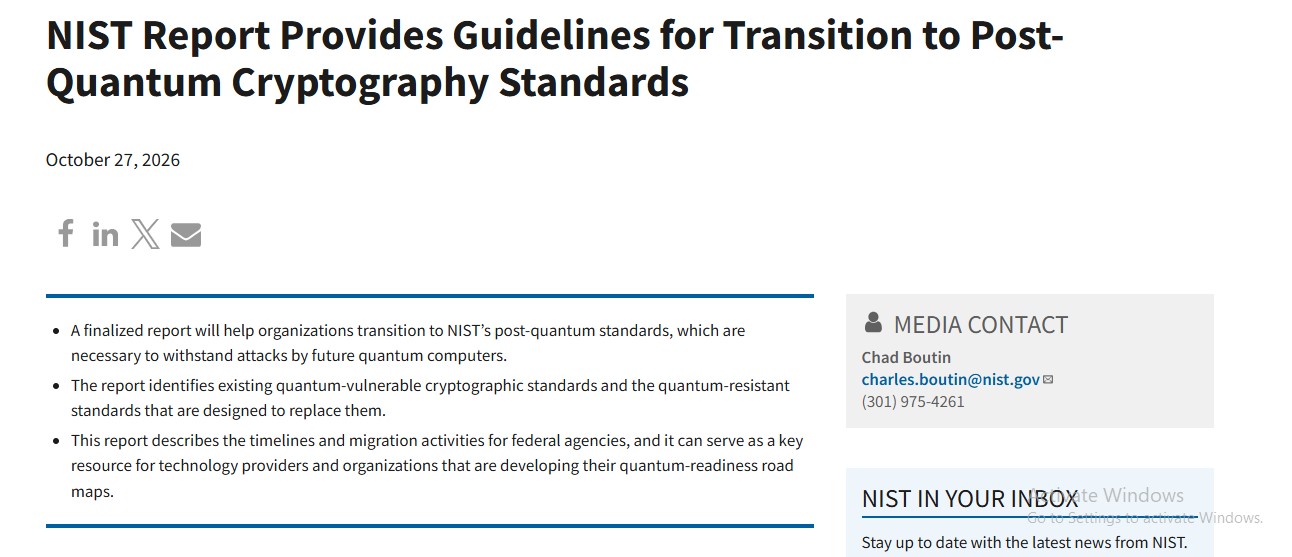
Source: NIST news release, captured October 29, 2026
It then gives a plan to replace them. The new NIST quantum-safe cryptography standards came out in August 2024. This is the NIST cryptography transition plan.
NIST's Dustin Moody said, "There's not one strategy that fits all use cases." The report covers a hybrid option too.
It mixes old encryption with new methods. NIST allows it. It needs more computing power.
Why Is 2031 Important for Post-Quantum Cryptography?
Two federal directives set the dates. National Security Memorandum 10 set 2035 as the main goal. Executive Order 14412 sped that up.
It sets 2030 for key establishment and 2031 for digital signatures. They cover federal high-value and high-impact systems. NISTIR 8547 supports those dates.
NIST-cites "harvest now, decrypt later" attacks as the reason to act. Stolen data could be read later.
Quantum computers that can do this are still being built. The page does not discuss blockchains.
Can Naox Protocol Meet NIST Post-Quantum Standards?
@NaoXprotocol says it is aligned with final standards. It says its quantum-resistant Layer 1 was built on that architecture. The update lists five features of its post-quantum blockchain security:
ML-DSA digital signatures sign transactions, using ML-DSA-87 at Security Level 5.
Signatures are checked in the protocol in about 38.5 µs.
Keys are enrolled with ML-KEM-768.
Hybrid transactions run on a forward-only path.
The validator registry has taken only 2,592-byte ML-DSA-87 keys since genesis.
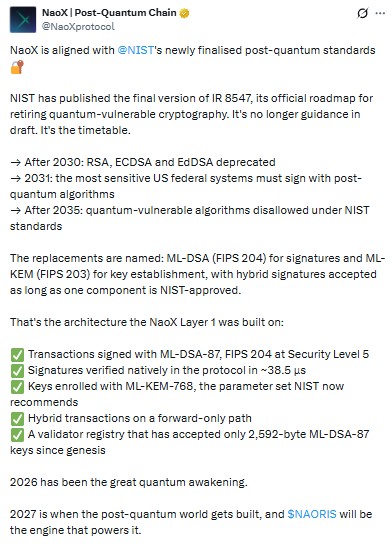
Source: @NaoXprotocol on X, captured October 29, 2026
The Naox post-quantum security update closes with a pitch. It says 2027 is when the post-quantum world gets built, and the $NAORIS token will power it.
Does Naox's Post-Quantum Design Align With Official Standards?
That is the project's claim, and this Naox Protocol News report treats it as unverified. NIST's page does not mention NaoX.
It names FIPS 203 as the key establishment standard. The update ties FIPS 203 to ML-KEM for key establishment. The page does not name ML-DSA, ML-KEM, or FIPS 204.
In the update, one says RSA, ECDSA, and EdDSA are deprecated after 2030. Another says vulnerable methods are disallowed after 2035. The full report may state them. It was not reviewed.
The hybrid rule is a gap too. The update says hybrid signatures are accepted if one part is NIST-approved. The page says only that it allows a hybrid option. The speed, key, and validator claims have no outside check.
Conclusion
NIST's report backs a timeline for federal systems. NaoX says its Layer 1 fits it. Outside checks are still missing. Whether they arrive is the open question for Naox Protocol News and for crypto news today.
YMYL Disclaimer
This article is for information only and is not financial or investment advice. Crypto projects and tokens carry a high risk of loss. Project claims in this article are not independently verified. Check details with official sources.








