NEAMA Protocol Presale: Tokenomics and Key Risks


What Is the NEAMA-Protocol Presale and How Does It Work?
Five million NMA tokens, and not one more can ever be minted. That fixed supply is the headline number behind the NEAMA Protocol Presale, a crypto presale that opened on October 10, 2026. According to NEAMA’s official site, NMA is the native token of a project that wants to link crypto with everyday cross-border banking.
The whitepaper describes a Web3 financial layer across five corridors: North America, Europe, Africa, the Middle East, and Asia. That’s a big ambition. What’s live today is much smaller, and this guide keeps the two apart.
How Does the NEAMA-Financial Platform Aim to Work?
The whitepaper lists seven planned pillars: near-zero-cost remittances, sub-second settlement, fiat on- and off-ramps tied to bank networks like SEPA and ACH, steadier settlement for businesses, tokenized real-world assets, crypto debit cards, and multi-currency virtual IBAN accounts.
NEAMA’s own site marks the multi-currency accounts, RWA investing, and Visa-powered cards as “Coming Soon.” That label applies to the products, not the presale.
Tokenizing real-world assets isn’t new either, and several RWA crypto projects already run live products, which gives a useful yardstick.
What Are the NEAMA Presale Dates and Token Prices?
According to NEAMA’s official site, the NEAMA Protocol Presale runs in three phases from October 10, 2026. Phase 1 costs $0.50, Phase 2 costs $0.60, and Phase 3 costs $0.70 per NMA.
Two private rounds follow at $0.60 each, with a six-month cliff. After that, two public ICO rounds sell at $0.80 and $0.85, with a two-month cliff, ahead of the stated listing target of $1.00.
A cliff is a waiting period before tokens can be sold. One oddity: the private rounds at $0.60 sit below. Phase 3’s $0.70, and the published material doesn’t say why.
The sale page shows an end date of October 31, 2026, but the whitepaper itself doesn’t give one. The later-round prices and the listing target come from the project alone. Check the live dashboard before you pay, and set these numbers beside other early token sales before deciding anything.
How Is the NMA Token Supply Allocated?
Allocation | Share | Tokens (NMA) |
Locked Reserve | 30% | 1,500,000 |
Exchange Listings | 20% | 1,000,000 |
Owner Holdings | 10% | 500,000 |
Team, R&D, Marketing | 10% | 500,000 |
Presale | 10% | 500,000 |
DEX Liquidity | 10% | 500,000 |
Private Round | 5% | 250,000 |
Public ICO | 5% | 250,000 |
The shares add up to 100%, and the token counts add up to exactly 5,000,000.
The whitepaper claims about 60% of supply sits under multi-year locks or DAO-voted release rules. If that holds, far fewer tokens could hit the market at once. Right now, though, that protection exists only on paper, and nothing confirms it’s enforced on-chain.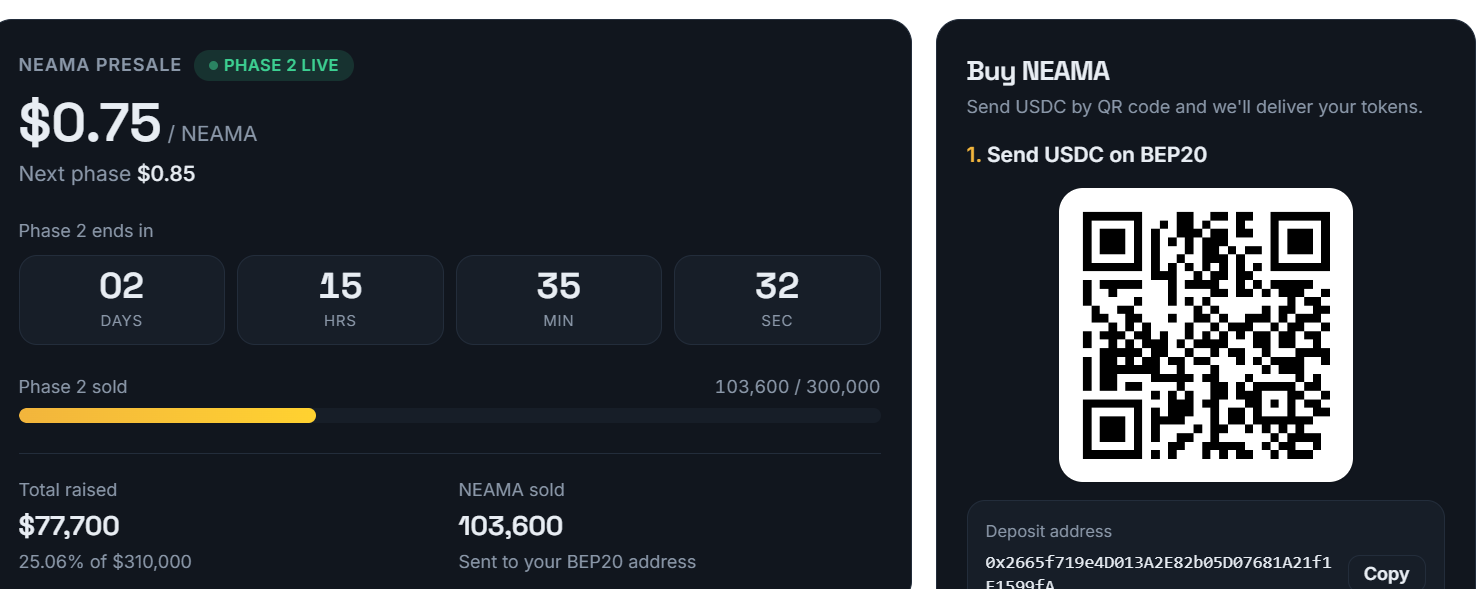
One more number to keep in mind: at the $1.00 target, 5 million tokens would equal a $5 million fully diluted value. That’s a project goal, not a market price.
What Could NMA Tokens Be Used For?
The project links NMA to future platform services, staking, and, later on, DAO votes over the 30% locked reserve and the team’s funds. Those votes only start when the roadmap reaches full DAO decentralization in 2028 or after, meaning an organization run by token holder votes.
One question stays open. Will any NEAMA service really need NMA, or will it only accept NMA as one payment option among many? The answer matters, because it separates real token demand from a coin that just tags along.
What Does the NEAMA Roadmap Plan for 2026 to 2028?
The roadmap runs in four stages. Q4 2026 covers the presale and security audits. In Q1 and Q2 2027, the plan is to run the private and public rounds, create the token, and reach an exchange listing.
Virtual accounts with their own IBANs and the crypto debit card are slated for Q3 and Q4 2027, along with off-ramp links in Africa and the Middle East.
The 2028 phase brings a portal for RWA tokenization, covering fractional real-world assets and US stocks, and it moves the 30% locked reserve and the team’s funds under DAO governance.
All these dates come from the project, and no one outside has confirmed it can meet them. Roadmaps are easy to write and hard to keep, so treat each quarter as a target, not a promise.
What Are the NEAMA Vesting and Security Details?
Presale tokens carry a three-month cliff after token generation. Owner holdings face a two-year cliff, then release 0.5% a month for 200 months, which is roughly 17 years.
The whitepaper also describes a mandatory five-day staking lock before any sell or swap order clears after listing, meant to slow bot-driven dumping.
Admin actions are said to need a 5-of-9 multisig, meaning five of nine keyholders must approve, plus a 48-hour time lock.
CertiK and Hacken are named as planned auditors. Until a finished report is public, it makes sense to verify contract and vesting terms directly.
No finished, public audit report was available at the time of writing. Check for one on the auditor’s own portal, and run through a checklist to verify a crypto presale before sending any funds.
What Risks Should Readers Check Before the NEAMA Protocol Presale?
Price risk: the $1.00 listing target is a goal, not a promise.
Audit risk: the CertiK and Hacken reviews are planned, not confirmed finished.
Contract risk: check any posted contract address yourself on a blockchain explorer.
Ticker mix-up: another project also uses the NMA ticker, so make sure you’re looking at NEAMA’s own contract.
Product risk: cards, IBANs, and RWA tools are all slated for 2027 and later. Nothing is live today.
Liquidity risk: early buyers may not find a ready market at the price they want.
Comparing these terms with how the best crypto presales structure theirs shows what’s normal and what isn’t.
Conclusion:
The NEAMA Protocol Presale pitches a wide plan: remittances, bank rails, crypto cards, and RWA tokenization under one roof, backed by a published tokenomics table and a dated roadmap.
What stands out is how specific the whitepaper gets on vesting and the anti-dump staking rule. What’s still unverified is the live contract address, any finished audit, and whether the 2027 product dates hold.
Treat the whitepaper as a plan, confirm every figure through NEAMA’s official channels, and weigh it against other upcoming crypto presales before deciding anything.
Disclaimer: Nothing here is financial advice. Presales carry high risk, including losing everything you put in. Confirm current terms on NEAMA’s official website before joining the NEAMA Protocol Presale.
















