NeoSoul Crypto Token: How Its AI Agent Ecosystem Works

NeoSoul Crypto: Exploring DNA Token Utility and AI Agents
NeoSoul Crypto is an AI agent project that wants to prove trading agents can be measured before they handle serious money. Its token, DNA, began trading on October 16, 2026, which pushed the project into wider view.
Search interest has followed the launch. Many want to know what the agents do, how-DNA fits in, and how much supply circulates.
How Does the NeoSoul Crypto AI Agent Ecosystem Work?
Among AI crypto projects, the pitch of NeoSoul Crypto is unusual. The project says an agent should build a track record before it gets authority over capital.
Evoevo is the data side. It organizes sources, forecasts, outcomes, and post-mortem reviews into records that models can learn from. The whitepaper describes it as a data-readiness and evaluation engine.
NeoTrade is the action side. It is a local-first desktop client for macOS and Windows. Users set the rules, and agents research markets and act inside those limits. Today it supports paper trading and prediction markets.
How Do the Agents Learn From Outcomes?
Every run leaves a record of judgment, action, and result. Those records feed back into models, memory, and strategy playbooks. The project calls this a constrained self-improvement loop.
Updates do not go straight to real money. The whitepaper says they pass offline tests and a limited canary rollout first.
The company also says its agent network has passed 4 million agents and 11 million predictions. Those numbers are project claims, not independently audited data.
Who Controls the Funds?
Users keep custody. According to the white paper, NeoSoul does not hold user funds, promise returns, or pool assets into a managed fund. Private keys stay in local encrypted storage, and only data needing public settlement or proof goes onchain.
What Is the DNA Token Used For Inside NeoSoul Crypto?
DNA is the settlement and incentive token of the ecosystem. Total supply is fixed at 1,000,000,000 DNA. The planned uses are:
Product payments: NeoTrade is set to accept DNA as its only payment method for agent services, skills, and data services.
Technical services: partners get 20% off when they pay in DNA. Stablecoins remain a second option.
Company operations: DNA gets priority in internal settlement and partner payments.
Rewards: the Agent Developer Program and qualifying Agent Owners in NeoTrade can earn DNA.
Product access: holding or staking DNA will unlock higher tiers later, with details unpublished.
What Does the NeoSoul Crypto Tokenomics Model Look Like?
The published tokenomics document splits the fixed NeoSoul-Crypto supply across eight categories.
Allocation | Share | Tokens | Purpose |
Ecosystem | 36.175% | 361,750,000 | Developers, agent owners, growth |
Investors | 16.825% | 168,250,000 | Early backers |
Marketing | 15% | 150,000,000 | Campaigns and partnerships |
Treasury | 10% | 100,000,000 | Long-term reserve |
Team | 10% | 100,000,000 | Current and future contributors |
Airdrop | 6% | 60,000,000 | Early users and community |
Liquidity | 4% | 40,000,000 | Exchange liquidity |
Advisors | 2% | 20,000,000 | Advisors |
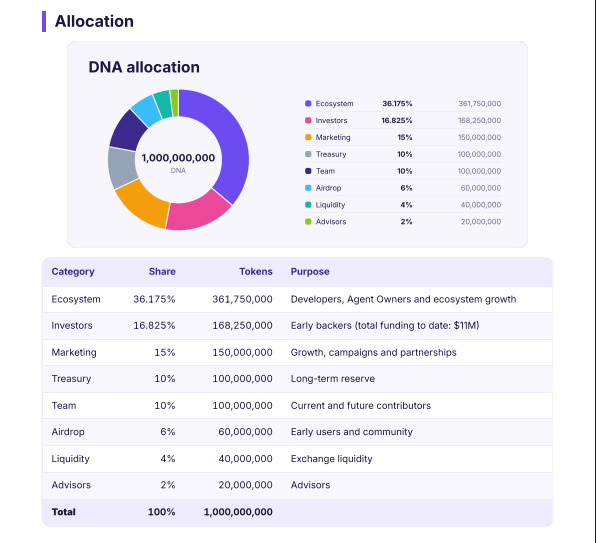
The ecosystem is the largest slice, so growth incentives carry the most weight. Investors hold 16.825%, tied to the $11 million the project says it has raised. Liquidity is only 4%.
How Does the DNA Unlock Schedule Work?
Investors, the team, treasury, and advisors receive nothing at the token generation event. Their tokens stay locked for 12 months, then unlock monthly for 24 months. Ecosystem tokens unlock from month 4, and the full supply is free by month 39.
On day one, 130,000,000 DNA (13%) was circulating: 60 million marketing, 40 million liquidity, 20 million ecosystem, and 10 million airdrop. About 355 million DNA should be unlocked after one year.
That gap matters. Market cap counts circulating tokens only, while fully diluted valuation (FDV) counts all 1 billion. With 13% circulating, FDV sits far above market cap.
Did the Team NeoSoul Crypto Unlock Rules Change?
Yes, partly. On launch day the Believe Plan kept the 12-month team lock but replaced linear monthly releases with KPI-linked unlocks. The project says the KPIs will be shaped with community input. How strict they are will decide whether the change means much.
Where Is DNA Listed? NeoSoul Crypto Launch Details
The project describes itself as working across the BSC and 0G ecosystems. The tokenomics document names Binance Alpha as the first venue, with trading from 16:00 (UTC+8), plus OKX perpetual futures subject to exchange announcements.
The project's launch announcement later added KuCoin, Bitget, Gate, and MEXC. For launch-day listing details, each exchange's own notice sets the pairs and trading times.
Price is left out on purpose, because it moves too fast for a static article. Early trading often swings sharply, and a 13% float can add to that.
NeoSoul Crypto Airdrop: How To Claim DNA Tokens?
The NeoSoul Crypto airdrop pool holds 60,000,000 DNA, or 6% of supply, set aside for early users and the community. The schedule shows 10 million unlocked at launch, with the rest vesting monthly after a two-month lock-up.
Eligibility is checked by connecting a wallet on the airdrop checker page. The check window runs from October 15 to October 23, 2026 (UTC+8).
On Binance Alpha, eligible users could claim 400 DNA with Alpha Points, first come, first served. A separate Questboard also rewards community tasks, a common format among crypto airdrops.
What Does the NeoSoul Crypto Roadmap Say About What Comes Next?
The NeoSoul Crypto roadmap in the whitepaper has five stages. Each sets the evidence needed before deployment widens.
Stage | Focus |
1. Operable and observable | Controlled execution and behavior logging |
2. Learnable and evaluable | Decision datasets and holdout testing |
3. Verifiable and deployable | Staged, constrained live trading |
4. Generalizable | Centralized exchanges, decentralized exchanges, U.S. equities |
5. Available at scale | Reusable specialized agents |
The blockchain track moves in parallel: self-custody and onchain settlement first, then verifiable records such as hash commitments, with a contribution network as the long-term stage.
No calendar dates are given. The docs call later stages planned or exploratory, subject to product readiness.
What Does the NeoSoul Crypto Whitepaper Actually Claim?
The NeoSoul Crypto published white paper argues that a strong model alone is not enough. Agents also need memory, tools, controlled execution, and real-outcome feedback.
It also sets a high bar for evidence. One correct forecast or profitable trade is not treated as proof. Judgments must hold up across time, samples, and markets.
The paper also makes no short-term return promise and keeps humans as final decision-makers.
What Risks Surround NeoSoul Crypto Right Now?
Unproven performance: the product is new, and live agent results have a short record.
Low float: only 13% circulated at launch, so later unlocks could add selling pressure.
Changing terms: team vesting has already shifted once, and the tokenomics document says details may change.
Market exposure: agents trade real accounts, so losses, thin liquidity, and regulation all apply.
Unaudited claims: agent and prediction counts are self-reported, and no smart contract audit report appeared in the materials reviewed.
Impersonation: fake contracts and claim pages are common around token launches.
Is NeoSoul Crypto Worth Watching After Launch?
NeoSoul Crypto pairs a data engine with a trading client, aiming to rank agents by measured results. The fixed supply, 12-month investor lock-ups, and plain no-returns language stand out.
Still uncertain are live agent performance, the KPI-based team unlocks, and how fast the project moves past prediction markets. Rule changes appear first on NeoSoul's X account, and supply data should be rechecked against live trackers.
Disclaimer:
This article is for information only and is not financial advice. Crypto assets are volatile and can lose value quickly. Investors should research independently and consult a licensed advisor before making decisions.
















