New York Prediction Market Tax: What the FUTURES Act Proposes


New York Prediction Market Tax: Could Operators Pay 10% on Fees?
New York State Sen. Jeremy Cooney introduced Senate Bill S.10748, the FUTURES Act, on November 23, 2026. It proposes a 10% tax on prediction market operators' net trading fee revenue from New York.
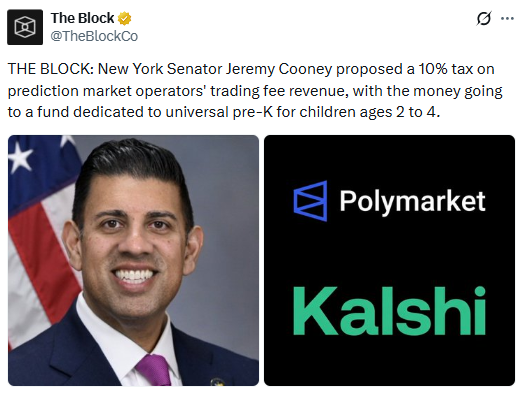 Source: X (formerly Twitter)
The money would fund universal pre-K for children aged 2 to 4. The bill is in the Senate Rules Committee and isn't law. That is per the official bill page, checked November 25, 2026.
How Would the 10% Be Calculated?
This New York prediction market tax hits operator fees. It isn't 10% of bets, deposits or volume.
Rate: 10% of net trading fee revenue apportioned to New York
New York connection: a resident, domiciled and physically present in the state, trades an event contract and pays trading fees
Deductions: broker, software, data and market-maker pay; promotions; clearing and withdrawal fees; necessary compliance costs
Filing: quarterly
For illustration, $1 million in qualifying net fee revenue apportioned to New York would mean $100,000 in tax. This is hypothetical, not a earnings estimate.
The bill's scope is narrower than the wider industry. Its event-contract definitions focus on sports-related contracts and exclude commodity-price contingencies. Readers shouldn't assume every political, election or economic contract falls inside the proposed rules.
The bill also addresses gains. It directs revenue from individuals' existing income tax and corporations' existing franchise tax to the Futures Fund. But it says the individual provisions create no additional tax and change no rates.
What Consumer Protections Does the FUTURES Act Include?
Area | Proposed rule |
Identity | Verify age and identity before trading |
Limits | Deposit limits and cooling-off periods |
Self-exclusion | Minimum one-year exclusion |
Advertising | No misleading or "risk-free" claims; marketing opt-outs |
Privacy | Privacy policy and data safeguards |
Insider trading | Bans trading on nonpublic information; bars elected officials and some state employees |
Oversight | Annual report to the Attorney General and independent audit |
Election crimes | Felony to use a platform for an election-law offense |
Penalties | Up to $25,000 per violation; up to $100,000 for willful or reckless conduct |
Customer funds would be kept separate from operator funds. Available balances would be withdrawable within five business days. Open positions, holds, compliance inquiries, identity checks and margin commitments can limit that.
The Futures Fund would pay school districts for 2-K, 3-K and 4-K programs.
New York Prediction Market Tax: Law or Still in Committee?
Still in committee. If enacted, it takes effect 180 days later.
The bill says federal obligations under the Commodity Exchange Act, CFTC rules or NFA rules control where they conflict. It doesn't resolve the wider state-federal dispute.
Separately, reports say a New York judge didn't immediately block Kalshi from operating at a November 23 hearing. That doesn't mean S.10748 has passed.
State | Tax approach |
North Carolina | 6% of net trading fee revenue, from 2027 |
Kentucky | 14.25% on a broader base including contract purchases, from 2027 |
New York proposal | 10% of net trading fee revenue apportioned to the state |
A fee-based New York prediction market tax differs from taxing contract value. Users may trade far more than operators earn in fees. No reliable revenue estimate was found.
The Bottom Line
The New York prediction market tax would target operator fees, not users' bets. Watch for committee action and any revenue estimate.
YMYL Disclaimer: This article is for informational purposes only and is not legal, tax or financial advice. It is based on New York Senate Bill S.10748 and supporting reports reviewed on November 25, 2026. The FUTURES Act is a proposal and may change or fail to become law.


Frequently Asked Questions (FAQ)




