Next Crypto to Explode: NEAR Needs $4B to Double as an Original Pepe Cofounder Backs Pepeto Near $80M


The whole crypto market is valued near $2.21 trillion this week, with Bitcoin trading about half below its $126,080 record. Big multiples in past cycles started from drops like this one, so the useful question is which entry gives $100 the most room to grow for anyone searching for the next crypto to explode.
This test puts one $100 entry into NEAR, Bittensor, Aave and Pepeto, a presale-stage Ethereum meme coin with trading tools in the works and no exchange listing yet. One yardstick covers all four: the fresh market value each one needs to double.
$100 in NEAR (NEAR), Bittensor (TAO) and Aave (AAVE): What Doubling Takes
On November 20, 2026, $100 buys about 33 NEAR at $3.05. NEAR runs a fast blockchain whose Intents system lets users swap across many chains in one step, and its governance just cut the maximum yearly issuance from 2.5% to 1.6%. With a market value near $4 billion, NEAR needs about $4 billion of fresh money to double, lifting that $100 to $200.
Bittensor works out differently, as $100 picks up about 0.57 TAO at roughly $175. The network pays miners in TAO for useful AI work and caps supply at 21 million coins, and it added quantum-resistant wallets this month. TAO is valued near $2.05 billion, so a $2.05 billion inflow is what turns the stake into $200.
Aave, one of the largest lending markets in decentralized finance, turns the same $100 into about 0.96 AAVE at $104. Its V4 upgrade this year opened credit markets run by partners such as Lido and EtherFi on shared liquidity. At about $1.61 billion in value, AAVE must draw roughly $1.6 billion of new capital before $100 becomes $200.
Together the three are worth about $7.7 billion, and that size brings deep liquidity and steady trading for larger portfolios. The arithmetic still matters: turning $100 into $1,000 across all three would take roughly $69 billion of new capital.
$100 or $1,000 in Pepeto (PEPETO): Two Entries Measured Against Half of Shiba Inu's Record!
The biggest meme coin fortunes went to small buyers who got in before the first listing. Today $100 buys about 526.8 million PEPETO at $0.0000001898, in a presale that has raised $11.3 million from more than 40,000 holders. Think of Pepe, then add real tools, and you get Pepeto, a meme coin built on Ethereum by a team that includes an original Pepe cofounder and is building a no-fee exchange for holders. That price lasts until the stage timer runs out or its supply is gone.
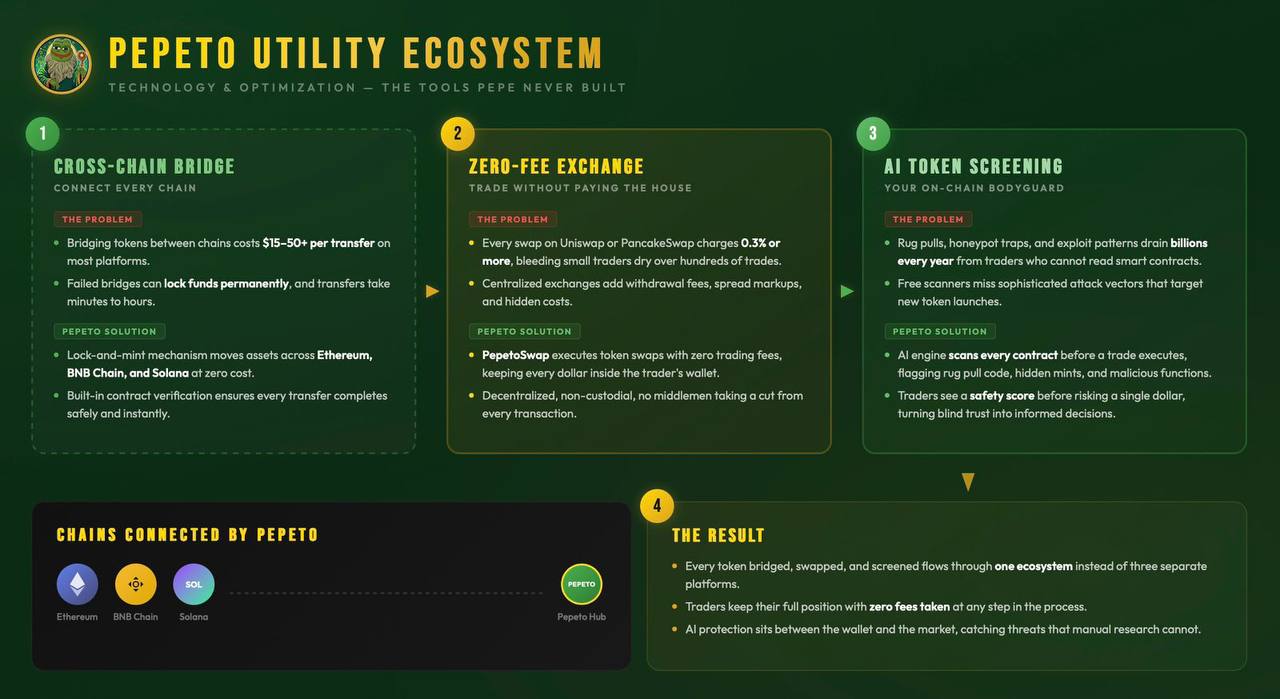
Under the same doubling test, Pepeto is valued near $80 million at presale price, so about $80 million of new money doubles it, against roughly $4 billion for NEAR, about 50 times more. Your $100 earns about $160 a year staking at today's 160% rate, while a $1,000 entry buys about 5.27 billion PEPETO that earns around $1,600. If Pepeto ever reached half of Shiba Inu's $41 billion record, the math puts the $100 near $25,700 and the $1,000 near $257,000. Staking starts the day you buy and every wallet pays the same stage price, which is why holders keep committing before listing.
PancakeSwap takes 0.25% of each swap, so a $10,000 trade costs $25. PepetoSwap, built by a former Binance specialist on the team, takes zero fees for itself on any trade size, so that $25 stays with the trader. Traders who save on every swap come back after launch, and that use builds demand for PEPETO. Once this stage closes its price is gone, a pricier stage follows, and the upcoming Binance listing price is higher than both. Buyers searching for the next crypto to explode are buying Pepeto at $0.0000001898 now, while $100 still buys over half a billion tokens.
Is Pepeto the Next Crypto to Explode in 2026?
On the math, yes, because the same $100 faces very different doubling costs. The three large caps need about $7.7 billion between them just to double, and roughly $69 billion to multiply ten times, while Pepeto starts near $80 million and keeps building.
Those three large caps are solid networks that can benefit from a recovery and belong in a steady portfolio, while growth money has more room at today's $0.0000001898 stage price. This difference explains why early buyers see Pepeto as the next crypto to explode and are buying now, before it lists at a higher price.
Click To Visit Pepeto Website To Enter The Presale