October PPI Data: Inflation Hits 6.5%. Will Fed Rate Hike in December?

October PPI Data: Stocks, Bitcoin and Fed Rate Hike Odds After Report
The October PPI Data landed on November 13, 2026, and it sent a mixed message. Monthly producer inflation slowed to 0.3%, below the 0.4% economists expected. Yet the annual rate climbed to 6.5%, the highest since November 2022, according to the Bureau of Labor Statistics (BLS).
This matters because the Federal Reserve meeting wiil be on December 8 and 9. Traders now ask whether cooler monthly numbers can stop a rate hike. So far, the answer looks like no, though nothing is decided.
At a Glance: Key October PPI Figures and Market Expectations
| PPI indicator | October 2026 | Previous / Expected |
| Headline PPI MoM | 0.3% | 0.4% expected; 1.4% previous |
| Headline PPI YoY | 6.5% | 6.6% expected; 6.3% previous |
| Core PPI MoM | 0.3% | 0.3% expected |
| Core PPI YoY | 5.0% | 5.0% expected |
| Food prices MoM | 1.3% | Not stated |
| Energy prices MoM | Down 0.1% | Not stated |
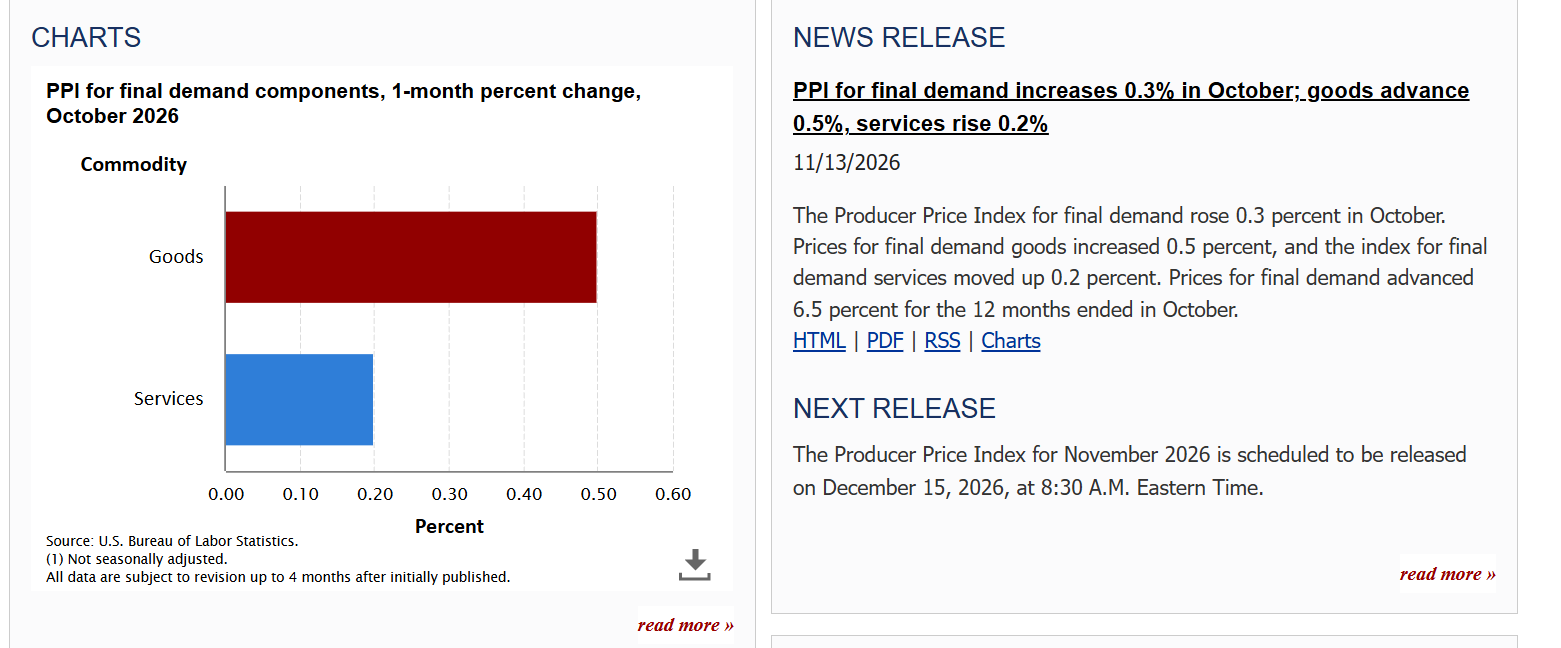
Source: BLS October 2026 PPI release and market consensus reports. Check the annual core figure against the detailed BLS table before relying on it.
Headline PPI tracks all the prices producers receive. Core PPI removes food and energy, which swing a lot. Economists watch core to see the underlying trend.
Why Did US PPi Inflation Reach Highest Level Since November 2022?
Here is the key puzzle. How can monthly inflation slow while the yearly rate rises? The answer is base effects. The annual rate compares October 2026 with October 2025. It also stacks twelve months of increases. September’s jump of 1.4% is still inside that window, so it keeps the yearly number high even after a quieter October.
Food added to the pressure. Food prices rose 1.3% in October, according to BLS data. Final-demand goods prices are also up 10.2% over the past year, according to market commentary on the release.
Energy is not the only driver. Costs are rising in categories that have little to do with fuel. The government shutdown also distorted last October’s data, so the yearly comparison is harder to read than usual.
October PPI Data: What Happened to Core Inflation and Energy Prices?
Core inflation matters because policymakers believe it shows lasting price trends. Core PPI rose 0.3% on the month, matching forecasts. The yearly core rate stood at 5.0%.
Readers should not mix up two different measures. Core PPI excludes food and energy. A separate BLS measure also strips out trade services, and it rose 0.5% in October, matching September. They are not interchangeable.
Energy prices fell 0.1% on the month but remain about 37% higher than a year ago. Falling oil helps, but it cannot fix broader pressure. Fed officials have said inflation is spreading into areas unrelated to energy. Chicago Fed President Austan Goolsbee said inflation is “going the wrong way.”
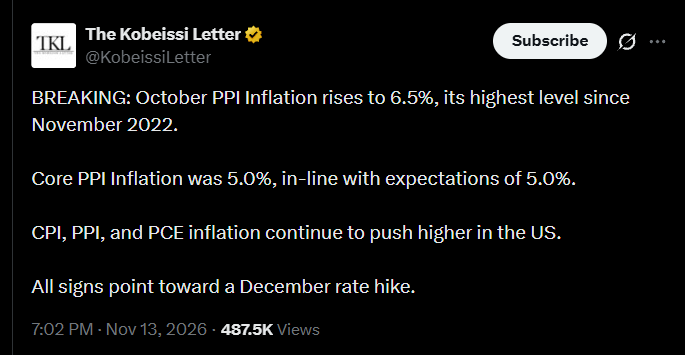
Source: The Kobeissi Letter
Will October PPI Data Confirm a December Fed Rate Hike?
No data release can confirm a hike. Only the Federal Reserve can announce its decision, and it will do so after the December 8 and 9 meeting. You can check the official schedule on the Federal Reserve calendar
What the data does is shape expectations. October’s CPI rose 0.4%, above the 0.3% forecast. Jobs data stayed strong. Now the October PPI Data shows core pressure that did not ease more than expected. Market pricing reflects this. According to market-based reports, the odds of a 25 basis point hike rose from 76% to 89% after the CPI release. A basis point is one hundredth of a percentage point.
The softer headline PPI may reduce worry about a larger 50 basis point move. Still, these are market probabilities, not Fed rate hike promises.
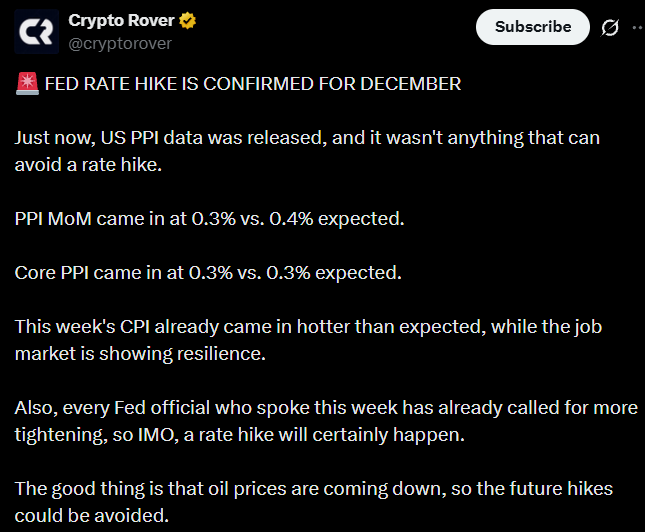
Source: Crypto Rover X Post
How Did Bitcoin and Stock Markets React to the October PPI Report?
Crypto news market Reaction was mixed. The reports showed S&P 500 futures up 0.43% and Nasdaq futures up 0.72% within ten minutes of the release. Most of those gains faded soon after. Traders appeared to decide the data was better, but not good enough to change the Fed news path.
For Bitcoin (BTC), the link works through interest rates and liquidity. Higher rates raise borrowing costs and can reduce the money flowing into risk assets. Lower rates tend to do the opposite. That is a general relationship, not a forecast. Bitcoin Price Falls 2.9% to $66,924.33. However, BTC price depends on many other factors too.
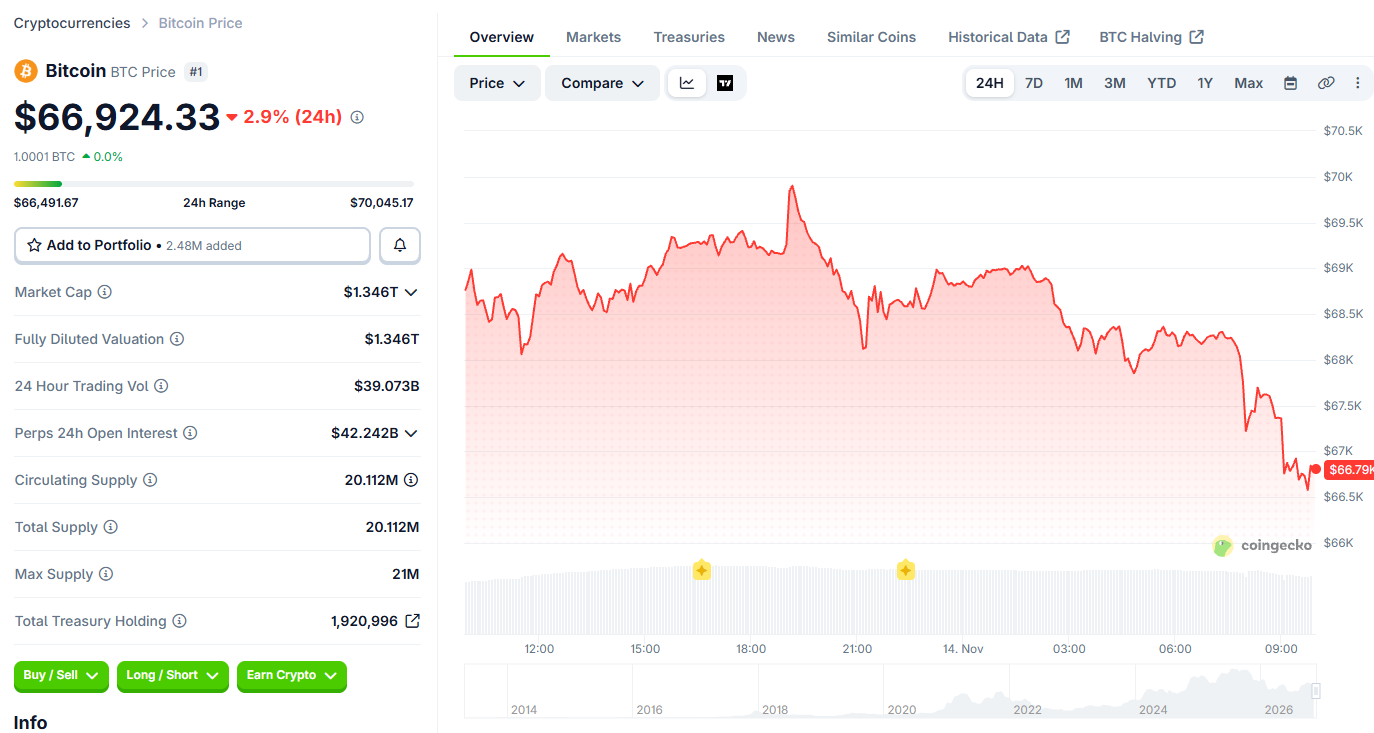
Source: CoinGecko Data
October PPI Data Timeline: US Inflation and December Fed Decision
-
November 10, 2026: October CPI is released. Consumer prices rise 0.4% on the month, hotter than expected.
-
November 13, 2026: The October PPI Data arrives. Monthly inflation slows to 0.3%, while the annual rate reaches 6.5%.
-
December 8 and 9, 2026: The Federal Open Market Committee (FOMC) meets to set its next policy move.
Each step adds to the outlook. CPI showed consumer pressure, PPI showed pressure at the producer level, and the Fed meeting will show how it weighs both.
Conclusion: Does Slower Monthly PPI Offer Enough Relief to Markets?
The October PPI Data offers partial relief. Monthly inflation cooled sharply from September, but the 6.5% annual rate shows prices are still elevated. Core readings matched forecasts, so they gave policymakers no reason to relax.
A December Fed hike is the market’s base case, not a certainty. Federal Reserve officials will keep watching incoming data, including the next jobs and inflation reports. For stocks, Bitcoin, and borrowing costs, the outlook stays tied to those numbers. Readers should expect volatility around each release.
YMYL Disclaimer: The information provided in this article is for educational and informational purposes only and should not be considered financial or investment advice. Cryptocurrency and financial markets involve risks, and readers should conduct independent research before making investment decisions.






