
Offload AI Debt: JPMorgan and Citi Shift Risk as Lending Concerns Grow


Offload AI Debt: Why JPMorgan and Citi Are Shifting AI Loan Risk Today
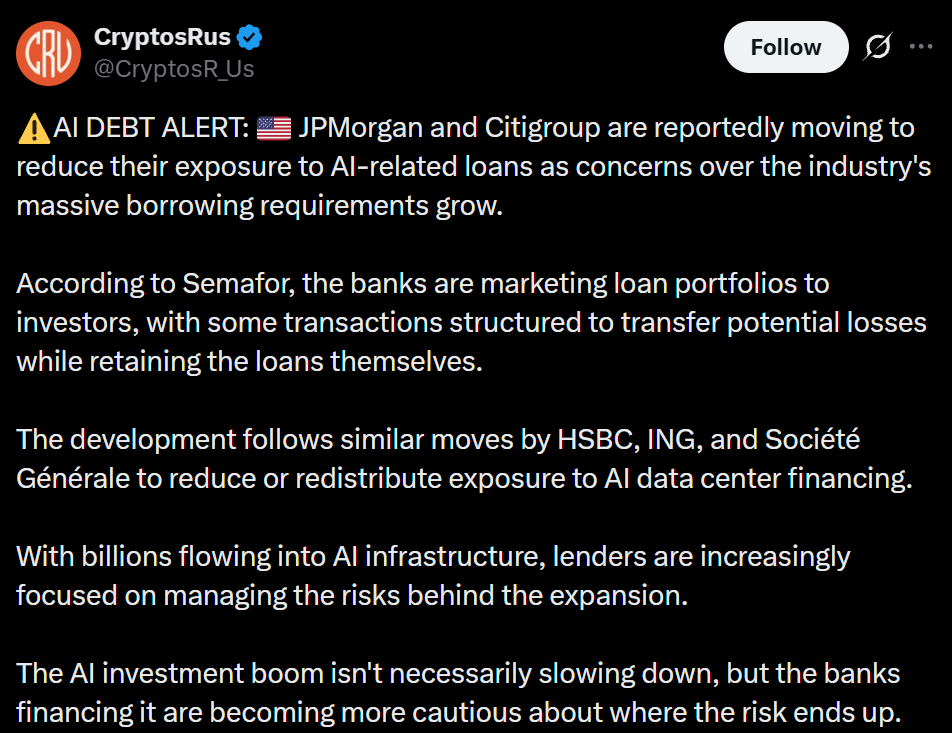
Two of the biggest US banks, JPMorgan and Citigroup, are reportedly moving to reduce their exposure to AI-related loans.
According to a recent report, they want to offload AI debt as worries grow about how much money the AI industry needs to borrow. This article explains what has been reported.
Source: Post on X
Key Facts at a Glance
Detail | What Is Reported |
Banks named | JPMorgan and Citigroup |
What they are doing | Reducing exposure to AI-related loans |
Main reason | Concerns over the industry's massive borrowing needs |
Methods | Marketing loan portfolios to investors; transferring potential losses |
Other banks with similar moves | HSBC, ING and Société Générale |
Area of focus for those banks | AI data center financing |
Loan amounts | Not stated in the material provided |
How the Banks Are Reducing Their Exposure
The report says the banks are marketing loan portfolios to investors. In plain words, a bank that has lent money to AI-related businesses is offering a bundle of those loans to other investors so that it does not carry all the risk alone.
The report also says some deals are structured in a particular way. The bank transfers the potential losses to investors while still keeping the loans themselves.
That gives two routes:
Selling loan portfolios: the bank markets a group of loans to investors.
Transferring losses: the bank keeps the loans but passes the possible losses to others.
Both routes aim to lower risk without stopping the bank from doing business in this area. Banks that offload AI debt in this way are managing risk, not necessarily leaving the sector.
Why Banks Want to Offload AI Debt Now
The main reason given is concern over the industry's massive borrowing requirements.
Building AI systems and the facilities that run them takes huge amounts of money, and much of it comes from lenders.
The more a bank lends to one fast-growing industry, the more it depends on that industry doing well.
With billions flowing into AI infrastructure, lenders are increasingly focused on managing the risks behind the expansion.
A loan is only safe if the borrower can repay it. If too many loans are tied to the same sector, a problem in that sector could hurt a bank badly. Spreading that risk to other investors is one way to reduce the danger.
Other Banks Taking Similar Steps
The development follows similar moves by other lenders, according to the same report.
HSBC, ING, and Société Générale have also moved to reduce or redistribute their exposure to AI data center financing.
Bank | Reported Action |
JPMorgan | Reducing exposure to AI-related loans |
Citigroup | Reducing exposure to AI-related loans |
HSBC | Reduced or redistributed AI data center financing exposure |
ING | Reduced or redistributed AI data center financing exposure |
Société Générale | Reduced or redistributed AI data center financing exposure |
Data centers are the large facilities that hold the computers needed to run AI. Because they are costly to build, they are a major reason for the heavy borrowing.
When several banks act in a similar way, it suggests lenders across different regions are thinking about the same risk.
What This Means for the AI Boom
The report makes an important point: the AI investment boom is not necessarily slowing down.
What is changing is the attitude of the banks financing it. They are becoming more cautious about where the risk ends up.
Here is what readers should keep in mind:
Money is still flowing: billions are still going into AI infrastructure.
Risk is being moved, not removed: loans passed to investors still carry risk. It simply sits with different holders.
Caution is rising: banks want to avoid being the only party exposed if the industry struggles.
Some points are not clear from the material provided. The size of the loan portfolios, the price at which they are offered and the identities of the buyers have not been stated.
Readers should treat the story as a report on deals that are still in progress, not as a final outcome.
Conclusion
JPMorgan and Citigroup are reportedly working to offload AI debt by marketing loan portfolios and by transferring potential losses to investors. HSBC, ING and Société Générale have made similar moves.
The AI boom may continue, but banks are now more careful about who holds the risk.
This article is for information only and is not financial advice. Please verify all details through official channels.
Disclaimer
This article is for educational and informational purposes only and is not financial or investment advice. Crypto assets are high risk, their prices can be very volatile, and you can lose some or all of your money. Always do your own research and consider speaking with a licensed financial advisor before making investment decisions.






