Optimizely Malware Attack Hits 178 Sites: Is Your Crypto Safe?


Optimizely Malware Attack Hits 178 Sites: Is Your Crypto Safe?
As of November 17, 2026, the Optimizely malware attack belongs in crypto news today, because it targeted wallet addresses.
On November 16, 2026, malicious code reached visitors of 178 organisations through the Optimizely Web platform, according to Report URI.
The first injection appeared at 04:21 UTC. By 21:52 UTC, only 1 of 188 infected snippets still carried the code. This Optimizely hack news is still developing.
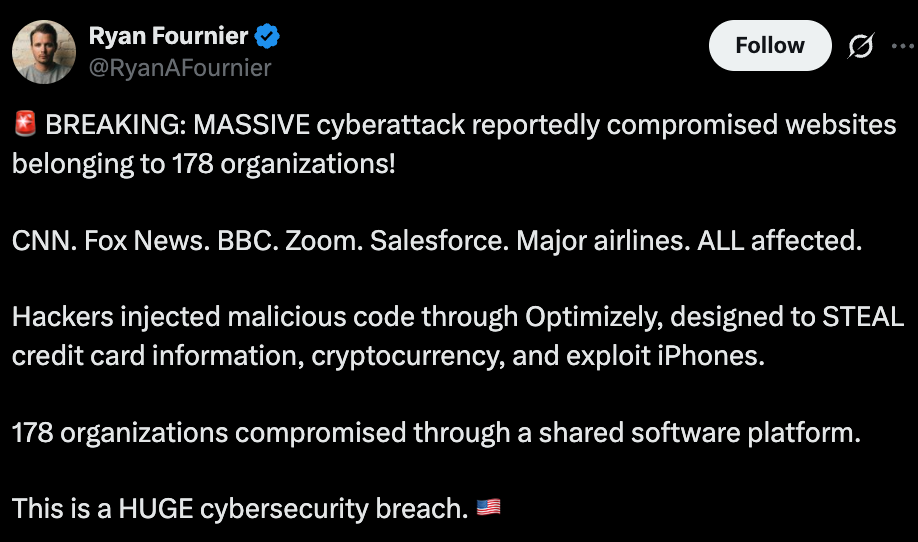
X user Ryan Fournier (@RyanAFournier) also covered this news in a post on X, flagging card, crypto and iPhone risks.
Optimizely Malware Attack: Which Websites Were Affected?
Report URI tested 1,611 snippets and found 188 infected. This 178 organisations malware count may rise, since only scripts found in time were checked.
Sector | Orgs | Examples |
Banking and Finance | 32 | HSBC US, Equifax |
Technology | 23 | Zoom, Salesforce, GitLab |
Retail | 20 | IKEA, ASOS |
News and Media | 10 | BBC, CNN, Fox News |
Crypto and Trading | 6 | Ledger, IG |
The BBC CNN malware exposure applied only to visitors who loaded an infected snippet.
How Does Crypto Address Swapping Malware Work?
The script acted as crypto clipper malware. This wallet address swapping malware replaced valid addresses with the attacker’s, including in the clipboard, a form of clipboard hijacking.
Crypto clipper: covered BTC, ETH, TRON, Solana, TON, LTC, BCH and DOGE
Card skimmer: card skimming hit numbers typed into a site’s own forms
Cookie theft: took non-HttpOnly cookies and screenshots
The attacker’s wallets had received about $7,040 by 19:25 UTC on November 16. Report URI traced some USDC to a HitBTC deposit address.
Was Ledger Website Hit by Optimizely Malware?
Report URI lists Ledger among affected organisations, so Ledger website malware exposure was possible for visitors who loaded the infected snippet. Its snippet was cleaned at about 20:41 UTC.
Report URI does not tie the stolen total from the Optimizely malware attack to any single site.
How Did Hackers Get Into Optimizely?
Sites load a third-party JavaScript snippet from the vendor’s CDN. The attacker wrote code into the Project JavaScript field, a JavaScript injection that left the rest untouched.
That makes this a supply chain attack, not a direct hack of each website.
Report URI said the access method was unknown. On November 17 at 01:02 UTC, Optimizely’s status page said an unauthorized party exploited a vulnerability in Experimentation to add malicious JavaScript to some customer projects. The company said it fixed the flaw and removed the injected code.
The Optimizely breach notice names no customers, and the Optimizely cyberattack remains under monitoring.
Optimizely Malware iPhone: How to Update iOS
On Apple devices, the Optimizely malware attack loaded an iPhone exploit kit.
The Coruna exploit kit targeted iOS 13 to 17, while the DarkSword exploit kit targeted iOS 18.x. The Coruna DarkSword chains formed an iOS exploit kit for older software.
Check Apple’s security releases page and install the latest iOS update
Recheck any crypto address before sending
Watch card statements after paying on an affected site
Expert View: Is Optimizely Safe After the Breach?
Analysts following crypto news may read the Optimizely malware attack as a reminder that trusted code can change without warning.
Report URI found a Content Security Policy blocked the payload at 24 of 256 organisations crawled, while 68 had none.
Such web skimming is tracked as Magecart activity. Report URI also published indicators of compromise, including 1688360.cc.
Disclaimer: This article is for information only and is not financial, legal, or investment advice. Crypto assets are volatile, and you can lose money. Verify details with official sources before making any decision.






