ORE Solana Virtual Mining: How the 5x5 Grid Works

ORE Solana Virtual Mining: How the 5x5 Grid, Emissions and Risks Work
ORE Solana Virtual Mining replaces computer-powered mining with a game of chance played in SOL.
Miners deploy SOL on tiles of a shared grid, one tile is picked at random each round, and ORE tokens go to the miners on that tile. Emissions are capped by a fixed maximum supply.
Rewards are not guaranteed, fees apply to every round, and a miner can lose part of the Solana deployed. It is not traditional proof-of-work.
What Is ORE Solana Virtual Mining?
ORE Solana Virtual Mining is an on-chain mining mechanism on the Solana blockchain; nobody solves puzzles with hardware. Miners commit Solana, the protocol selects a winning tile with on-chain randomness, and settlement happens in a wallet transaction.
Feature | Current mechanism |
Blockchain | Solana |
Mining method | Virtual mining with SOL |
Layout | Square grid of tiles |
Winner | One randomly selected tile per round |
Supply | Fixed maximum, not circulating supply |
The grid is the heart of ORE Mining on Solana, and the rest of the design follows from it.
How Does the ORE 5x5 Mining Grid Work?
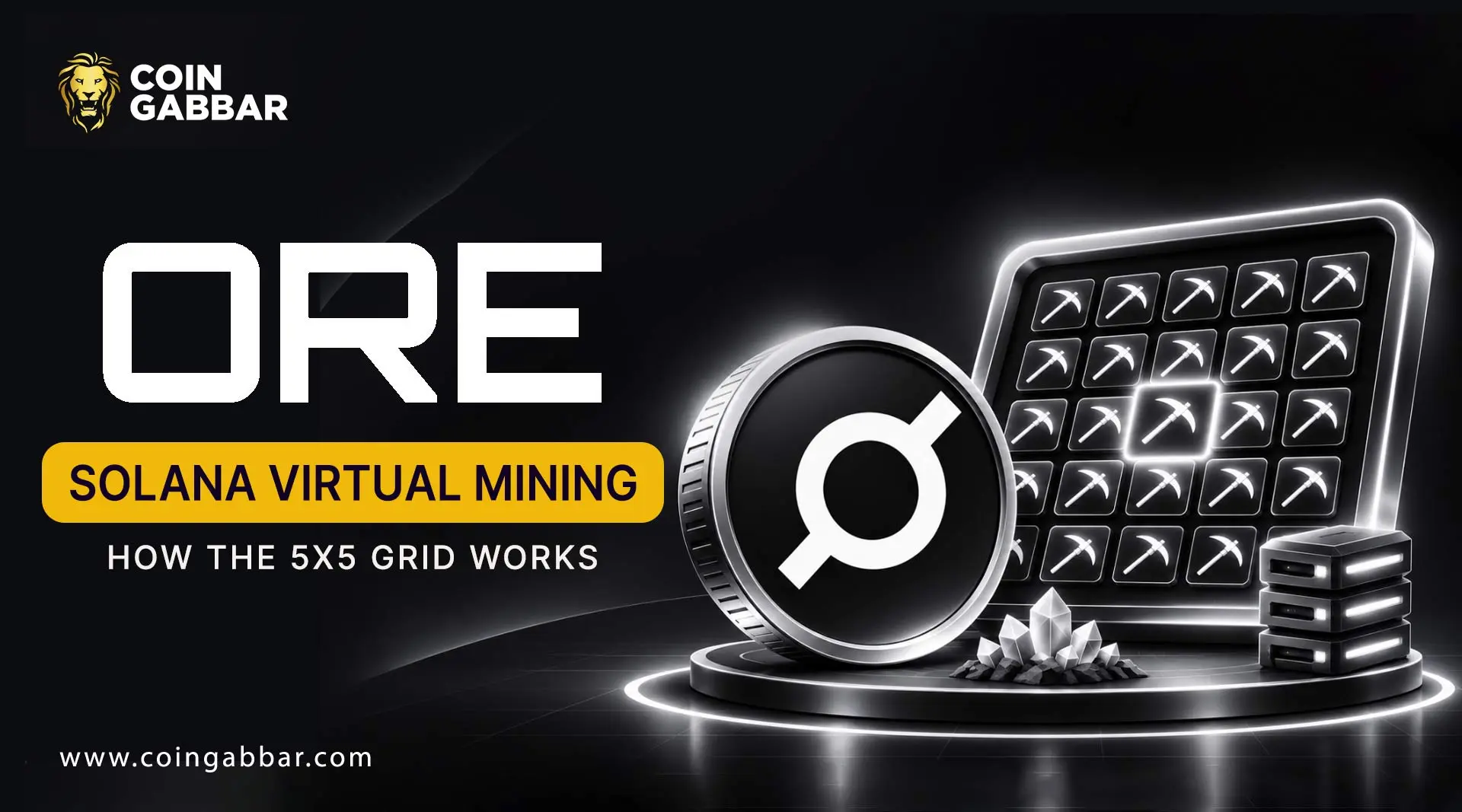
The ORE 5x5 grid is a board of equal tiles shared by every miner. Miners choose tiles and deploy Solana on them.
In ORE Solana Virtual Mining, each tile has the same chance of being picked, whoever has deployed there. When the round ends, one tile is selected at random, and the result is settled on-chain.
Because odds are equal, the choice of tile does not change the chance of winning, only how crowded the reward is. For readers new to the network, the Solana ecosystem map shows where mining sits among other Solana projects.
What Is the Difference Between Split and Solo Tiles?
Tiles in ORE Solana Virtual Mining come in two kinds, and there are more split tiles than solo tiles.
Split tiles: The reward is divided among the miners on the tile according to their Solana contribution.
Solo tiles: One miner receives the full reward, and the chance of being that miner is weighted by the SOL they contributed.
That is why ORE Mining Rewards can look very different from one round to the next.
How Are ORE Mining Rewards Distributed?
Under ORE Solana Virtual Mining, miners on the winning tile receive the round's ORE reward. On a split tile the share depends on each miner's SOL, and on a solo tile the winner takes all. Miners on other tiles do not receive ORE for that round.
Mined ORE first builds up as unrefined ORE. It may carry a refining fee when it is claimed, so the amount that reaches a wallet can be lower than the amount earned.
The current settlement rules matter here, and older descriptions that say losing Solana is redistributed to winners are out of date.
Anyone checking ORE Solana Virtual Mining should read the live documentation, as the official guide to how mining works is the primary source.
How Do ORE Token Emissions and Maximum Supply Work?
Every round of ORE Solana Virtual Mining creates a fixed amount of ORE. Most of it goes to the winning tile, and a small slice goes to a separate pool.
This steady flow is what people mean by ORE Token Emissions, and the total is limited by a fixed maximum supply.
That cap is not the circulating supply. The cap is a ceiling on what can ever exist, while circulating supply is what has been issued so far.
Treating them as the same number is a common mistake in ORE Tokenomics discussions. The project overview explains the supply design.
What Is the ORE Motherlode and How Does It Pay Rewards?
The ORE Motherlode is a growing prize pool inside ORE Solana Virtual Mining. A small part of each round's emissions is added to it, and each round carries a small chance of triggering a payout. When it triggers, the pool is paid out to the winners of that round, on top of the normal reward.
The Motherlode is separate from the winning-tile reward, and no miner should plan around it.
How Do SOL Deployment Fees and ORE Buybacks Work?
Every SOL deployment carries a cost. A winning tile gets back most of the deployed Solana, and other tiles get back a smaller share.
The protocol keeps the difference as mining revenue, and an admin fee applies as well. Wallet transactions also cost network fees, so transaction costs add up for miners who run automated mining.
The protocol revenue is used for token buybacks, and bought tokens can be burned. A token burn reduces supply, but it does not guarantee a higher market price, because price depends on market liquidity and demand.
For related reading on trading costs on Solana, the guide to Solana MEV is a useful companion.
What Are the Main Risks of ORE Virtual Mining?
Loss of SOL: A miner on a losing tile gets back only part of the SOL deployed.
Reward variability: A round can pay nothing, and streaks of rounds can be long.
Fees: Mining fees, refining fees and transaction costs reduce results.
Price volatility: Both SOL and ORE can move sharply.
Smart contract risk: Code bugs or exploits can affect funds; the entry on smart contracts explains why.
Any miner weighing ORE Solana Virtual Mining should treat the deployed SOL as capital at risk. Market direction matters too, and readers who track sentiment can follow Latest Cryptocurrency News for context.
How Is ORE Virtual Mining Different From Traditional Proof-of-Work?
Traditional proof-of-work mining uses electricity and hardware to compete at solving puzzles.
ORE Solana Virtual Mining spends SOL on a random draw. There is no hash power, no mining rig and no block-solving race. The word mining is used for the token issuance, not for the method.
A traditional miner risks equipment and power costs, while a virtual miner risks the deployed SOL directly. Neither guarantees profit, and outlooks such as Crypto Price Predictions 2026 are opinions, not promises.
What Does the Evidence Show About ORE Solana Virtual Mining?
Official/Confirmed
The mechanism runs on Solana, uses SOL deployment on a shared grid and selects one winning tile per round at random.
Rewards are not guaranteed in every round.
Mined ORE accrues as unrefined ORE and may carry a refining fee on claim.
Supply has a fixed maximum.
Reported
Split tiles share rewards, while solo tiles pay one miner.
Protocol revenue funds buybacks and burns.
Final Thoughts
ORE Solana Virtual Mining combines random tile selection, SOL deployment and capped emissions.
Anyone reading about ORE Solana Virtual Mining should check the live documentation, separate the winning-tile reward from the Motherlode and treat SOL spent as capital at risk.
Disclaimer: This article is for educational purposes only and is not financial, legal or investment advice. Crypto mining and token markets are highly volatile and can lead to loss of funds. Always confirm current rules and fees in the official documentation before participating.
















