Orex Network Gaming: Exploring the Future of Its Web3 Gaming Plans


What Is the Role of ORX in the Future of Orex Network Gaming?
Orex Network gaming is the part of the project that aims to bring blockchain games, digital ownership and token rewards into one ecosystem. The whitepaper calls gaming a central pillar of the long-term vision. The idea is simple: players enjoy the game, while the blockchain works quietly in the background. This guide explains the plan, how it is meant to work and which parts are planned or available, based on the official website and whitepaper v1.2.
Key Takeaways
The whitepaper calls gaming a central pillar of the long-term vision, but it is still planned, not live.
ORX may be used for selected economic functions, and each game keeps its own gameplay balance.
ORX is not publicly listed or freely tradable at present.
What Is the Orex Network?
The Orex Network is a community-focused Web3 project. It links mobile participation, blockchain infrastructure, digital rewards and gaming in one ecosystem. Its token is ORX.
The project’s first product is a free Android app. According to the official website, a user starts a 24-hour session and earns 0.5 ORX per hour, which adds up to about 12 ORX per full session. A referral code adds a bonus of 200 ORX for each friend who joins. The whitepaper is clear on one point: this app-based mining is a reward system, not conventional proof-of-work.
Source: official website.
How Do Orex Tokens Fit Into the Gaming Plan?
Orex tokens have a stated maximum supply of 500 million ORX. The whitepaper splits them into five groups.
Allocation | Share | ORX |
Community and mobile mining | 50% | 250,000,000 |
Liquidity and listings | 15% | 75,000,000 |
Ecosystem and gaming partners | 15% | 75,000,000 |
Core team and developers | 10% | 50,000,000 |
Marketing and treasury | 10% | 50,000,000 |
Gaming has its own bucket. The 15% for ecosystem and gaming partners is aimed at developer, gaming and ecosystem growth. The whitepaper calls the split a project-level target that may change.
What Does the Orex Network Gaming Ecosystem Aim to Do?
The goal is to support games where digital ownership, rewards and token use work together. Players should not have to think about blockchain complexity first. The Orex Network gaming ecosystem also plans room for independent developers.
The whitepaper adds a useful limit. Entertainment value should not depend only on token speculation. A game should be fun even if ORX never moves.
Which Gaming Features Does the Whitepaper Mention?
Five features appear in the plan. Here is what each one means in plain words.
Feature | Plain meaning |
On-chain items | Game items recorded on the blockchain |
Collectible digital assets | Items players can collect |
Player rewards | Prizes earned through play |
Marketplace functionality | A place where items could change hands |
Game-specific economies | Each game sets its own rules for token use |
The official whitepaper also mentions interoperability, meaning items could work across games. It adds a condition: only where technically and economically appropriate.
How Will ORX Be Used Inside Orex Games?
The ORX token gaming utility is described in broad terms. Inside supported games, ORX may be used for purchases, rewards, access mechanisms or crafting. The exact use can differ from game to game, and each application should disclose it.
So no single rule is expected for every title. Players should read each game’s own terms before joining.
What Do Orex Network Digital Assets Mean for Players?
Orex Network digital assets would need clear ownership rules, security controls and user disclosures. That is the whitepaper’s own standard for any NFT or digital-item system.
It also carries a warning. Digital assets do not automatically represent ownership of real-world property or financial instruments. A rare sword in a game is a game item, nothing more.
Why Do Blockchain Games Need a Fast Network?
Games create many small actions. Reward events, item updates and tiny payments pile up fast. On networks with high fees or slow confirmation, that is inefficient.
That is why Orex Network blockchain games are tied to a planned dedicated blockchain. The whitepaper describes fast confirmation and low transaction costs as goals. A DPoS-style consensus model is being considered. EVM compatibility is also planned, so developers who know Ethereum-style tools could adapt more easily. Final details may change after testing, audits and community feedback.
This is the same problem Web3 gaming projects across the industry try to solve.
Can Developers Build Inside the Blockchain Gaming Ecosystem?
A blockchain gaming ecosystem needs builders, not just players. Orex plans APIs, SDKs, documentation, smart-contract tooling and test environments as the infrastructure matures. The whitepaper says tools will arrive step by step, not all at once.
Third-party apps may also be reviewed for security and compatibility before they get official support or promotion.
Is Orex Network Gaming Live?
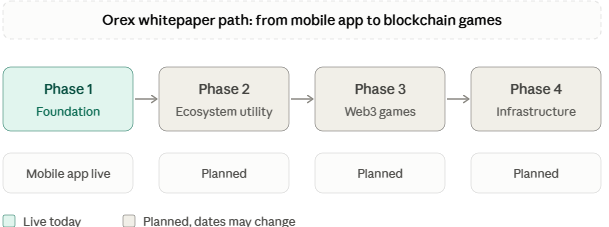
What is live is the Android mining app. The whitepaper roadmap has five phases, and gaming is Phase 3. It also says dates may change. The document itself is labeled a concept and development roadmap, and future features are not presented as live.
One more point matters for any reader. ORX is described as not publicly listed or freely tradable. It is not convertible into USDT or fiat through an official public market.
What Risks Should Users Know Before Joining?
The whitepaper lists several risks: technical failures, smart-contract vulnerabilities, cybersecurity incidents, regulatory changes, market volatility and loss of private keys. Anti-bot checks are planned to protect rewards, but the whitepaper admits no system detects everything.
Users also stay responsible for their own keys and seed phrases. Orex cannot recover assets lost to a compromised personal wallet, unless a custodial recovery option is clearly offered.
What Should Readers Watch Next?
Orex Network gaming has a clear idea behind it, but an idea is not a product. Four things are worth watching: named games, SDK documentation, security audit statements and a test network. Each one would show real progress.
Until then, the plan should be treated as a plan. Readers should never put in money they cannot afford to lose.
Disclaimer: This article is for information only and is not financial advice. Crypto assets are highly volatile. Project plans can change. Do your own research and speak to a licensed financial advisor before making any decision.