Ozak AI Tokenomics: Understanding $OZ Allocation, Vesting and Unlocks

How Does Ozak AI Tokenomics Define $OZ Supply, Vesting and Unlocks?
A token table looks dull until a large unlock hits the market. That is why supply, vesting and release dates matter more than most buyers expect.
This guide explains Ozak AI tokenomics and total token supply in plain words. It uses the project’s official documentation and website.
Key Takeaways
The $OZ supply is fixed at 10 billion tokens, split across five buckets, with the team on a 3-month cliff and 24-month vesting.
The community sale is closed, and the project says final tokenomics will publish with the exchange listing.
Staking and a few other uses are still planned. The platform itself, Eon, is already live.
What Is Ozak AI?
Ozak AI is an agentic AI platform for financial intelligence. Its official site says it uses predictive AI built for market data, analytics and trading decisions.
For readers asking about the Ozak AI crypto project, the product is called Eon. It is a research and trading terminal where AI agents analyze markets, flag opportunities and help place trades. The $OZ token sits at the center of that setup.
Source: official website
The Ozak AI Ecosystem
The Ozak AI ecosystem is built around Eon. The homepage lists these parts:
Part | What it does |
Specialist AI agents | Research, technicals, fundamentals, news, whale tracking, unlocks, derivatives, DeFi, economics and portfolio |
Live Signals | Alerts for breakouts, squeezes and narrative shifts, sent by Telegram, email or in-app |
Trading | Spot swaps, perpetuals and prediction markets, non-custodial |
Portfolio Analysis | Risk metrics and AI rebalancing guidance |
Plans | A free tier and a Premium plan, listed at about $49 a month |
The October announcement also mentions Ozak AI Enterprise pilots with institutions and a DePIN plan, both described as upcoming. It reports 146,385 registered app users. That figure is self-reported.
Ozak AI Tokenomics at a Glance
The docs call $OZ the native utility token of the ecosystem. The $OZ token supply is fixed at 10,000,000,000, and no more will ever be created.
Allocation and vesting are said to be enforced by audited smart contracts. The announcement names CertiK and Sherlock as auditors. Readers should check the audit page before relying on that.
Ozak AI $OZ Token Supply and Allocation
Bucket | Share | Cliff | Vesting | Purpose |
Presale | 30% | 1 month | 6 months | Gets the token to the earliest community, with 10% liquid at TGE |
Ecosystem and Community | 30% | 3 months | 18 months | Grants, rewards and contests that grow the platform |
Future Reserve | 20% | 3 months | 18 months | Partnerships, acquisitions and long-term planning |
Team | 10% | 3 months | 24 months | Aligns core builders with long-term success |
Liquidity and Listings | 10% | None | None | A healthy market at launch |
Source: official $OZ tokenomics documentation
Ozak AI Token Allocation and Distribution
Why this split? The docs point to three goals, shown in their “what the schedule is designed to prevent” box.
No large team unlocks. Team and Reserve carry the longest vesting. The team waits months, then receives tokens slowly across two years.
A market from day one. A full 10% of supply goes to exchange liquidity at launch.
Enforced in code. The release schedule sits in audited smart contracts, so it runs automatically instead of on trust.
This token distribution model also keeps the largest buckets, Presale and Ecosystem, at 30% each. Ozak AI allocation to the ecosystem funds developer grants, trading contests, liquidity incentives and community rewards.
Ozak AI Token Vesting Schedule Explained
Two terms matter here, and the docs define them simply.
Cliff is a waiting period after launch before a bucket starts releasing. The team has a 3-month cliff, so no team tokens move for the first three months.
Vesting is the gradual release after the cliff. Team tokens release in equal monthly amounts over 24 months.
In any cryptocurrency vesting schedule, the cliff delays supply and vesting spreads it out. Ozak AI vesting follows that pattern, as the chart shows.
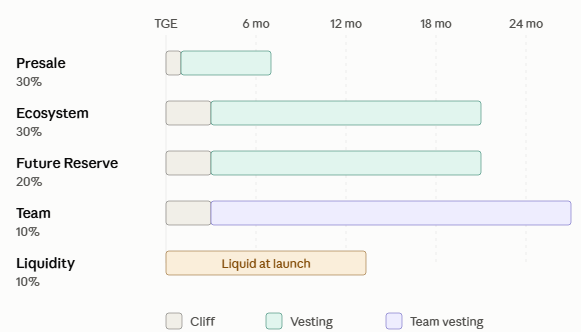
Presale also has 10% liquid at TGE, before its 1-month cliff begins.
Token Unlocks and What They Mean
Token unlocks are the moments when locked tokens become tradable. Big, sudden unlocks can add sell pressure. The official channels list this risk and how they plan for it.
Risk | Mitigation |
Large sell pressure at unlocks | Unlocks are gradual and linear month by month, and launch liquidity helps the market absorb new supply |
AI models underperforming over time | The 30% ecosystem allocation funds data scientists and developers to keep improving the models |
Smart contract bugs or exploits | Independent third-party audits before launch |
The stated aim is a loop. Holders provide capital, builders receive grants, tools generate fees, and the token captures that value. That is a design goal, not a result.
Ozak AI Token Utility
The Ozak AI token utility is split into what is live and what is planned.
Use | Status |
Pays for platform use, such as running models and storing data | Live |
Funds the ecosystem: grants, contests, liquidity incentives, rewards | Live |
Staking to help secure the network and earn a share of protocol fees | Planned after TGE |
Higher staking tiers with lower platform fees | Planned after TGE |
The October announcement adds two ideas: subscriptions payable in $OZ at a discount, and staking for fee rebates. Both sit under “what’s next.”
Soure: Official documentation
The Sale Is Closed: What Is Still Open
The community sale closed with $7.65M raised across eight sold-out phases, priced from $0.001 to $0.014. The announcement says the Ozak AI token supply sold came to 1.23B $OZ. That is below the 3B presale bucket, and the docs do not say what happens to the remainder.
Three things are still open, according to the announcement:
Final tokenomics and distribution mechanics will publish with the listing.
Token and vesting contracts will be deployed on the chain the listing venue confirms.
The TGE date will come with at least 14 days’ notice. The project commits to a Q4 2026 listing.
Until an address appears on docs.ozak.ai, the project warns that any $OZ contract address in circulation is fake. The docs’ buying guide was last updated during the sale, so it should be read as history.
Key Risks to Keep in Mind
Terms may change. The project says final tokenomics publish with the listing.
Listing not confirmed. Exchange names and the TGE date are not public yet.
Self-reported numbers. Revenue, users and audits come from the project.
Unlock pressure. Even gradual unlocks can weigh on the price.
Fake contracts. Scam addresses and copy-cat sites are common, so only official pages should be trusted.
Final Verdict
Ozak AI tokenomics is easy to read: a fixed 10 billion supply, five buckets, and a team that waits three months and then vests over two years. Putting the schedule into audited contracts is a sound idea.
The catch is timing. The final terms are still due with the listing, so readers should treat today’s table as the published design. Check the official channels before any step, and invest only what can be lost.
Disclaimer: This article is for information only and is not financial, investment, tax or legal advice. Crypto assets carry high risk, including total loss. Token allocations describe the protocol’s design, not a prediction of value, and details can change.