PepeHood Presale: Examining the Project’s Token Sale and Market Entry


PepeHood Presale Breakdown: Supply Allocation and Launch Milestones
The PepeHood Presale tells a familiar story in a new costume. A Pepe-style meme token plays Robin Hood, promising to take from the rich and help the poor.
Search interest comes down to one question. What is actually on offer, and how does the PepeHood-Presale move from sale to open trading?
This breakdown tests the published prices, supply split, dates, and safety claims against basic arithmetic. Everything reflects the official page as of 9 October 2026.
What Is PepeHood, and What Does a Presale Mean?
A presale is an early token sale held before a coin trades on open markets. Buyers get a fixed, lower price. In return, they accept more uncertainty, because no live market exists to test the project's value.
PepeHood is a meme token, a coin built on a joke and community attention rather than a product. The official page calls it a high-volume meme token on Robinhood Chain, an Ethereum-compatible network. No staking, governance, or app is listed.
That makes the PepeHood Presale a sale built on attention, not utility.
How Do the PepeHood Presale Price Stages Compare?
The official presale section lists three price points. The table puts them side by side.
Price point | USDT per token | Change vs current |
Current-presale | 0.0001 | None |
Next stage | 0.00015 | +50% |
Stated listing | 0.0005 | 5x |
The next stage is a 50% step up. The listing figure is a stated plan, not a confirmed market price.
The page calls the move to listing a 500% increase. Arithmetic says 0.0005 divided by 0.0001 is five times the current price, or 400% growth. The label likely means 5x, but loose wording like that deserves a second look.
How Much Has the PepeHood Presale Raised So Far?
The page counter showed 81 USDT raised at the time of research. At 0.0001 per token, that buys about 810,000 tokens, roughly 0.16% of the 500 million set aside.
Sold out at the current price, that allocation would bring in 50,000 USDT. At the next stage price, 75,000 USDT.
Thin liquidity can make price swings sharp.
What Does the Tokenomics Model Look Like?
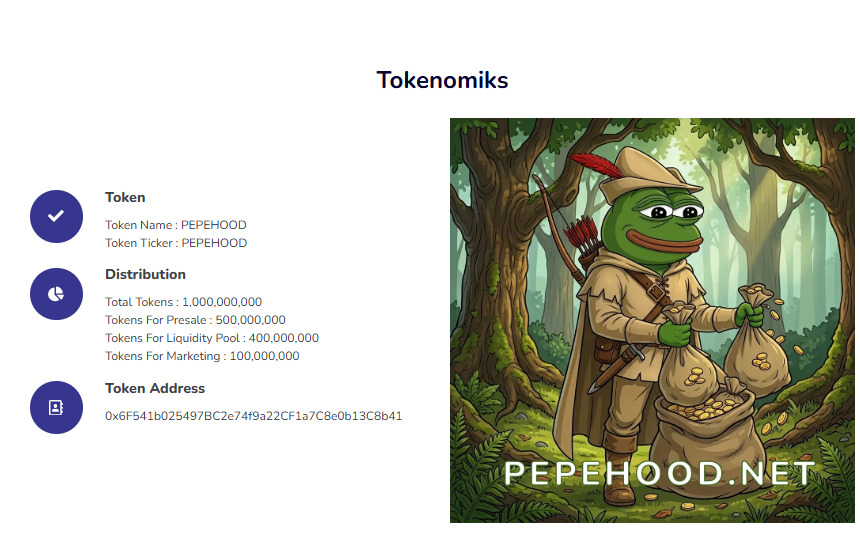
Total supply is 1 billion tokens, per the official tokenomics. The published whitepaper loads as an embedded document, so these figures come from the main page.
Allocation | Tokens | Share | Purpose |
Presale | 500,000,000 | 50% | Public token sale |
Liquidity pool | 400,000,000 | 40% | Trading liquidity |
Marketing | 100,000,000 | 10% | Promotion |
Half the supply is reserved for the PepeHood-Presale itself. Two details stand out: no team allocation appears, and no vesting schedule is given. Vesting is the timetable that controls when tokens unlock.
Fully diluted valuation (FDV) is price multiplied by total supply. That gives 100,000 USDT at the presale-price and 500,000 USDT at the stated listing price. FDV isn't market cap, which counts only circulating tokens. Circulating supply at launch isn't stated.
The liquidity pool also needs a second asset to trade against. The page doesn't say how much of the raise will pair with its 400 million tokens.
When Does the Sale End and Trading Start?
According to the stated roadmap, the Pepehood-Presale runs from 5 September to 5 December 2026. The token launch follows on 10 December 2026 on Uniswap, with other decentralized exchange listings after that.
That leaves five days between sale close and launch. The claim process, meaning how buyers receive tokens, isn't explained beyond automated wallet delivery. No vesting terms appear.
One more gap. The token contract sits on Robinhood Chain, yet the roadmap names Uniswap. The page doesn't explain how the two connect.
Which PepeHood Presale Safety Claims Can Be Checked?
Claim on the page | Meaning | Still unclear |
Liquidity locked for 365 days | Pool liquidity can't be pulled for a year, per the project. | Lock provider and start date |
No mint | Supply shouldn't grow. | Needs contract check |
No freeze | Wallets shouldn't be frozen. | Needs contract check |
"Audit" label | Links to an explorer token page | No firm report shown |
An audit is an independent security review of contract code. The "Audit" label leads to a token page on a blockchain explorer, which shows contract details and activity. That helps, but it isn't a review by an outside firm. Even a real audit doesn't guarantee safety.
Comparing how crypto presale listings show locks, audits, and dates helps separate normal practice from thin disclosure.
"Powered by Robinhood" sits under the project name, but no partnership statement appears. It reads as a reference to the chain.
A row of third-party tracker logos also appears. Getting onto those pages through a presale submission process is a visibility step, not a vetting.

Check PepeHood’s official X account for the latest presale-updates, project announcements, and token launch details.
What Are the Main Risks to Weigh?
Meme token sales share common risks, which earlier presale explainers cover in more detail. For this sale, the main ones are:
No product or cash flow backs the token, so price rests on attention that can fade.
The team isn't named on the page, which limits accountability if plans change.
Dates and the listing price are plans, not commitments.
A small raise may mean a thin pool.
Is the PepeHood Presale Worth Watching Right Now?
The PepeHood-Presale is a small, early, meme-driven sale with clear prices and a simple 50/40/10 supply split.
What stands out is the plain structure. What remains uncertain is who runs the project, how tokens unlock, what the audit label covers, and how a Robinhood Chain token reaches a Uniswap launch.
Whether the PepeHood-Presale deserves attention depends on risk tolerance. The outcome stays uncertain, and a meme token can lose most of its value fast.
Disclaimer:
This article is for information only and is not financial advice. Crypto-presales and meme tokens carry high risk, and prices can fall sharply. Always research independently before making any decision.