Pepeto News: Can Investors Test Its AI Token Scanner?

Pepeto News: What Risks Does the AI Token Scanner Claim to Detect?
Pepeto says an AI engine will screen token contracts for scams before you trade. Can you test it today?
This Pepeto News report checks the official website, whitepaper and audit as of October 23, 2026. It looks for a public AI tool, test results and outside proof.
A feature description isn't a tested product.
What Does the AI Token Scanner Claim to Do?
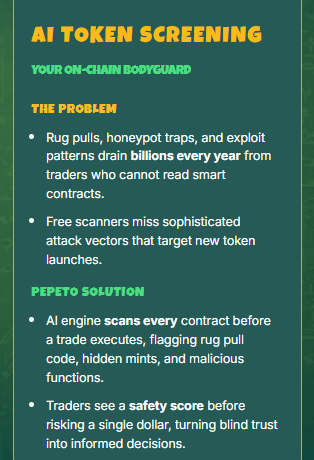
Pepeto's website says its AI engine scans contracts for rug pull code, hidden mints and malicious functions. A rug pull is when developers drain a project's funds. A hidden mint lets an owner create new tokens in secret.
The site says traders see a safety score before they trade. Its FAQ applies the screening to tokens listed on PepetoSwap, the planned exchange.
Source | What it says about the AI Tool |
Homepage | Scans contracts before a trade; shows a safety score |
FAQ | Screens tokens before they reach the exchange |
Whitepaper | No AI scanner mentioned in the text reviewed |
Project release, July 11, 2026 | Scanner sits inside the swap flow; exchange in final testing |
So the AI tool looks tied to the exchange, not a standalone tool. Public access to that exchange wasn't confirmed in the sources reviewed. Its launch date isn't stated either.
Is There a Public Test, and Does the Audit Cover It?
No AI engine page, demo link or sample report appeared in the sources reviewed. The homepage menu lists Staking, Giveaway, Bridge, Tokenomics, How To Buy, Roadmap and Blogs and News.
Other Sources describe 42 static checks, a forked-chain test trade and a 0 to 100 score. The project's own pages state none of those details. Treat them as unverified.
SolidProof's audit is dated October 30, 2024. Its file list names only Token.sol, and it says other project contracts aren't covered.
Item | Audit status |
Token contract (Token.sol) | Reviewed |
AI scanner | Not mentioned |
PepetoSwap and bridge | Outside the stated scope |
External services | Excluded by SolidProof's disclaimer |
The report lists one informational finding, marked Open. The homepage FAQ says the audit covered staking and distribution and that all findings were resolved. The report doesn't state those scope items.
Pepeto News: What Proof Would Show the Scanner Works?
A safety score only helps if it's accurate. A false positive flags a safe token. A false negative misses a scam.
Proof would look like this:
Test set: a published list of known scam and safe contracts
Error rates: counts of false positives and false negatives
Method: the checks behind each score
Repeatability: anyone scans the same contract and gets the same result
Review: a third party confirms the results
This Pepeto News check found none of these in the sources reviewed. The homepage says the AI catches threats manual research can't. That claim needs measured results.
The Bottom Line
This Pepeto News review finds a clear AI tool claim but no public test, sample report or measured accuracy. The audit covers the token contract, not the AI tool.
Treat the scanner as an announced feature until you can run it yourself.
YMYL Disclaimer: This article is for information purposes only and is not financial, investment, or trading advice. Information is based on the official Pepeto website and FAQ, the project whitepaper, the SolidProof audit dated October 30, 2024, and a project-issued release dated July 11, 2026 as indexed, as of October 23, 2026. No scanner interface was found or tested, and no contract was scanned. Paid promotional articles are not independent evidence and were not used to confirm any AI tool detail. Scanner capabilities are project claims and can change. Crypto assets are volatile and carry risk of loss, including full loss of funds. Always verify current details directly with official sources and consult a licensed advisor before making investment decisions.









