Pheasant Network Tokenomics: PNT Allocation, Utility and Governance

Pheasant Network Tokenomics: What Does PNT Allocation Reveal?
A token’s price gets the headlines. Its tokenomics tells the real story: who holds it, how it is shared out and what it is meant to do.
This guide breaks down the official numbers and plans behind PNT. It also points out what the official page does not say, which matters just as much.
Key Takeaways
User and community hold the largest share of PNT at 44.71%.
Team (15.5%) and investors (15.79%) together hold 31.29%.
All four PNT utilities are listed as upcoming, so they are plans and not live features.
What Is Pheasant Network?
Pheasant Network is an AI-powered DeFAI project that enhances user intent across chains. An intent is a goal, like moving a token to another network. The user states it and the app works out the steps.
PNT is the project’s governance and utility token. Our earlier guide to Pheasant Network and cross-chain AI covers the product. This one stays on the token.
Pheasant Network Tokenomics Explained
Tokenomics is short for token economics. It covers four questions: how many tokens exist, who gets them, when they unlock and what holders can do with them.
It matters because those answers shape trust. A token with a fair split and real use is easier to judge than one with neither.
PNT Tokenomics and Distribution at a Glance
The official claim page lists five groups. The token allocation percentages add up to exactly 100%.
Group | Share | Who it covers |
User and community | 44.71% | Everyday users and contributors |
Treasury | 18% | Funds held by the project |
Investors | 15.79% | Early backers |
Team | 15.5% | Builders of the project |
Liquidity | 6% | Market liquidity |
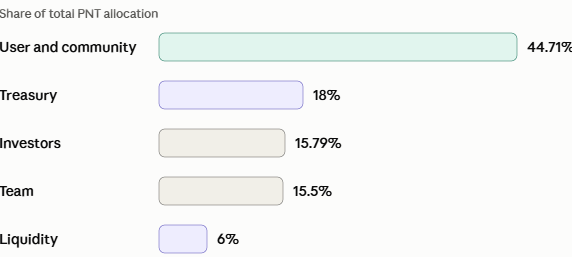
Pheasant Network Token Allocation, Group by Group
User and community (44.71%). This is the biggest slice by a wide margin. It signals that the project wants the people using it to hold most of the supply.
Treasury (18%). This is the second-largest share. According to the official page, holders will be able to vote on how treasury funds are used.
Investors (15.79%) and team (15.5%). These two are almost equal. Together they make up 31.29%.
Liquidity (6%). This is the smallest share. Its job is to support trading.
Source: Official PNT tokenomics
Reading the Token Distribution Model
Numbers need context. Here is a simple way to read this token distribution model.
Community alone holds about 1.4 times as much as team and investors combined.
Non-insider groups (community, treasury and liquidity) hold 68.71%.
Insiders hold 31.29%, which is a minority share.
This is a reading of the published percentages, not a verdict. A fair-looking split can still be affected by unlock schedules, and those are not shown.
Pheasant Network Token Supply and Allocation: What Is Missing
The claim page gives percentages, not a total supply. It also shows no vesting or unlock schedule.
Some exchange explainers mention a supply of 1 billion. The claim page does not confirm it, so it should be checked in the official docs before anyone calculates token amounts.
Vesting matters because it decides when team and investor tokens can reach the market. Readers should look for it before drawing conclusions.
How Users Receive PNT
The claim page is the main route for PNT token distribution to users. The steps are short:
Connect a wallet and check eligibility.
Choose a claim period.
Confirm with the wallet.
The page also offers a Deferred Claim, which means claiming later for a larger one-time allocation. It is clear that this is not interest, yield or returns. Points are non-transferable, have no cash value and give no right to PNT.
The FAQ covers deadlines and future claim seasons. It is worth reading before choosing a period.
PNT Utility and Tokenomics: Why Allocation Needs Use
Allocation says who holds PNT. Utility says why anyone would hold it. All four uses below are listed as upcoming.
Utility | Planned role |
Smart Fees | Reduced fees, with higher balances unlocking more benefits |
AI Engine | Smarter intent routing, AI agents and DeFAI tools |
Ecosystem Plus | Extra benefits for relayers, onchain participants and community, plus Pheasant NFT initiatives |
Governance | Onchain votes on the protocol |
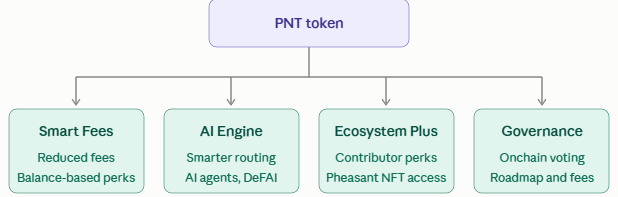
The PNT token utility is tied to real use of the network. A holder who uses Pheasant for cross-chain actions would feel the fee benefit most.
PNT Governance: Who Decides What
PNT holders are expected to shape the protocol through onchain decisions. Voting is meant to guide four things: the roadmap, fee rules, treasury usage and grants.
The roadmap’s final phase goes further. A governance shift places decisions with holders and the community. Relayers open to third parties, and AI-assisted governance adds data-informed insights.
This phase is still ahead. It is a plan, not a current feature.
Source: official documentation
Pheasant Network Ecosystem Benefits
The Pheasant Network ecosystem lists three key strengths on the official page.
AI powered: automates complex cross-chain actions with smarter routing.
Super app: one interface instead of switching between apps and networks.
Cost-effective: fast, low-cost transfers through its optimistic mechanism.
Holders would gain from these as users first, and as token holders second. That ties the token to real activity on the network.
What to Check Before Acting
Start only from the official site, pheasant.network, and its linked pages.
Never share a seed phrase. No official page needs it.
Confirm total supply and vesting in the official docs.
Read the full claim page and its FAQ.
Treat utility and governance as plans until they go live.
Final Thoughts
Pheasant Network tokenomics shows a community-heavy split, with 44.71% for users and 31.29% for insiders. The utility and governance plans are clear but not yet live.
The missing pieces, total supply and vesting, are the ones to verify next. The official tokenomics section is the place to start.
Disclaimer: This article is for information only and is not financial, investment, tax or legal advice. Crypto tokens are volatile and carry a high risk of loss.
















